 Garden

Affiliate Disclosure
Some links on this page are affiliate links. As an Amazon Associate, we earn from qualifying purchases — at no extra cost to you. We do not buy, test, or physically handle the products we cover; our rankings come from aggregated owner reviews, ratings and expert consensus. Commissions never change our verdicts. How we rank · full disclosure.
The short version: the best home fire extinguisher for most households is the First Alert HOME1, a rechargeable 1-A:10-B:C unit with an all-metal valve. That rating covers the three fire classes a house actually produces — ordinary combustibles, flammable liquids, and energized electrical equipment — and the metal valve is the difference between a unit that still holds pressure at year eight and one that has quietly bled down. For a garage, basement or workshop, step up to the 2-A:10-B:C First Alert HOME2PRO or Kidde Pro 210, or buy the commercial-grade Amerex B402 once and stop thinking about it.
Before the products, the rule that matters most. The NFPA position is that a portable extinguisher is for a small, contained fire — used only after everyone else has left the building and the fire department has been called, and only if you have a clear escape route behind you. An extinguisher is a tool for the first thirty seconds, not a substitute for getting out. Working smoke alarms remain the higher-value purchase; those are ranked in best smoke detector. We do not test devices first-hand; see how we rank.
Top Picks at a Glance
Our #1 Pick: First Alert HOME1
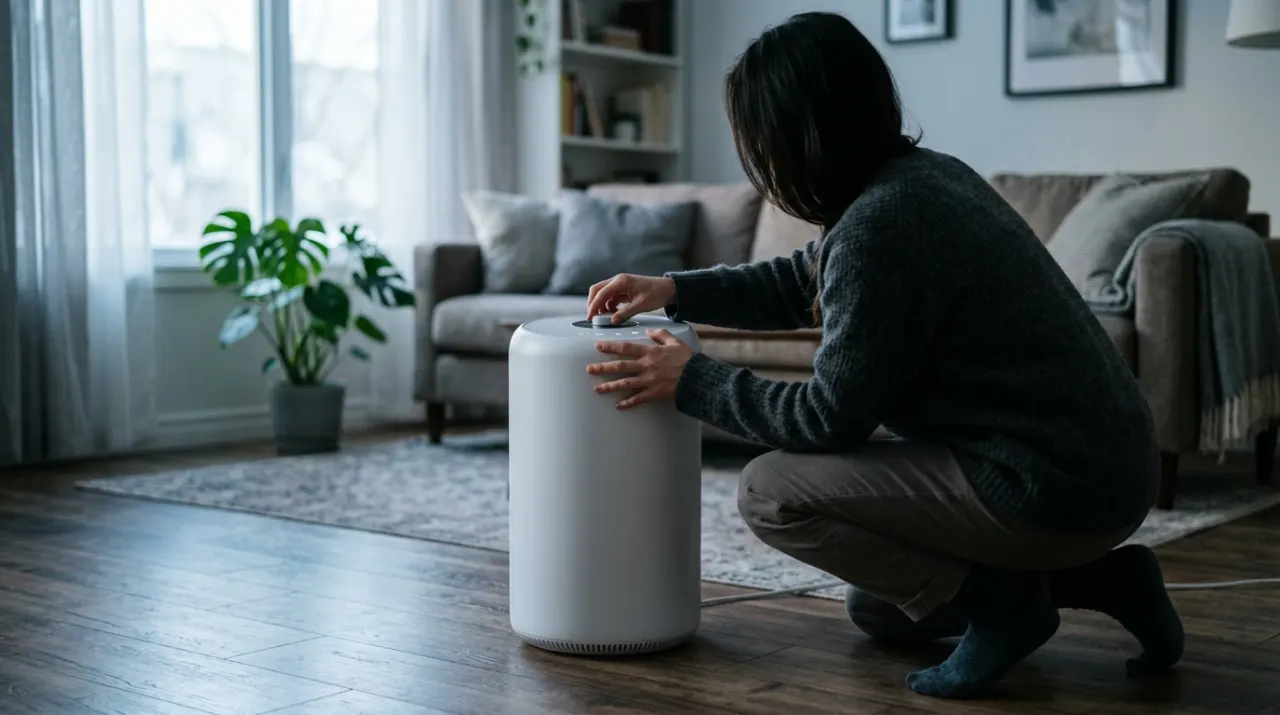
The HOME1 is the extinguisher that fits the way houses actually burn. Its 1-A:10-B:C rating means it will work on burning wood, paper and fabric (Class A), on gasoline, oil and solvents (Class B), and on live electrical equipment (Class C) — and household fires very often involve more than one of those at once, which is why a single-class unit is a poor choice for a home. At around 3 pounds it is light enough that most adults can hold it steady and sweep the base of a fire rather than fighting the recoil.
The build details are what separate it from the cheapest units on the shelf. The valve, trigger and pressure gauge are metal rather than plastic, which is the component that most commonly fails silently over years of sitting on a wall. It is rechargeable by a certified professional after use or after a partial discharge, so a small kitchen incident does not mean throwing the unit away. The pull pin carries a tamper seal, and a mounting bracket is included — use it, because an extinguisher lying in the back of a cabinet is one nobody finds in time.
Consensus Score ██████████░ 9.2 — among the strongest and longest-running owner consensuses in the safety category.
The honest weaknesses: the dry-chemical agent is monoammonium phosphate, which is corrosive and leaves a fine powder that gets into everything and needs prompt cleanup off appliances and electronics; the 1-A rating is modest, so it is undersized for a garage or a workshop; and recharging costs enough that many owners simply replace the unit instead. None of that changes the recommendation for a kitchen or hallway.
Check price on Amazon → (paid link)
The Ranked Field
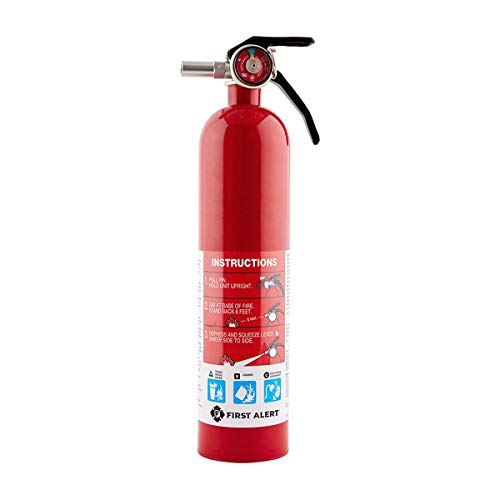
Best for the kitchen, hallway or laundry room in an ordinary house
- UL rated 1-A:10-B:C for wood, liquid and electrical fires
- All-metal valve, trigger and gauge
- Rechargeable by a certified professional after use
- Mounting bracket and pull pin with tamper seal included
Why buy it: the ABC rating covers all three fire classes a home actually produces, and the metal valve is what separates an extinguisher that still works in year eight from a plastic one that does not.
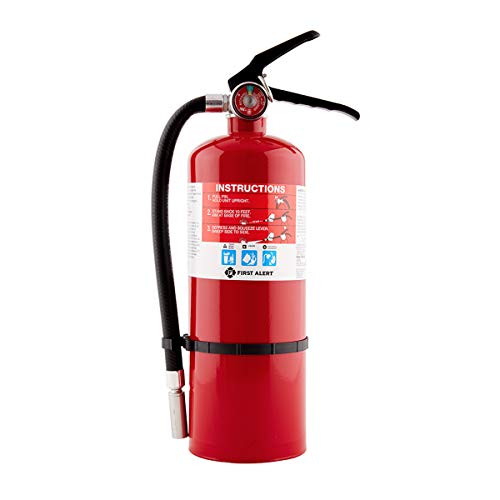
Best for a garage, basement or main-floor position where you want more discharge time
- 2-A rating, double the Class A capacity of a HOME1
- Heavier charge and longer discharge time
- Commercial-grade metal valve and gauge
- Rechargeable, wall bracket included
Why buy it: twice the Class A capacity buys you the extra seconds that decide whether a small fire goes out or gets away from you.

Best for a workshop, garage or anyone who wants a commercial-grade unit at home
- 3-A:40-B:C rating, far above typical home units
- 5 lb charge in an all-metal commercial body
- Rechargeable and serviceable for decades
- Steel wall bracket included
Why buy it: the extinguisher fire-service professionals buy for themselves — a 40-B rating handles a fuel or solvent fire that a 10-B home unit would only annoy.
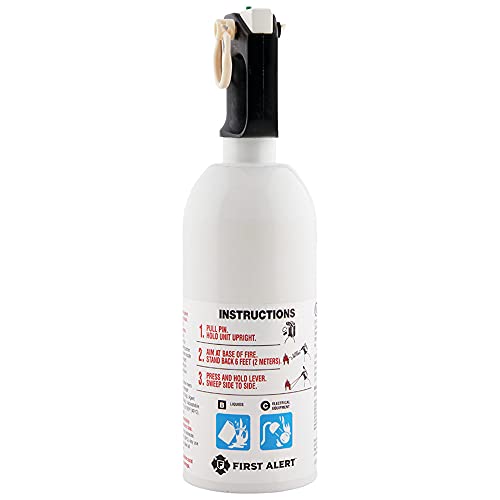
Best for mounting beside the stove where a grease fire is the likely event
- Sodium bicarbonate agent, less corrosive on cookware
- 5-B:C rating for cooking oil and electrical fires
- Compact white body designed to sit out in a kitchen
- Single-use, disposable
Why buy it: a bicarbonate kitchen unit is the one people will actually mount within reach of the stove, and reach matters more than rating in the first ten seconds.
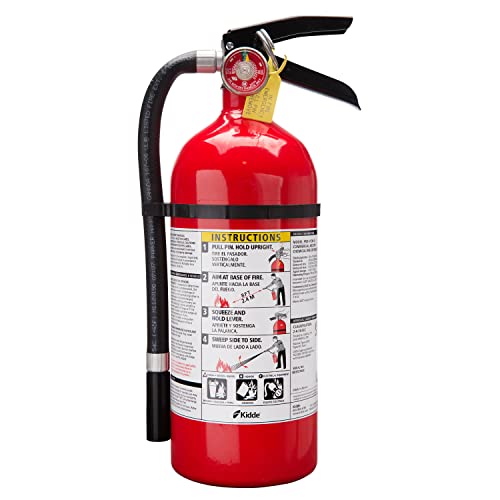
Best for a hallway or garage where you want a serviceable metal unit at a fair price
- 2-A:10-B:C multi-purpose ABC rating
- 4 lb rechargeable metal cylinder
- Metal valve assembly and pressure gauge
- Mounting bracket included
Why buy it: the same practical rating as the HOME2PRO from the other major American brand, and often the cheaper of the two on any given week.
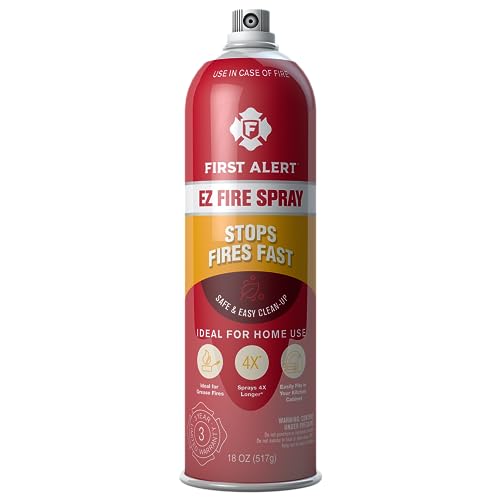
Best for a drawer or countertop as a fast, low-mess first response
- Aerosol can, no pin to pull and no gauge to check
- Biodegradable agent that wipes up with a cloth
- Roughly 32 seconds of discharge
- Not a UL-rated replacement for an ABC extinguisher
Why buy it: the one people reach for without hesitating, because it works like a can of spray — but it supplements a real extinguisher rather than replacing it.
Quick Comparison
| Product | Best for | Rating | Price | Buy |
|---|---|---|---|---|
| First Alert HOME1 Rechargeable Home Fire Extinguisher, UL Rated 1-A:10-B:C | Best Overall | — | Check (paid link) | |
| First Alert PRO2 HOME2PRO Rechargeable Fire Extinguisher, UL Rated 2-A:10-B:C | Best for a Whole Floor | — | Check (paid link) | |
| Amerex B402 5 lb ABC Dry Chemical Fire Extinguisher with Wall Bracket | Best Build Quality | — | Check (paid link) | |
| First Alert KITCHEN5 KFE2S5 Kitchen Fire Extinguisher, UL Rated 5-B:C | Best for the Kitchen | — | Check (paid link) | |
| Kidde Pro 210 Rechargeable Fire Extinguisher, 2-A:10-B:C, 4 lbs | Best Multi-Purpose Value | — | Check (paid link) | |
| First Alert EZ Fire Spray AF400 Extinguishing Aerosol, 18 oz | Best Grab-and-Spray Backup | — | Check (paid link) |
How We Rank
We do not buy, discharge or physically handle fire extinguishers. We rank them on evidence that scales: star ratings weighted by review volume, the published UL rating and agent type for each model, the recurring failure modes that surface in critical reviews, long-term owner reports written years after purchase, and NFPA guidance as a cross-check. For extinguishers we weight three things unusually hard — whether the valve assembly is metal, whether the unit is rechargeable, and whether owners report pressure loss over time — because an extinguisher that has quietly lost pressure looks identical to one that works. Prices were current at the time of writing. Full method on how we rank.
What the Numbers and Letters Mean
Every UL rating reads like 2-A:10-B:C. Decoded, it is the only spec on the label that matters.
| Symbol | Fire class | Examples | What the number means |
|---|---|---|---|
| A | Ordinary combustibles | Wood, paper, cloth, trash, most plastics | Water equivalence: 1-A is about 1.25 gallons |
| B | Flammable liquids | Gasoline, oil, grease, paint, solvents | Approximate square feet of fire an average user can extinguish |
| C | Energized electrical | Panels, appliances, wiring, tools | No number — it means the agent is non-conductive |
| K | Cooking oils and fats | Deep fryers, commercial kitchens | Wet chemical agent; rare in homes |
| D | Combustible metals | Magnesium, lithium, sodium | Industrial only, not a home purchase |
A home needs A, B and C coverage in a single unit — that is what ABC or multi-purpose means on the label. A 5-B:C kitchen extinguisher deliberately omits the A rating in exchange for a bicarbonate agent that is gentler on a kitchen; it is a good supplement beside the stove and a poor sole extinguisher for a house.
Where to Put Them
Near the exit of the area you are protecting, never right beside the likely hazard. The logic is that you want to pick the extinguisher up as you move toward the door, so that if the fire wins you are already on the right side of it. In a kitchen that means mounting near the doorway rather than next to the range — a stove fire will keep you from an extinguisher hanging above it.
A reasonable household set is four units: kitchen, garage, basement near the furnace and laundry, and one on each upper floor landing. Mount every one on its bracket in plain sight at about chest height, and make sure everyone in the house knows where they are and has read the label. Add one in the car and one in the workshop if either is a meaningful part of your life.
How to Actually Use One
The standard sequence is PASS: Pull the pin, Aim low at the base of the fire, Squeeze the handle, Sweep side to side. Stand 6 to 8 feet back and move closer only as the fire shrinks. A home extinguisher gives you roughly 8 to 20 seconds of discharge depending on size, which is far less than people expect and is why aiming at the flames instead of the fuel wastes the whole unit.
Stop and leave if the fire is bigger than a wastebasket, if it is climbing a wall, if the room is filling with smoke, if the extinguisher empties without effect, or if you find yourself between the fire and the door. Close the door behind you as you go — a closed door meaningfully slows fire spread and buys time for everyone else. Have someone call 911 before you start, not after, and let the fire department confirm a fire is out even if it looks extinguished.
Kitchen Fires Specifically
A pan of cooking oil that ignites is the most common home fire scenario and the one most often handled wrong. The first response is not an extinguisher: turn off the burner and slide a lid or a sheet pan over the pan, then leave it covered until it is completely cool. Removing the lid early re-ignites it. Never throw water on burning oil — the water flashes to steam instantly and blows burning oil across the room, which is the mechanism behind a large share of serious kitchen burns.
If covering it is not possible, a sodium bicarbonate kitchen extinguisher such as the KITCHEN5 is the right tool, aimed at the base and from a distance, because a forceful blast at close range will splash the oil. An ABC dry-chemical unit works but is more violent and leaves a corrosive residue on everything nearby. Ventilating a smoky kitchen afterward is a job for open windows and an exhaust fan; a filter unit only helps with the residual smell, and that is covered in best air purifier for smoke smell.

Maintenance and Expiry
Check the gauge monthly — the needle belongs in the green band, and a unit that has drifted into the red is empty regardless of how full it feels. Invert and shake a dry-chemical extinguisher a couple of times a year so the powder does not cake into a solid plug at the bottom. Inspect the hose and nozzle for cracks and the pin seal for tampering. Disposable units are generally rated for around 12 years from the manufacture date stamped on the cylinder; rechargeable units want professional service around every 6 years and a hydrostatic test at 12. Any extinguisher that has been discharged at all, even for a second, must be recharged or replaced — a partially used unit will not hold pressure.
What Owners Actually Complain About
Four themes repeat across the critical reviews. Slow pressure loss is the biggest, showing up as a gauge in the red a few years in, and it correlates strongly with plastic valve assemblies — the reason the metal-valve units rank highly here. Recharging cost and hassle is second: many owners discover that recharging costs a meaningful fraction of a new unit and that finding a local service shop is harder than expected. Residue cleanup after a discharge surprises people, particularly on electronics and around appliances. And bracket quality is a recurring irritation, with several brands shipping brackets that flex or do not hold a full cylinder securely on drywall. Owners consistently report that mounting into a stud rather than a drywall anchor solves the last one.
How to Choose Between These Six
One extinguisher for a normal house? The First Alert HOME1. Garage, basement or workshop? The HOME2PRO or the Kidde Pro 210. Want a unit that outlives the house? The Amerex B402. Beside the stove? The KITCHEN5, as a supplement rather than a replacement. Something anyone can grab without instructions? The EZ Fire Spray, alongside a real ABC unit rather than instead of it. Fire safety works as a system, so the higher-value purchase is still alarms — see best smoke detector and how many smoke detectors do I need.
The Verdict
For most homes the First Alert HOME1 is the extinguisher we would recommend: a genuine ABC rating, a metal valve, rechargeable, light enough to aim, and cheap enough to buy several. Put one near the kitchen exit, one in the garage, one near the furnace, and one on each upper landing; check the gauges monthly; and know before you need it that the correct move for anything bigger than a wastebasket is to close the door and get out. Combine that with alarms in every bedroom and a CO alarm on every level — see where to place a carbon monoxide detector — and you have covered the failures that actually kill people. Check price on Amazon → (paid link)