 Garden
Affiliate Disclosure
Some links on this page are affiliate links. As an Amazon Associate, we earn from qualifying purchases — at no extra cost to you. We do not buy, test, or physically handle the products we cover; our rankings come from aggregated owner reviews, ratings and expert consensus. Commissions never change our verdicts. How we rank · full disclosure.
Short version: living with pets is mostly a materials problem. Hair works its way into carpet fibers and upholstery, dander gets into the air, urine gets into padding and subfloor, and the products marketed at each of those jobs vary enormously in whether they actually do it. This hub covers what works on shed hair, how to kill odor at the source rather than cover it, feeders and fountains worth the counter space, and how to keep a house and yard genuinely safe for an animal that chews things.
We do not buy or physically handle any of the products we rank. Every recommendation comes from reading owner reviews at volume, weighing star ratings against review counts, and cross-checking manufacturer specs against veterinary and extension-service guidance. Our method is on how we rank.
Hair Is a Mechanical Problem, Not a Suction Problem
The instinct when a vacuum stops picking up pet hair is to buy one with more suction. Usually the problem is the brushroll. Hair wraps around a conventional beater bar, packs tight against the bearings, and progressively strangles airflow until the machine is technically running and functionally useless. That is why anti-tangle and self-cleaning brushrolls dominate the highest-rated pet vacuums, and why owners of ordinary uprights end up with a seam ripper in the closet.
The second thing that matters is sealed filtration. Dander, not hair, is what triggers allergies, and it is small enough to pass straight through a loosely assembled vacuum housing and back into the room. A vacuum advertised with a HEPA filter but no sealed system is filtering only the air that happens to go through the filter. Look for language about a complete seal, not just a filter grade.
Third is where the hair goes. Bagless bins are cheaper to run but release a cloud when emptied, which is a bad trade in an allergy household; bagged machines and self-emptying robot bases contain it better. Our ranked picks are in best pet hair vacuums, with robots covered separately in best robot vacuums for pet hair, and embedded-carpet technique in getting pet hair out of carpet.
Odor: Find It, Then Digest It
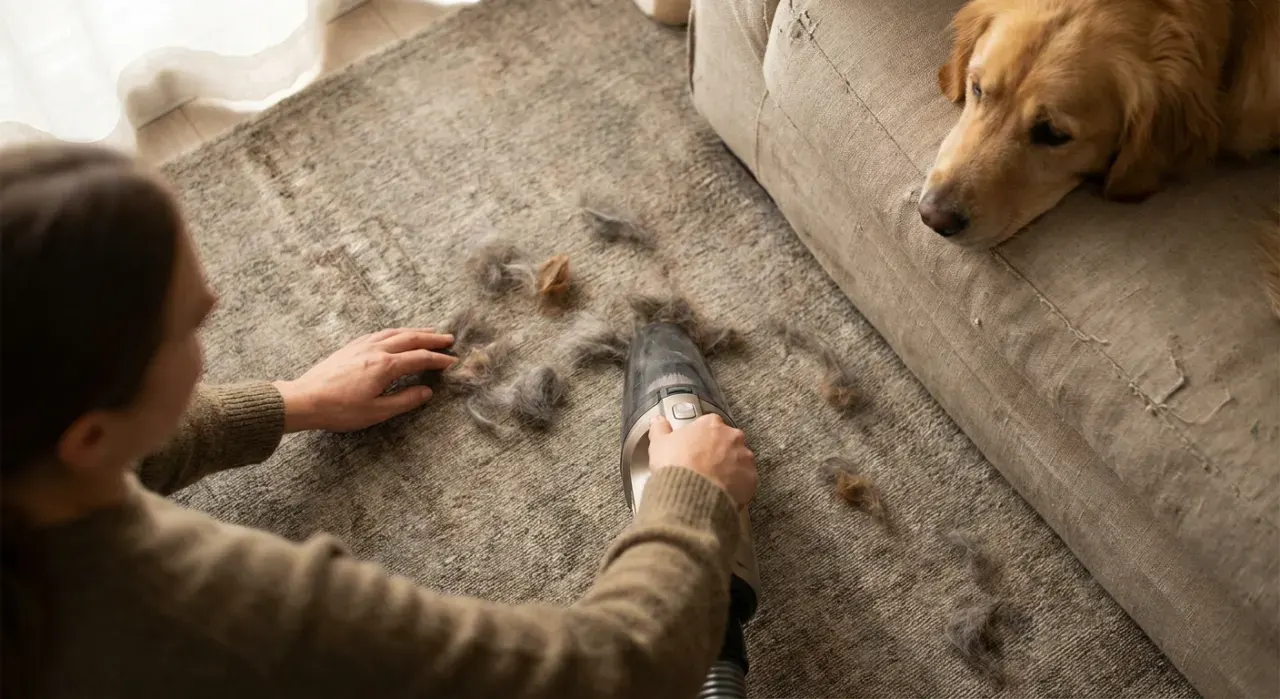
Pet odor is one of the few household problems where the standard approach makes things worse. Scented sprays and general-purpose cleaners sit on top of urine residue; the uric acid crystals underneath stay put, reactivate in humidity, and the smell returns every August. Worse, ammonia-based cleaners smell enough like urine to a dog that they encourage re-marking the same spot.
The method that works has three steps. Find the source with a UV blacklight in a dark room — old urine fluoresces, and the map it reveals is usually larger than anyone expects, because liquid spreads under carpet backing. Saturate, do not spray: whatever soaked into the padding has to be reached, which means using enough enzyme cleaner to get down there rather than misting the surface. Let it work slowly: enzymes need hours of damp contact time, so cover the area and leave it, rather than blotting it dry in ten minutes.
Air quality is the other half. A true HEPA purifier with a real activated carbon stage handles airborne dander and the smell together, which most single-stage units cannot. Details in how to get rid of pet odor, best enzyme cleaners and best air purifiers for pets.
Feeders and Fountains: Buy for the Failure Mode
Automatic feeders and water fountains are conveniences that become critical the moment you rely on them, so the right way to choose is by asking what happens when they go wrong.
For feeders, the two failure modes are jams and power cuts. Jamming is nearly always a mismatch between auger geometry and kibble shape — large, round or irregular kibble in a feeder designed for small pellets. Check the manufacturer's stated kibble size against yours before ordering, because it is the single most common complaint in the category. Power cuts are solved by buying a model with battery backup as well as a plug, which is a cheap feature to insist on.
For fountains, the failure mode is neglect. A fountain that is not cleaned develops biofilm in the pump housing, gets noisy, and cats — who are far more sensitive to water conditions than dogs — quietly stop drinking from it. Prefer stainless steel or ceramic over plastic, which scratches and harbors bacteria, and prefer a pump that disassembles without tools. Picks in best automatic pet feeders and best pet water fountains.
The Plant List Worth Memorizing
Houseplants are the most common accidental hazard in a pet home, because the dangerous ones are also the popular ones. Lilies are the serious case: for cats, every part of a true lily including pollen can cause acute kidney failure, and there is no safe quantity. Beyond that, the common indoor plants to avoid with chewers are pothos, philodendron, dieffenbachia, peace lily, sago palm, aloe and ZZ plant.
The good news is that the safe list covers the same decorating jobs. Spider plants, parlor palms, areca palms, calathea, prayer plants, Boston ferns and most true palms give you the same trailing, architectural or leafy looks without the risk. Keep the ASPCA Animal Poison Control number somewhere findable, and if something is eaten, photograph the plant before you call — identification is the first thing they ask for. Full list in pet-safe houseplants.

Outside: Lawn Chemicals and the Fence Walk
The yard is where pet safety gets least attention and where the exposures are largest, because a dog spends hours on treated turf and then licks its paws. Two habits cover most of it.
First, read the reentry interval on any lawn product rather than the marketing on the front. Most granular fertilizers want watering in and full drying before pets return — commonly 24 to 48 hours. Herbicides and insecticides vary far more, and some products marketed as natural still carry meaningful restrictions. Cocoa mulch deserves a specific mention: it smells like chocolate, it is attractive to dogs, and it contains theobromine, so it does not belong in a yard with a dog in it.
Second, walk the fence line twice a year looking at it the way an animal would. Gaps at grade where soil has settled, loose boards, gate latches that do not spring shut, digging spots along the shaded side, and the plants growing along the fence — sago palm, oleander, azalea and foxglove are the ones worth removing. Add shade and water for hot months. Checklists in pet-safe lawn care and pet-proofing your yard.
A Routine That Keeps Ahead of It
Households that live comfortably with heavy shedders are not cleaning harder; they are cleaning at the right frequency and in the right order. Brush the animal outdoors two or three times a week during a shedding season — hair removed at the source never becomes a carpet problem, and this single habit does more than any vacuum upgrade. Vacuum high-traffic paths twice a week and the whole floor weekly, going over pet areas in two directions because hair lies flat and only lifts against the grain. Wash pet bedding weekly on hot, and run it through a rinse-only cycle first to shed the loose hair rather than clogging the washer.
Then let equipment cover the gaps: a robot vacuum on a daily schedule keeps the baseline low so the weekly clean is short, and an air purifier running continuously in the room the animal sleeps in does more for dander than any amount of surface cleaning. The topical map below links every ranked list and guide in this section.