 Garden
Affiliate Disclosure
Some links on this page are affiliate links. As an Amazon Associate, we earn from qualifying purchases — at no extra cost to you. We do not buy, test, or physically handle the products we cover; our rankings come from aggregated owner reviews, ratings and expert consensus. Commissions never change our verdicts. How we rank · full disclosure.
Short version: indoor air is usually dirtier than the air outside, and the fixes are less exotic than the marketing implies. Ninety percent of what matters comes down to three things — mechanical filtration sized correctly for the room, humidity held in the right window, and source control. This hub explains each one, then points you at the ranked guides where we name specific machines based on aggregated owner reviews.
How we work: we do not buy, test or physically handle any of these machines. Our rankings come from aggregated owner reviews, star ratings weighted by review volume, verified AHAM CADR figures where they exist, and expert consensus. The full method is on how we rank. Want specific models? Start with the best air purifier rankings.
What Is Actually in Your Indoor Air
Four categories cause most household complaints. Particulate matter — dust, pollen, pet dander, cooking smoke, wildfire smoke — is what HEPA filtration removes, and it is what most people are chasing when they buy a purifier. Volatile organic compounds come off paint, new furniture, cleaning products and air fresheners; these need activated carbon, not HEPA, and carbon has a finite capacity that people rarely account for. Biological growth, chiefly mold, is a moisture problem masquerading as an air problem. And carbon dioxide is not a contaminant so much as a proxy: rising CO₂ tells you the room is under-ventilated, which usually means everything else is accumulating too.
That last distinction is worth holding onto. Filtration cleans the air already in the room; ventilation replaces it. A purifier cannot fix a sealed, unventilated bedroom, and opening a window for a few minutes does more for CO₂ than any appliance on the market.
How HEPA Filtration Actually Works
A true HEPA filter captures at least 99.97 percent of particles at 0.3 microns, which is the hardest size to catch — both larger and smaller particles are captured at even higher rates, which surprises people who assume smaller means harder. The important qualifier is the word true. Products described as HEPA-type, HEPA-like or 99 percent HEPA are not held to that standard, and the gap is meaningful.
Just as important is whether the machine is sealed. If air can bypass the filter through gaps in the housing, the filter grade stops mattering. This is why the purifiers with the strongest allergy reputations are consistently the ones with well-engineered seals rather than the ones with the biggest headline numbers. Most quality units also stack a washable pre-filter for hair and large dust, then activated carbon for odors and VOCs, before the HEPA layer.
Sizing: CADR, Air Changes and Marketing Math
CADR — Clean Air Delivery Rate, certified by AHAM — is the only spec worth comparing across brands, because it combines filter efficiency with actual airflow. It is quoted in cubic feet per minute for smoke, dust and pollen, and smoke is the number to watch since it represents the smallest particles.
The practical rule is to match roughly two-thirds of your room's square footage in smoke CADR: a 300-square-foot bedroom wants a smoke CADR near 200, which delivers four to five air changes per hour. Manufacturer coverage claims are usually calculated at one or two air changes per hour, which is why a purifier advertised for 1,500 square feet may only give an allergy sufferer meaningful relief in a room a third that size. Full explanation in understanding CADR ratings.
Humidity: The Other Half of Air Quality
Relative humidity belongs between roughly 30 and 50 percent, and both ends of the range cause real problems. Too dry — common in winter with forced-air heat — dries out sinuses and skin, worsens static, and shrinks wood floors and furniture until seams open. Too humid, above about 60 percent, is where dust mites thrive and mold begins colonizing bathroom grout, closets and basement corners. Dust mite populations in particular are governed by humidity more than by cleaning, which is why allergy sufferers often get more relief from a dehumidifier than from another round of vacuuming.
A cheap hygrometer settles the argument in a day. If you are consistently under 30 percent, you need a humidifier; consistently over 55 percent and you need a dehumidifier. The season-by-season targets are in ideal indoor humidity levels.
The Running Costs Nobody Budgets For
A purifier is not a one-time purchase, and the filters are where the money goes. Expect a true HEPA filter to cost $30 to $80 and last six to twelve months, with carbon pre-filters needing more frequent replacement in smoky or pet-heavy homes. Over a five-year life, filters commonly exceed the price of the machine. Electricity is the smaller line item — most bedroom units draw well under 60 watts — but running one continuously still adds up across several rooms.
The practical consequence is that filter price and availability should influence your purchase as much as the CADR. Machines with proprietary, expensive or hard-to-find filters get abandoned; machines with cheap widely-stocked filters get used for years. That math is broken down in air purifier running costs, and replacement timing is in how often to change a HEPA filter.
What to Avoid
Two categories deserve genuine caution. Ozone generators are marketed as air purifiers but work by producing ozone, a known lung irritant; the EPA has warned against residential use and California regulates emissions from indoor air cleaners. Some ionizers produce ozone as a byproduct, so check for CARB compliance on the listing. Separately, be skeptical of any machine sold primarily on UV-C: contact time in a fast-moving airstream is generally too short for the claimed effect, and the mechanical filter is doing the real work regardless. Sealed HEPA plus activated carbon remains the approach with the least controversy and the strongest owner satisfaction.
Source Control Beats Filtration
The most effective air-quality improvements are the ones that stop pollutants entering the room in the first place, and most of them are free. Run the kitchen range hood every time you cook, and use the back burners where the hood captures best — gas and electric cooking are both major sources of indoor particulate, and frying in an unventilated kitchen produces PM2.5 readings that would close a highway. Run the bathroom fan during and for twenty minutes after every shower, which is the cheapest mold prevention available. Take shoes off at the door, since street dust, pollen and lawn chemicals arrive on soles and then get kicked back into the air with every step.
Beyond that, be careful what you deliberately add. Scented candles, incense, plug-in fresheners and aerosol sprays all release particulate and VOCs directly into the room, and they are frequently the reason a purifier’s sensor is showing poor air in an otherwise clean house. New furniture, paint, flooring and mattresses off-gas VOCs for weeks, so ventilate hard after any of those arrive. A purifier running against an active source is fighting a losing battle; remove the source and the machine gets to do the job it is good at.
Wildfire Smoke and Seasonal Spikes
Smoke seasons have made air purifiers a mainstream American purchase, and the response that works is different from everyday filtration. When outdoor PM2.5 climbs, the priority order is: close windows and doors, switch the HVAC system to recirculate rather than drawing outside air, run a purifier sized generously for the room you will spend the most time in, and treat one room as a clean-air refuge rather than trying to protect the whole house. A higher-MERV furnace filter helps if your system can handle the pressure drop — check the manual, because forcing a MERV 16 into a system built for MERV 8 restricts airflow and can damage the blower.
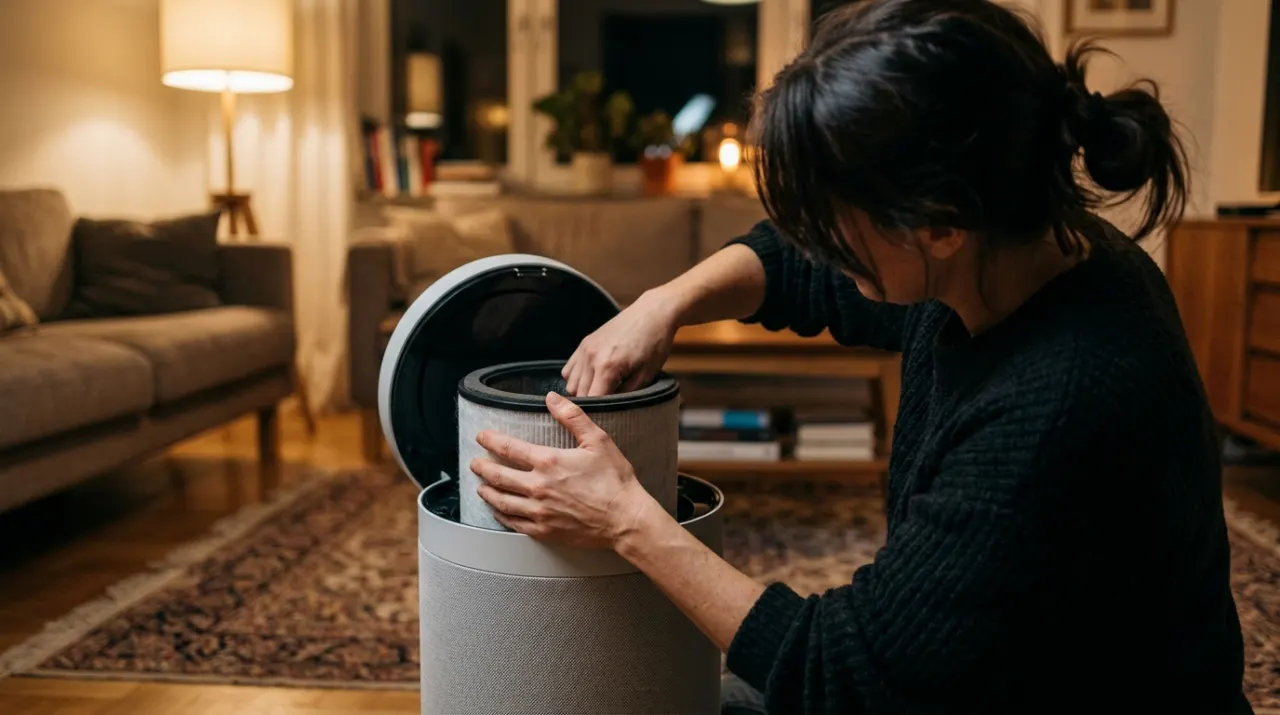
Expect filters to load far faster during a smoke event; a HEPA filter that would normally last a year can need replacing after a single bad season, and carbon saturates faster still. Pollen season behaves similarly on a smaller scale. Planning for that consumable cost up front is the difference between a purifier that keeps working and one that quietly stops doing anything while still humming. Timings are covered in how often to change a HEPA filter.
Where to Start
Measure the room, buy on smoke CADR, and put the machine where you sleep. If allergies are the driver, go to best air purifier for allergies; if it is pets and odor, best air purifier for pets. If you are not sure whether your problem is particles or dryness, air purifier vs humidifier sorts it out in a few minutes. Otherwise start with the main best air purifier ranking. The topical map below links every part of the hub as it publishes.