 Garden

Affiliate Disclosure
Some links on this page are affiliate links. As an Amazon Associate, we earn from qualifying purchases — at no extra cost to you. We do not buy, test, or physically handle the products we cover; our rankings come from aggregated owner reviews, ratings and expert consensus. Commissions never change our verdicts. How we rank · full disclosure.
Central, open and raised. Put the unit near the middle of the basement rather than against a wall, with at least 12 inches of clearance on every intake and exhaust face, elevated 12 to 18 inches off the slab on a shelf or blocks, and close enough to a floor drain, sump pit or laundry sink to run a gravity drain hose downhill the whole way. Bias the position slightly toward the dampest zone, which is usually the coolest exterior corner or the wall where moisture enters. Then close the stairwell door and the windows so it is drying the basement rather than the house.
We do not buy or physically handle the units we rank; our picks come from aggregated owner reviews and expert consensus, explained in how we rank. Model shortlists are in best dehumidifier, inside the air quality hub.
How much clearance does a dehumidifier need?
Twelve inches minimum on the grille faces, and more is better. The reason is airflow, not aesthetics: the unit has to draw room air across a cold coil and discharge the dried, warmed air far enough away that it mixes back into the room rather than looping straight into its own intake. That loop, called short-cycling, is what makes an adequately sized machine behave like an undersized one. Most manufacturers specify 6 to 12 inches in the manual, but that is a minimum for safe operation rather than an optimum for performance. Owners consistently report better results after moving a unit off a wall and out from behind stored boxes than after buying a larger one.
| Location | Verdict | Why |
|---|---|---|
| Center of the open basement | Best | Free airflow on all faces, even coverage |
| Beside a floor drain, on a shelf | Best | Enables continuous gravity drainage |
| Near the sump pit | Good | Drain target plus the dampest zone |
| Against one wall, intake facing out | Acceptable | Workable if 12 in clearance is kept |
| Directly on the slab | Poor | Flood risk, no fall for a drain hose |
| In a corner or behind storage | Worst | Short-cycles its own dry exhaust |
| Inside a closed storage room | Worst | Dries one small room, not the basement |
Should it go near the damp spot or in the middle?
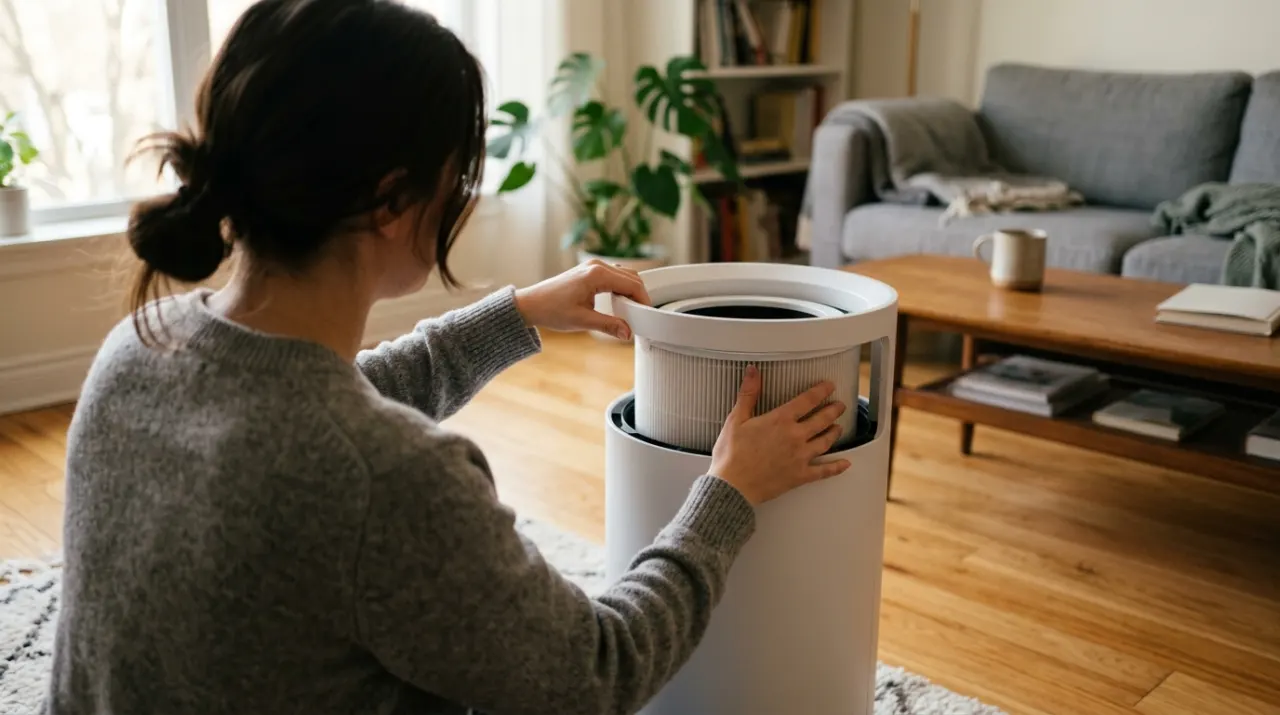
Split the difference, favoring the middle. Air mixes far faster than most people assume, so a dehumidifier does not need to sit on top of a damp wall to dry it, and putting the machine in a tight spot to be near the problem usually costs more in blocked airflow than it gains in proximity. The exception is a basement with a genuinely localized source, such as a corner where groundwater seeps after rain or an uncovered sump pit. In that case, place the unit in the open but on the side of the room nearest the source, and point the exhaust discharge toward the damp wall so moving air keeps the surface from staying saturated.
Before optimizing placement, deal with bulk water. No dehumidifier outruns a downspout discharging beside the foundation, negative grading that slopes toward the house, or an uncovered sump. Sealing the sump pit with a proper lid alone often drops basement humidity several percentage points, because an open pit is a permanently exposed pool of groundwater evaporating into the room.
Why does placement near a drain matter so much?
Because a bucket turns a continuously working machine into an intermittent one. A 50-pint unit in a genuinely damp basement can fill a 1.5-gallon reservoir in six hours or less, and every hour it sits shut off on a full-tank sensor is an hour the humidity climbs back. Running the outlet port to a floor drain, sump or laundry sink means the unit works to the humidistat rather than to the bucket, which is the difference between a basement that holds 50 percent and one that oscillates between 50 and 65. Set the hose with continuous fall and no dips, because a low spot holds water and stops flow entirely.
Where no gravity drain exists, a condensate pump mounted beside the unit will lift the water 15 feet or more to a utility sink or an exterior discharge. Check the pump has an overflow safety switch that cuts the dehumidifier if the pump fails. On the setting itself, 50 percent is the number for a basement, explained in what should I set my dehumidifier to.

What if the basement is cold?
Then placement will not save a compressor unit. Below roughly 65 degrees the coil frosts instead of condensing, and below 60 degrees a standard portable is close to useless no matter where it stands. An unheated basement in a northern climate spends much of the shoulder season in exactly that range. The correct machine is a desiccant model, which adsorbs moisture onto a rotating wheel and keeps working near freezing, at the cost of higher energy use and noticeable heat output into the space. The comparison is in desiccant vs compressor dehumidifier, and if your unit is collecting nothing right now, work through why is my dehumidifier not collecting water first.
Size before you place. A unit too small for the volume will run flat out in the perfect position and still lose, and the sizing table by square footage and dampness level is in what size dehumidifier for a basement. If the smell is what prompted this, what causes musty basement smell covers the source rather than the symptom.