 Garden

Affiliate Disclosure
Some links on this page are affiliate links. As an Amazon Associate, we earn from qualifying purchases — at no extra cost to you. We do not buy, test, or physically handle the products we cover; our rankings come from aggregated owner reviews, ratings and expert consensus. Commissions never change our verdicts. How we rank · full disclosure.
Moisture, feeding mold and bacteria. That earthy basement smell is microbial volatile organic compounds, or mVOCs, released as mold and bacteria metabolize damp building materials. Two of them, geosmin and 2-methylisoborneol, are detectable by the human nose at parts per trillion, which is why a basement can smell strongly with no visible growth. The odor is a symptom; the cause is always water, arriving as summer condensation on cold walls, groundwater through the foundation, poor exterior drainage, plumbing leaks, or humid air with nowhere to go. Fix the water and the smell follows.
We do not buy or physically handle the units we rank; our picks come from aggregated owner reviews and expert consensus, explained in how we rank. Model shortlists are in best dehumidifier, inside the air quality hub.
Where is the moisture coming from?
Work outward from the cheapest thing to check. In most homes the answer is either exterior water management or summer condensation, and both are addressable without excavation. Diagnose by pattern and timing rather than by guessing: water that appears after rain is coming from outside, water that appears on humid days is condensation, and water that is present year round is groundwater or a leak.
| Source | Telltale sign | First fix |
|---|---|---|
| Gutters and downspouts | Damp wall only after rain | Extend discharge 6 to 10 ft from the foundation |
| Negative grading | Soil slopes toward the house | Regrade to fall 6 in over the first 10 ft |
| Summer condensation | Damp only in humid weather, worst on cold walls | Close windows, run a dehumidifier at 50 percent |
| Open sump pit | Constant humidity near the pit | Fit a sealed lid |
| Groundwater through the slab or wall joint | Efflorescence, white crusty deposits | Interior drain tile or exterior waterproofing |
| Plumbing or water heater leak | Localized, year round, unrelated to weather | Repair the fixture |
| Unvented dryer or bathroom fan | Damp near the appliance | Duct it to the outdoors |
| Dry floor drain trap | Sewer smell, not musty | Pour a gallon of water down the drain |
Why is summer the worst season for it?
Because a basement is a cold surface inside a warm humid house, and cold surfaces condense water. Foundation walls and slabs sit close to deep-ground temperature year round, commonly in the fifties across much of the country. Outdoor air in July at 78 degrees and 65 percent relative humidity has a dew point near 65 degrees, so the instant that air reaches a 58-degree concrete wall it deposits liquid water. This is the counterintuitive part: opening basement windows to air out a musty smell in August actively makes it worse, because you are importing the moisture. Close them, and treat the basement as a sealed volume served by a dehumidifier.
The same mechanism explains the seasonal pattern in the rest of the house, covered in why does my house smell musty in summer. It is also why an air conditioner running short cycles can leave a house smelling damp even while the thermostat is satisfied, since a compressor that runs briefly cools the air without removing much moisture.
How do I actually get rid of the smell?
In this order, because doing it out of order wastes money. Stop the water first: extend downspouts, correct grading, cap the sump, repair leaks. Then dry the space to a stable 50 percent relative humidity with a correctly sized dehumidifier running to a continuous drain rather than a bucket, which is the setting and placement question covered in what should I set my dehumidifier to and where to place a dehumidifier in a basement. Then remove what is already colonized, because drying does not un-grow anything. Cardboard, carpet pad, damp fiberglass batts and any drywall that has been wet are consumables at that point, not salvage.
Finally, clean hard surfaces. The EPA guidance for areas under about 10 square feet is that a homeowner can handle it with detergent and water and thorough drying, and specifically notes that killing the mold is less important than removing it, since dead spores still cause reactions. Larger areas, contaminated water, or anyone in the household with asthma or immune compromise are reasons to bring in a professional. Do not paint over growth; encapsulating a damp surface is how a small problem becomes a hidden one.
Will an air purifier or an odor treatment help?
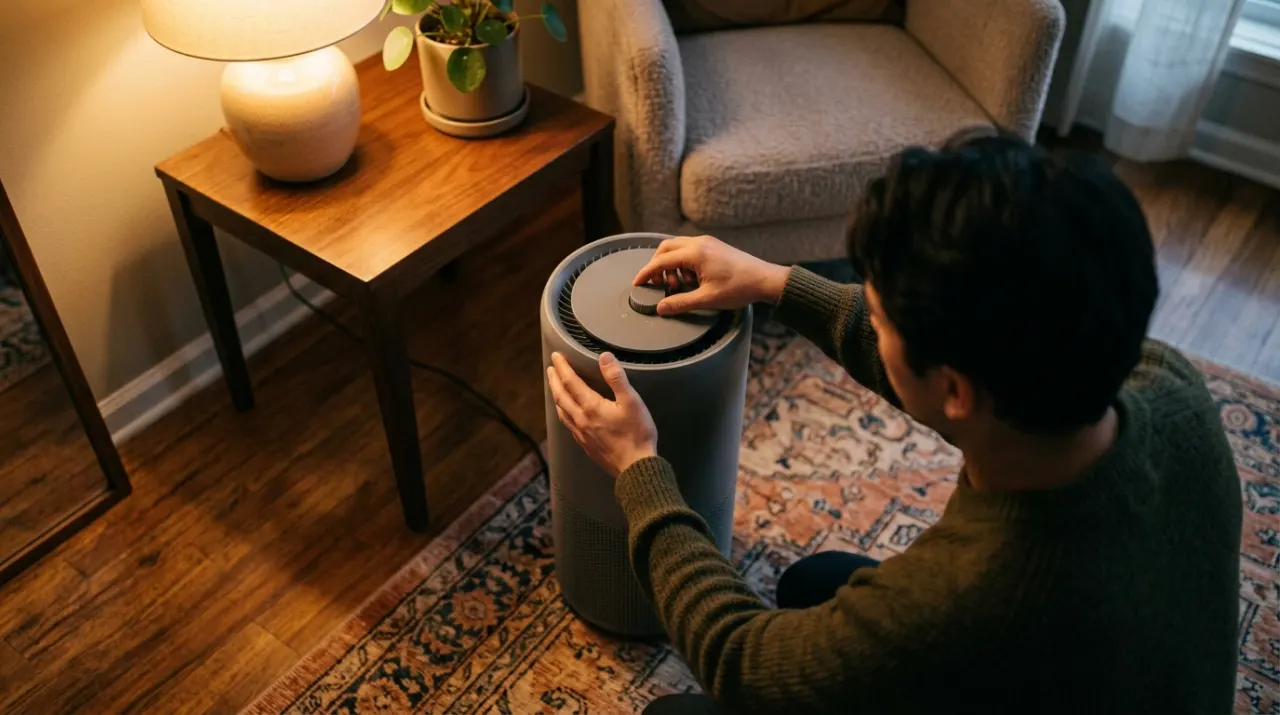
Only as comfort while the real work happens. A HEPA purifier captures airborne spores and makes a basement more pleasant to occupy, but the odor is gas-phase and passes straight through fiber media unless the unit carries a substantial activated carbon bed. That is the same limitation explained in do air purifiers help with smoke smell, and the spore side is covered in do air purifiers help with mold spores. Ozone generators are worse than useless here, since the EPA states ozone is ineffective at removing many odor-causing chemicals at concentrations that are safe to breathe, and it is a lung irritant. Scented plug-ins mask the signal you actually want to keep hearing.
If you want to know whether the humidity is genuinely under control rather than guessing, log it: a monitor recording relative humidity over days will show the afternoon peaks a spot check misses, discussed in do air quality monitors detect mold, which also explains why no consumer device identifies mold itself. To size the dehumidifier correctly in the first place, see what size dehumidifier for a basement.