 Garden
Affiliate Disclosure
Some links on this page are affiliate links. As an Amazon Associate, we earn from qualifying purchases — at no extra cost to you. We do not buy, test, or physically handle the products we cover; our rankings come from aggregated owner reviews, ratings and expert consensus. Commissions never change our verdicts. How we rank · full disclosure.
Yes, but only if the unit has a serious activated carbon stage. Smoke smell is caused by gas-phase compounds, and HEPA media does nothing to them because filtration catches particles, not gases. What removes odor is adsorption onto activated carbon, and the amount matters enormously: a purifier carrying one to five pounds of granular carbon makes a real difference, while the thin charcoal-coated mesh on most budget units saturates within weeks. And no purifier removes smoke absorbed into carpet, drywall and upholstery, which keeps re-releasing odor into the room.
We do not buy or physically handle the units we rank; our picks come from aggregated owner reviews and expert consensus, explained in how we rank. Model shortlists are in best air purifier and best air purifier for wildfire smoke, inside the air quality hub.
Why does a HEPA filter not remove the smell?
Because a smell is not a particle. HEPA works by mechanical capture, where fibers intercept, impact or diffuse solid and liquid particles out of the airstream, and it is superb at that down to 0.3 micron and below. Odor molecules are individual gas-phase compounds a thousand times smaller than the particles HEPA is designed for, and they slip through the fiber matrix as freely as the air itself. The EPA distinguishes these categories explicitly, noting that gaseous pollutants require sorbent media such as activated carbon rather than particle filters. This is the single most common misunderstanding in purifier shopping: a unit can strip the haze out of a smoky room and leave it smelling exactly the same.
The compounds involved in smoke are a mixture of aldehydes, phenols, aromatic hydrocarbons and, in tobacco smoke specifically, nicotine and its residues. Restoration literature refers to the residue left on surfaces as third-hand smoke, and it is chemically reactive, which is why a room that smelled tolerable when the furniture was cold turns pungent again on a hot day.
What makes a carbon filter actually work?
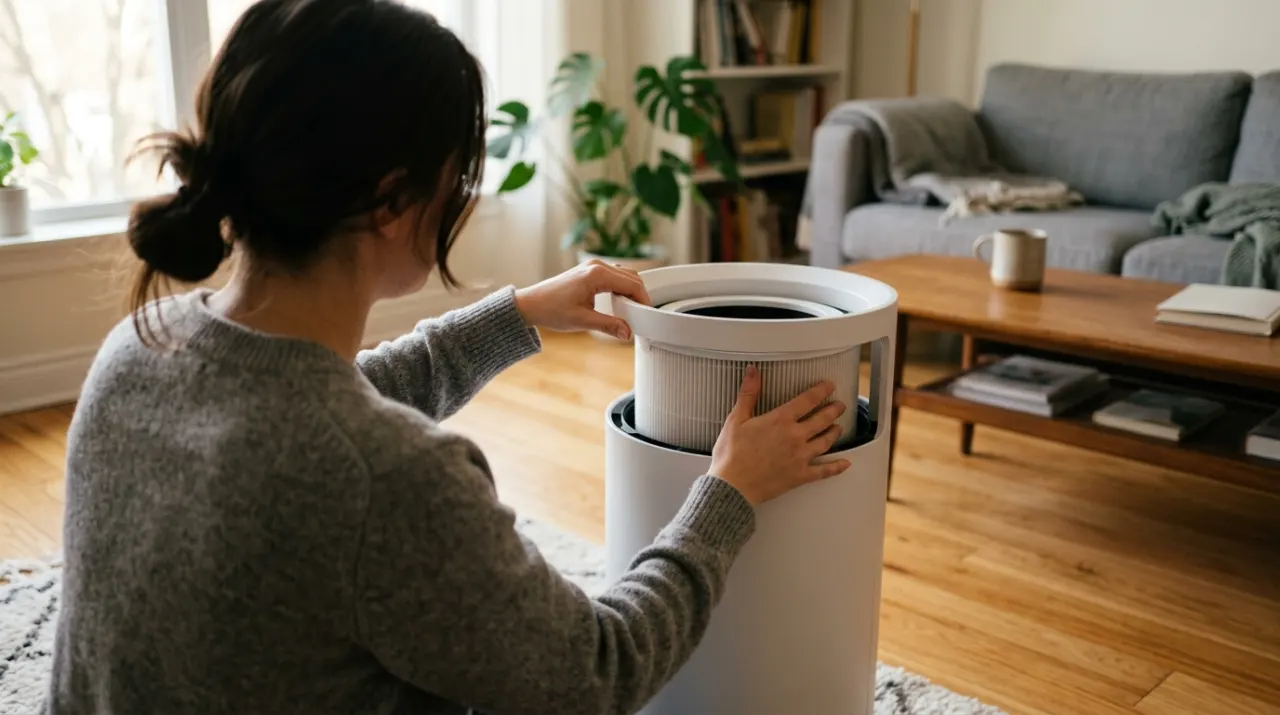
Three things, and only one of them appears on most product pages. First is mass: adsorption capacity scales with the number of available surface sites, and a few ounces of impregnated fabric runs out of them quickly. Second is contact time, sometimes called dwell time or residence time in filtration engineering, which means the air has to spend long enough in the carbon bed to transfer its molecules. A deep bed of granules does this; a sheet wrapped around a cylinder at high fan speed does not. Third is the specific carbon, since coconut-shell carbon has a finer micropore structure suited to small molecules while impregnated carbons are treated to target particular compound families.
| Carbon stage | Typical mass | Realistic odor performance | Replace |
|---|---|---|---|
| Charcoal-impregnated pre-filter fabric | 1 to 3 oz | Cooking smells for a few weeks | 2 to 3 months |
| Honeycomb carbon panel | 0.5 to 1 lb | Mild, intermittent odors | 3 to 6 months |
| Granular carbon canister | 2 to 5 lb | Persistent smoke odor, noticeable | 6 to 12 months |
| Commercial sorbent bed | 10 lb and up | Fire restoration, VOC control | Per service schedule |
Two things to be aware of. Carbon adds airflow resistance, so the same chassis delivers a lower clean air delivery rate with a deep carbon stage fitted than without, and the rated CADR on the box may have been established without it. And carbon is a consumable with a shorter life than the HEPA element beside it, so budget for it separately. Replacement mechanics are covered in how to replace an air purifier filter.
What removes the smell permanently?
Removing or sealing what is holding it. As long as the source keeps releasing, a purifier is bailing a boat that still has the hole in it. In order of payoff for a smoke-contaminated room: launder or dry-clean all textiles including drapes and cushion covers; wash hard surfaces including ceilings with a degreasing cleaner, since the residue is oily and sits on horizontal and vertical surfaces alike; replace HVAC filters and have the ductwork cleaned if the smoke ran through the system; replace carpet and pad if the odor persists, because the pad holds far more than the carpet does; and seal remaining porous surfaces with a shellac-based stain-blocking primer before repainting, which is standard practice in fire restoration precisely because latex primer does not stop odor transmission.
Ventilation does more than most people expect in the meantime. Cross-ventilating with two open windows and a box fan exhausting outward flushes the air far faster than any portable purifier, provided the outdoor air is clean. During a wildfire event that is exactly backwards, and the correct move is to seal up and filter, which is where a large-CADR HEPA unit earns its keep. If budget is the constraint, how to build a DIY box fan air purifier covers a filter-and-fan build that handles particles well, though it will not touch odor without a carbon stage added.
Is a smoke smell a health concern or just unpleasant?
Treat it as a signal rather than the hazard itself. The odor threshold for many smoke compounds is low enough that you can smell them well below concentrations of health concern, so a faint smell is not evidence of danger. But smell is a reliable indicator that particulate and gases are present, and the fine particulate in smoke is the part with documented respiratory effects. If the smell is persistent and you want to know what is actually in the air, a particle-sensing monitor gives you a number to work from; see best air quality monitor and do air purifiers help with dust for how to size a unit by air changes rather than by the room-size claim on the carton. If the smell is musty rather than smoky, that is a moisture problem instead: see what causes musty basement smell.