 Garden

Affiliate Disclosure
Some links on this page are affiliate links. As an Amazon Associate, we earn from qualifying purchases — at no extra cost to you. We do not buy, test, or physically handle the products we cover; our rankings come from aggregated owner reviews, ratings and expert consensus. Commissions never change our verdicts. How we rank · full disclosure.
An air purifier removes particles from the air. A humidifier adds moisture to it. Neither one does the other's job, and buying the wrong one is the most common mistake in this category. If your complaint is sneezing, dust settling fast, pet smell, or smoke, you want a purifier. If it is cracked lips, static shocks, nosebleeds, a scratchy throat on waking, and a hygrometer reading under 30 percent, you want a humidifier. Winter in a heated house frequently produces both problems at once, which is why plenty of homes run one of each.
Our picks come from aggregated owner reviews and expert consensus rather than first-hand handling — see how we rank.
What each one actually does
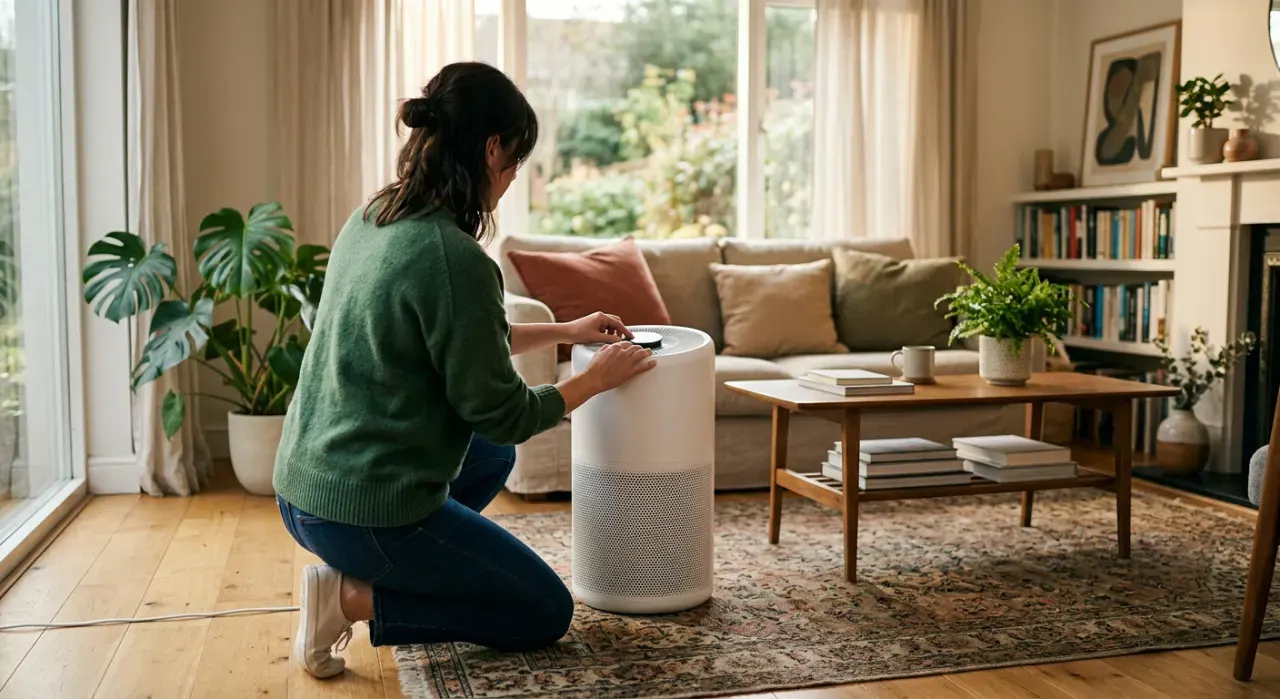
An air purifier is a fan that pulls room air through a filter stack and pushes it back out. A true HEPA stage captures at least 99.97 percent of particles at 0.3 microns, which covers pollen, dust-mite debris, pet dander, mold spores and smoke particulate. An activated carbon stage adsorbs some gases and odors. That is the entire mechanism, and it explains the limits: a purifier cannot touch anything that is not airborne and passing through the machine, and it has no effect on temperature or moisture.
A humidifier does the opposite kind of work. It evaporates or atomizes water into the room to raise relative humidity. Evaporative models wick water into a wet filter and blow air across it, which self-limits at a safe humidity. Ultrasonic models vibrate a plate to fling a fine mist, which is quieter but broadcasts whatever minerals or microbes are in the tank. Neither type filters anything meaningful out of the air.
Side by side
| Air purifier | Humidifier | |
|---|---|---|
| What it changes | Particle count in the air | Relative humidity |
| Helps with | Pollen, dust, dander, smoke, some odors | Dry skin, static, cracked lips, dry throat, sinus discomfort |
| Does nothing for | Dryness, static, chapped skin | Allergens, smoke, dust, odors |
| Running cost | Low — roughly $45 to $150 a year plus filters | Very low power, but water and cleaning time |
| Maintenance | Filter changes every 3 to 12 months | Cleaning every 3 days, refilling daily |
| Risk if neglected | Loses effectiveness, airflow drops | Grows bacteria and mold and disperses them |
| Best season | Year-round; peaks in pollen and wildfire season | Winter, when heating dries the air |
Diagnose it by symptom
The fastest route to the right purchase is matching the complaint, not the season.
- Sneezing, itchy eyes, congestion that improves when you leave the house — particles. Buy a purifier. See do air purifiers help allergies for what filtration does and does not fix.
- Dust visibly resettling within a day of cleaning — particles. Purifier, sized generously. Covered in do air purifiers help with dust.
- Static shocks, cracked lips, nosebleeds, wood floors gapping — dryness. Humidifier, with a target of 30 to 40 percent in winter. Targets are in ideal indoor humidity levels.
- Waking with a dry throat but no daytime allergy symptoms — usually dryness. Humidifier in the bedroom.
- Musty smell, condensation on windows, visible mold — too much moisture. You want a dehumidifier, the opposite appliance. Start with mold and indoor air.
- Lingering cooking or smoke odor — a purifier with a substantial activated carbon stage. A HEPA filter alone will not remove a smell.
If you cannot tell, spend about twenty dollars on a hygrometer first. A reading is worth more than a guess, and it tells you immediately whether dryness is even in play. Combination units that read particulate and humidity together are in best air quality monitors.
Running both in the same room
There is no incompatibility, and in a heated winter bedroom both are often justified. Three practical rules make them cooperate:
- Separate them. Put the humidifier and the purifier at opposite ends of the room. A purifier positioned right beside a mist plume pulls damp air straight into the HEPA media, and a persistently damp filter is exactly the environment mold likes. This is one of the few ways to genuinely ruin a filter early.
- Cap humidity at 50 percent. Above that, dust-mite populations climb and mold gets a foothold on cold surfaces, which creates the allergen load the purifier is then trying to remove. You would be fighting yourself.
- Clean the humidifier on schedule. An unmaintained tank grows bacteria and the unit sprays it into the room; a purifier is not a safety net for that. The routine is in how often to clean a humidifier.
The mistakes people make
The commonest is buying a humidifier for allergies. Marketing has blurred the two categories, and a humidifier bought for pollen symptoms does nothing about pollen while raising the humidity that dust mites depend on. The second is assuming a purifier dries the room out. It does not move any water; what you feel is airflow evaporating moisture off your skin, and pointing the outlet away from the bed fixes it.
The third is running an ultrasonic humidifier on hard tap water. The minerals get atomized and settle as a fine white dust across the room, which the air purifier then has to remove — two appliances working against each other. Distilled water or an evaporative model solves it; see why humidifiers leave white dust and can you use tap water in a humidifier.
Where to go next
For purifier shortlists, start with best air purifiers. For moisture, see best humidifiers and the type comparison in evaporative vs ultrasonic. If your house is damp rather than dry, the answer is in best dehumidifiers. All of it lives in the air quality hub.