 Garden

Affiliate Disclosure
Some links on this page are affiliate links. As an Amazon Associate, we earn from qualifying purchases — at no extra cost to you. We do not buy, test, or physically handle the products we cover; our rankings come from aggregated owner reviews, ratings and expert consensus. Commissions never change our verdicts. How we rank · full disclosure.
Mold needs moisture, and moisture is the only thing you can actually control. Spores are present in every home and every outdoor air sample; they only become growth when they land somewhere that stays wet. So the durable fix is always the same order: find and stop the water, dry the material within 24 to 48 hours, then remove the growth. The EPA suggests a homeowner can handle a patch under about 10 square feet — roughly a 3 ft by 3 ft area — on a hard surface. Larger areas, mold inside the HVAC system, or water that came from sewage or flooding call for a remediation contractor. This page is general home-maintenance information, not medical advice.
Our product recommendations come from aggregated owner reviews and expert consensus rather than first-hand handling — see how we rank.
Why it grows where it grows
Mold needs four things: spores, a food source, moderate temperature, and water. Three of those are unavoidable in a house — spores arrive on clothes and through open doors, drywall paper and wood and dust are all food, and room temperature suits most species fine. Water is the only variable you can remove, which is why every credible piece of guidance on this subject is really guidance about moisture.
That also explains the locations. Mold shows up where surfaces are cold enough for moisture to condense and still enough that nothing dries: the corner of an exterior wall behind a wardrobe, the wall behind a headboard, inside a closet on a north-facing wall, around single-pane window frames, under a bathroom vanity, along the sill plate in a basement. In each case the room-average humidity may be perfectly reasonable while the surface humidity in that spot sits far higher.
| Where you find it | Usual water source | The real fix |
|---|---|---|
| Bathroom ceiling and grout | Shower steam, no or weak exhaust | Vent fan ducted outdoors, run 20 min after showering |
| Window frames and sills | Condensation on cold glass | Lower winter humidity, improve glazing, wipe condensation |
| Behind furniture on an exterior wall | Cold surface, no air movement | Pull furniture 3 to 4 inches off the wall |
| Basement walls and boxes | Ground moisture, poor drainage | Grading, gutters, downspout extensions, then a dehumidifier |
| Under sinks | Slow supply or drain leak | Fix the leak; dry the cabinet fully |
| Attic sheathing | Bathroom fan venting into the attic, or poor ventilation | Duct fans outside; restore soffit and ridge ventilation |
| Around AC vents and drip pan | Condensate that never drains | Clear the condensate line; check pan slope |
What you can handle yourself
If the patch is under roughly 10 square feet, on a hard non-porous surface, and you have already stopped the water:
- Fix the moisture first. Cleaning before the leak is repaired guarantees it comes back, usually within weeks.
- Protect yourself. An N95 respirator, goggles without vents, and gloves. Anyone with asthma, a mold allergy or a compromised immune system should not do this work at all — have someone else do it, and stay out of the area.
- Contain the area. Close the door, tape plastic over vents in the room, and open a window if weather allows. Do not run the central HVAC while you work, or you distribute spores through the whole house.
- Scrub with detergent and water. The EPA's cleanup guidance for hard surfaces is scrubbing to physically remove the mold, then drying the item completely. Removal is the point — dead mold still triggers allergic reactions, so killing it in place is not the goal.
- Never mix cleaners. Bleach with ammonia, or bleach with certain acidic cleaners, produces toxic gas. If you use bleach at all, use it alone and ventilate.
- Dry it completely. Fans, a dehumidifier, and time. Anything still damp is simply waiting.
- Discard porous materials with real growth. Drywall, ceiling tile, carpet, carpet pad and insulation cannot be reliably cleaned. Cut them out and replace them; surface cleaning leaves the growth inside the material.
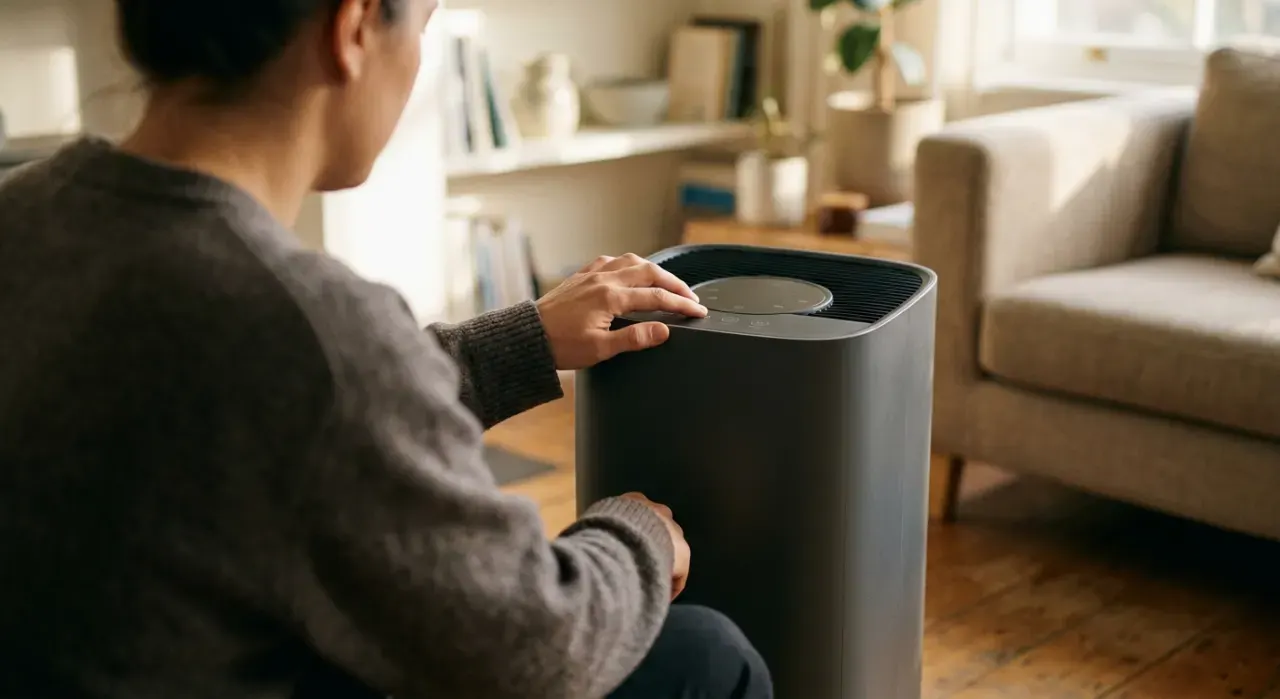
Run a HEPA air purifier in the room during and after the work to capture spores stirred up by scrubbing, and vacuum with a sealed HEPA vacuum rather than a shop vac that exhausts fines back into the room. Purifier options are in best air purifier for mold, and what filtration realistically achieves is covered in do air purifiers help with mold spores.

When to stop and call a professional
Some situations are past a weekend job, and the EPA's own guidance says so. Call a remediation contractor if any of these apply:
- The affected area is larger than about 10 square feet, or you keep finding more once you open things up.
- Mold is in the HVAC system — ducts, the air handler, the coil. Running the system distributes spores to every room, so shut it off and get it assessed.
- The water was sewage or floodwater. That is a contamination problem as much as a mold problem, with its own protocols.
- You can smell it but cannot find it. Hidden growth inside a wall cavity or under flooring needs someone with moisture meters and, sometimes, a borescope.
- The building is structurally affected — soft or spongy subfloor, sagging drywall, rot in framing.
- Anyone in the household has asthma, a mold allergy, or a weakened immune system. Do not do the disturbance work yourself.
- It keeps coming back after you have cleaned it twice. That means the water source has not actually been found.
Choose a contractor who follows a recognized standard, carries insurance, and will put a written scope and a containment plan in writing. Be cautious of any company offering free testing that then finds a large problem only they can fix — independent assessment and remediation are best kept separate.
Preventing it
Prevention is entirely about water and air movement. Hold indoor relative humidity below 60 percent and ideally between 30 and 50 percent, the range the EPA gives, closer to 45 in a basement — the targets and how to measure them are in ideal indoor humidity levels. Run bathroom exhaust fans during every shower and for twenty minutes after, and confirm they duct outdoors rather than into the attic, which is a common and destructive shortcut. Vent the range hood and the clothes dryer outside. Dry any spill, leak or flood within 24 to 48 hours, because that window is where mold either starts or does not.
Outside, keep gutters clear, extend downspouts several feet from the foundation, and grade soil to fall away from the house — most chronic basement dampness is a drainage problem wearing a mold costume. Indoors, keep furniture a few inches off exterior walls, leave closet doors ajar in problem rooms, and put a dehumidifier in the basement if it runs damp; setpoints are in what to set a dehumidifier to.
Where to go next
Related reading: how to test a house for mold, what causes a musty basement smell, and why a house smells musty in summer. For equipment, see best basement dehumidifiers. Everything lives under the air quality hub.
General home-maintenance information only. It is not medical advice and does not diagnose any health condition. If you have health concerns you believe relate to your home, speak with a clinician, and consult a licensed remediation professional about the building.