 Garden

Affiliate Disclosure
Some links on this page are affiliate links. As an Amazon Associate, we earn from qualifying purchases — at no extra cost to you. We do not buy, test, or physically handle the products we cover; our rankings come from aggregated owner reviews, ratings and expert consensus. Commissions never change our verdicts. How we rank · full disclosure.
The verdict: Angry Orange is the right buy if your problem is a smell rather than a stain — a dog-scented living room, a kennel, a garbage area, a car after a wet retriever. Diluted properly, one $20 bottle treats a whole house and the citrus base neutralises airborne odor faster than anything else at the price. It is the wrong buy for set-in cat urine, because it is a deodoriser, not an enzyme cleaner, and it cannot reach uric acid soaked into carpet padding. Buy it knowing which of those two problems you actually have.
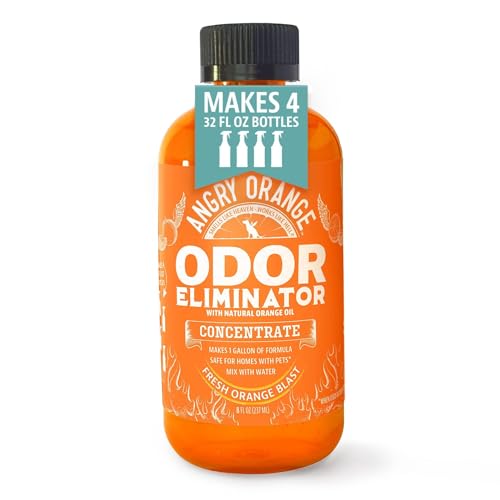
Best for knocking down lingering pet smell over a large area on a small budget
- 8 oz concentrate dilutes to roughly one gallon of finished cleaner
- Cold-pressed orange oil base rather than a synthetic fragrance
- Works on carpet, hard floors, upholstery, kennels and trash areas
- Costs a fraction of ready-to-use sprays per ounce
Why buy it: nothing else at this price treats a whole house, and the citrus base neutralises airborne smell far faster than a masking spray.
What Owners Consistently Praise
Three things come up again and again across the review record. The first is speed on ambient smell. Owners describe spraying a room that smelled unmistakably of dog and noticing the difference within minutes rather than hours. That is the citrus doing what citrus does — d-limonene is a genuinely effective odor neutraliser at the airborne stage, which is why it turns up in commercial degreasers and janitorial products.
The second is cost per treated square foot. This is the quiet reason the product has such a deep review pool. An 8 oz concentrate mixes out to roughly a gallon of finished cleaner, so the per-bottle economics land well under a dollar a quart. Owners who started with ready-to-use sprays consistently mention that they were going through a $12 bottle a week before switching.
The third is versatility. Reviewers report using it on carpet, tile, concrete kennel floors, litter areas, trash cans, garage floors, crates and car interiors. Very few odor products get used that broadly, and the reason is the dilution flexibility — a weak mix for fabric, a strong mix for concrete.
A smaller but repeated theme: people with a genuinely bad situation, such as a rental cleanup or a hoarding remediation, tend to rate it highly. When the baseline is severe, a strong citrus knockdown reads as a small miracle. Which is a useful clue to who this product is really for.
What Owners Actually Complain About
It is not an enzyme cleaner, and a large share of the disappointed reviews were bought expecting one. This is the central complaint and it is a mismatch of expectation rather than a defect. Cat urine deposits uric acid crystals that are not water soluble and that keep releasing ammonia every time the humidity rises. Citrus oil does not break those crystals down; it sits over them. Owners report the smell vanishing for three to ten days and returning, and they are not imagining it. If your problem is cat urine in carpet, start with our enzyme cleaner picks for cat urine instead, and read how to get cat pee smell out of carpet for the saturation technique that actually works.
The scent itself is polarising. Undiluted or heavily mixed, the orange is aggressive. Owners with sensitivity to fragrance, and a fair number without, describe headaches after treating a whole room and a smell that dominates the house for a day or two. Several report preferring the original dog smell to the first 24 hours of orange. Ventilate, mix weak, and treat one room at a time.
Dilution confusion causes a lot of the one-star reviews. People spray the concentrate neat, then report stickiness, residue on hard floors, darkened patches on light upholstery, and an overwhelming scent. The bottle is a concentrate. Mixing it at roughly 2 oz to a quart of water is the difference between a good result and a mess.
The sprayer is a recurring gripe. The concentrate ships without a practical applicator in most configurations, so you supply your own bottle, and owners who bought the bundled sprayer report leaks, seals that fail after a few weeks, and triggers that stiffen once citrus oil has passed through them. A cheap chemical-resistant garden sprayer solves this permanently.
Surface caution is under-communicated. Citrus oil is a mild solvent. Owners report hazing on some sealed hardwood finishes, softening of certain vinyl, and discoloration on untreated natural fibers such as jute or wool. Always test a hidden patch before the visible one, particularly on wool rugs.
Is any of that a dealbreaker? Only the enzyme issue, and only if your problem is embedded urine. Everything else is manageable with correct dilution and ventilation.
Who It Suits — and Who Should Buy Something Else
Buy it if you want to reduce general pet smell across a large area cheaply: dog odor in a living room, a kennel or crate, a car, a basement, a garage, a trash enclosure, or a rental you are turning over. It is also the sensible choice as a second stage, used after an enzyme treatment has dealt with the source and you simply want the room to smell fresh again.
Buy something else if your problem is urine that has soaked in, especially cat urine. Reach for a bacterial enzyme formula from our best enzyme cleaner for pet stains roundup and give it the dwell time the label asks for. If the smell is coming from the air rather than the floor — litter box ammonia, dander, dog odor that has permeated soft furnishings — a filter beats a spray, and our air purifier picks for pet households cover that. Cat households in particular should read the citrus caution above and consider going enzyme-only; the same d-limonene sensitivity is discussed in are essential oil diffusers safe around cats.
Specifications
| Product type | Citrus-oil odor eliminator concentrate (not enzymatic) |
|---|---|
| Bottle size | 8 fl oz concentrate |
| Dilution | Roughly 2 oz per 30 oz water — makes about four quart bottles |
| Active base | Cold-pressed orange oil (d-limonene) |
| Surfaces | Carpet, upholstery, hard floors, concrete, crates, vehicle interiors |
| Applicator | Not included in the standard configuration — supply your own spray bottle |
| Owner rating | See the verified figure on the card above |
How We Rank
We do not buy, test or physically handle any product on this site. This review is assembled from the owner-review record: the weighted star average across the full rating pool, the recurring themes in critical reviews separated from shipping and packaging complaints, long-term reports from owners writing months after purchase, and expert consensus as a cross-check. For odor products that method is a genuine advantage, because the important question — does the smell stay gone — is only answerable weeks later. Full method on how we rank.
The Bottom Line
Angry Orange earns its rating honestly, as long as you buy it for the job it does. As a cheap, potent, broadly useful deodoriser for pet smell across a large area, very little competes with it. As a solution for soaked-in urine, it is the wrong tool and the review record says so clearly. Dilute it properly, ventilate, keep cats out of a freshly sprayed room until it dries, and pair it with an enzyme cleaner if there is a source to destroy rather than a smell to neutralise. Start at the pets at home hub if you are still working out which problem you have. Check price on Amazon → (paid link)