 Garden

Affiliate Disclosure
Some links on this page are affiliate links. As an Amazon Associate, we earn from qualifying purchases — at no extra cost to you. We do not buy, test, or physically handle the products we cover; our rankings come from aggregated owner reviews, ratings and expert consensus. Commissions never change our verdicts. How we rank · full disclosure.
The short version: after weighing six of the most-reviewed bathroom exhaust fans on the US market against owner ratings, review volume, published CFM and sone figures and the complaints that recur year after year, the Panasonic FV-0511VQ1 WhisperCeiling DC is the fan we would put in almost any American bathroom. One model covers 50, 80 or 110 CFM on a switch, and at its lower speeds it is quiet enough that people forget it is running — which is precisely why it actually gets run. Below is the full ranked field, the consensus score behind each placement, and what owners genuinely complain about.
Two numbers decide everything in this category, and most buyers only look at one. CFM determines whether the fan can move the moisture out. That is the whole job: the EPA advises running the bathroom fan or opening a window whenever you shower, and the EPA advises keeping indoor humidity below 60 percent, ideally between 30 and 50 percent. Sones determine whether anyone will switch it on. A loud fan sized perfectly is worse than a quiet fan sized approximately, because the loud one spends its life switched off. If the musty smell in your bathroom is the reason you are here, the rest of the hub is at bathroom upgrades and fixes.
Top Picks at a Glance

Our #1 Pick: Panasonic FV-0511VQ1 WhisperCeiling DC
Panasonic has owned this category for two decades and the WhisperCeiling DC is why. The Pick-A-Flow switch on the housing sets the fan to 50, 80 or 110 CFM, so a single part number covers a powder room and a large main bath â and if you sized it wrong, you flip a switch instead of buying another fan. The DC motor senses static pressure in the duct and increases speed to compensate, which matters more than it sounds: a long, kinked flex run can cut a conventional fan’s real-world output nearly in half, and a fan that only delivers its rated airflow in a laboratory is not delivering it in your ceiling.
Then there is the noise, or the absence of it. At 50 CFM this fan is rated 0.3 sone, which in practice means people ask whether it is on. Owner reviews return to that point constantly, and it is not vanity — the reason bathrooms go moldy is that people switch the fan off, and nobody switches off a fan they cannot hear. The window is short, too — the EPA notes that materials dried within 24 to 48 hours will usually not grow mold. The Flex-Z Fast bracket articulates so the housing can be positioned between joists without a second trip to the attic, and the integrated adapter takes 4-inch or 6-inch duct.
Consensus Score ██████████░░ 9.4 — from the aggregated owner-review consensus
Check price on Amazon → (paid link)
The Ranked Field

Best for anyone replacing a fan once and wanting it right
- Pick-A-Flow switch selects 50, 80 or 110 CFM
- 0.3 sone at 50 CFM — effectively silent
- DC motor raises speed to beat duct static pressure
- Flex-Z Fast bracket, 4-inch or 6-inch duct
Why buy it: the quietest fan in the ranking by a wide margin, with one model covering every bathroom size in an American house.

Best for swapping an old fan without going into the attic
- 110 CFM at 1.0 sone
- Roomside installation — motor drops in from below
- Energy Star certified
- Fits most existing 4-inch duct openings
Why buy it: the only serious way to replace a fan from inside the bathroom, which matters enormously in a house with a low-clearance attic.

Best for tight joist bays, low ceilings and second-floor baths
- 70 CFM at 1.0 sone
- Under 5 lb, very shallow housing
- Brushless DC motor
- Energy Star qualified, 3-inch or 4-inch duct
Why buy it: a genuinely quiet DC fan light enough and shallow enough to fit where a Panasonic housing simply will not.
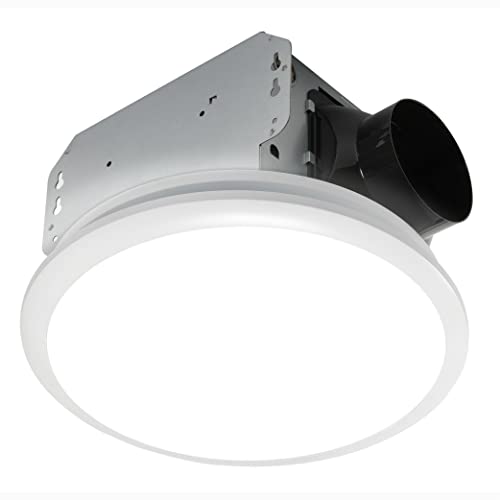
Best for a windowless bath that needs light and ventilation from one box
- 80 CFM at 1.1 sones
- Integrated dimmable LED panel
- Fits 4-inch duct
- One ceiling opening for both functions
Why buy it: the fan-and-light combination owners rate highest, and the LED panel looks like a modern fixture rather than a vent with a bulb in it.

Best for a 2x6 joist bay or a ceiling with almost no depth
- 5-5/8-inch housing depth
- Pick-A-Flow 50, 80 or 110 CFM
- 0.3–0.8 sone depending on speed
- Designed for retrofit into existing openings
Why buy it: Panasonic quietness in a housing shallow enough for a low-clearance ceiling, which is the constraint that defeats most upgrades.

Best for a half bath, a laundry room or a rental that has no fan at all
- 50 CFM at 4.0 sones
- Ceiling or wall mount
- 3-inch duct connector
- Polymeric grille, 20-gauge galvanized housing
Why buy it: the cheapest way to get real air movement into a room that currently has none — with the honest caveat that it is loud.
Quick Comparison
| Product | Best for | Rating | Price | Buy |
|---|---|---|---|---|
| Panasonic FV-0511VQ1 WhisperCeiling DC, 50/80/110 CFM | Best Overall | — | Check (paid link) | |
| Broan-NuTone AE110 InVent Roomside 110 CFM Bath Fan | Best Retrofit | — | Check (paid link) | |
| Delta Electronics BreezSlim SLM70 Bath Fan, 70 CFM | Best Slim Profile | — | Check (paid link) | |
| Homewerks 7141-80 Bath Fan with Integrated LED, 80 CFM | Best Fan and Light | — | Check (paid link) | |
| Panasonic FV-0511VF1 WhisperFit DC Retrofit, 50/80/110 CFM | Best for Tight Ceilings | — | Check (paid link) | |
| Broan-NuTone 688 Ceiling and Wall Fan, 50 CFM | Best Budget | — | Check (paid link) |

How We Rank
We never buy, test or physically handle the products we rank. Instead we aggregate what the owner base already knows: star ratings weighted by review volume, the shape of the one- and two-star distribution, published CFM and sone ratings, Energy Star listings, and the consensus of trade publications and working electricians. For exhaust fans we weight four things — real airflow against duct resistance rather than free-air CFM claims, sone rating, because a loud fan gets switched off and stops being ventilation at all, installation reality, meaning housing depth, joist fit and whether the thing can be retrofitted from below, and durability signals from long-tenure reviews, especially motor rattle, sticking backdraft dampers and grilles that discolor. Prices move constantly and were accurate at the time of writing. The full method is on our how we rank page.
Sizing a Fan Without Overthinking It
For a bathroom up to 100 square feet, use one CFM per square foot with a floor of 50 CFM. A 5 by 9 foot half bath is 45 square feet, so 50 CFM. A 9 by 10 foot main bath is 90 square feet, so 90 CFM or more. That single rule covers the great majority of American bathrooms.
Above 100 square feet, switch methods: count the fixtures. The Home Ventilating Institute approach allocates 50 CFM each to a toilet, a shower and a bathtub, and 100 CFM to a jetted tub, then adds them up. A large bath with a separate water closet, a walk-in shower and a soaking tub therefore wants around 150 CFM, and is often better served by two smaller fans — one over the shower, one in the toilet compartment — than by one large one.
Then subtract for reality. Every elbow, every foot of flex duct and every undersized termination cap costs you airflow. A fan rated 110 CFM at the housing may deliver 70 through 15 feet of kinked 4-inch flex into a screened cap. Two defenses: use smooth-wall rigid duct where you can, sized to the fan’s outlet rather than reduced, and buy a DC fan that compensates for pressure. Both of Panasonic’s picks here do the latter automatically.
The Fans, Reviewed
1. Panasonic FV-0511VQ1 WhisperCeiling DC — Best Overall
Covered above. Consensus Score ██████████░░ 9.4. What owners like: the silence, the selectable airflow, the pressure-compensating motor and the mounting bracket. What owners complain about: the price is roughly double a mainstream Broan; installation from below is not really possible, so a low-clearance attic means a ceiling repair; the housing is bulky in a 2x6 bay; and the fan does not include a light, which surprises buyers replacing a combination unit. A minority report the grille sitting slightly proud of the ceiling if the housing is not shimmed flush. Check price (paid link).
2. Broan-NuTone AE110 InVent Roomside — Best Retrofit
The whole argument for this fan is that the motor and blower assembly install from inside the bathroom, through the ceiling opening, without anyone crawling across joists in a 130°F attic. For a great many houses that is the difference between doing the job and living with the old fan. It moves 110 CFM at a rated 1.0 sone, which is genuinely quiet, and it is Energy Star certified. Consensus Score █████████░░░ 9.0. Complaints: it is louder than the Panasonic in side-by-side owner accounts, and a recurring theme is a faint motor hum that develops after a couple of years; the housing still has to be secured to a joist, so a true zero-attic install depends on your existing framing; and the grille is large, which some owners dislike on a small ceiling. Check price (paid link).
3. Delta BreezSlim SLM70 — Best Slim Profile
Under five pounds and shallow enough to fit ceilings where a full-depth housing has no chance, with a brushless DC motor rated 1.0 sone at 70 CFM. Delta’s Breez line has built a strong reputation among electricians for exactly this reason: it solves the fit problem without giving up quiet. Seventy CFM suits bathrooms up to about 70 square feet, which covers most secondary baths. Consensus Score ââââââââââââ 8.8. Complaints: 70 CFM is not enough for a large main bath and buyers who ignore that are the source of most low ratings; the grille is plain; and owners report the included mounting hardware being minimal, so a retrofit often needs extra brackets. Some also note the 3-inch duct option is a real compromise â use 4-inch where the run allows. Check price (paid link).
4. Homewerks 7141-80 Fan with LED — Best Fan and Light
Windowless bathrooms need light and air from the same ceiling box, and this is the combination owners rate highest at a reasonable price. Eighty CFM at 1.1 sones is a real specification rather than a marketing one, and the integrated LED panel is dimmable and bright enough to be the room’s only fixture in a small bath. It fits standard 4-inch duct. Consensus Score ââââââââââââ 8.6. Complaints: the LED panel is not replaceable, so when it eventually fails the whole unit is the repair; some owners report the light being a cooler color temperature than expected; and the fan is audibly louder than the Panasonic or Delta despite the sone rating. Wiring a combination unit also needs two switched circuits, which catches out buyers replacing a fan-only fixture. Check price (paid link).
5. Panasonic FV-0511VF1 WhisperFit DC — Best for Tight Ceilings
This is the WhisperCeiling engine in a housing under six inches deep, built specifically for retrofits and shallow bays. Same Pick-A-Flow switch, same DC motor and pressure compensation, same near-silence at the lower settings. If your ceiling cannot take the standard housing, this is the way to get Panasonic quiet anyway. Consensus Score █████████░░░ 9.1. Complaints: it is the most expensive fan here; owners note the shallow housing makes the duct connection tighter to work with, particularly on 6-inch duct; and like the WhisperCeiling it has no light. A handful of reviews mention the grille clip design being fussy to seat. Check price (paid link).
6. Broan-NuTone 688 — Best Budget
Twenty-five dollars, 50 CFM, a galvanized housing and a 3-inch duct connector. This is the fan that goes into half baths, laundry rooms and rentals, and it has been sold essentially unchanged for a very long time — which is itself a signal. If a room currently has no ventilation at all, this is a large improvement for very little money. Consensus Score ███████░░░░░ 8.0. Complaints: at 4.0 sones it is loud, and that is the dominant theme in the reviews; the 3-inch duct restricts real airflow further; the plastic grille is basic and yellows over time; and 50 CFM is genuinely marginal for anything but a small powder room. Owners upgrading from a quiet fan are consistently disappointed. Buy it for a room with nothing, not as a replacement for something better. Check price (paid link).

What Owners Actually Complain About
Across all six, four themes dominate the negative reviews.
Noise, and the gap between rating and reality. Sone figures are measured in a laboratory with a straight, correctly sized duct. Install the same fan on 15 feet of crushed flex and it works harder and sounds louder. Owners who report a fan being noisier than advertised are very often describing a duct problem rather than a fan problem.
Housings that do not fit. The most common installation complaint is discovering the new fan is deeper or wider than the old opening, which turns a one-hour swap into drywall repair. Measure the joist bay depth and the existing cutout before ordering, and favor a roomside or slim model if either is tight.
Backdraft dampers sticking open. Every fan here has a flap that should close when the motor stops. Owners in cold climates report the flap hanging up on lint or ice and letting cold air pour back into the bathroom. An in-line backdraft damper at the wall or roof cap solves it and costs very little.
The fan does not fix the mold. Ventilation removes moisture from the air; it does not remove moisture already in grout, caulk and drywall. Owners who install a fan expecting a musty bathroom to clear up overnight are usually also dealing with failed caulk at the tub or a slow leak. Our guides on caulking a bathtub and removing hard water stains cover the other half of the problem.
How to Choose Between Them
If you can get into the attic and want to solve this permanently, buy the Panasonic FV-0511VQ1, set the switch to match your bathroom, and duct it properly. If the attic is a crawl or does not exist, the Broan-NuTone AE110 installs from the room below and is the pragmatic answer. If the joist bay is shallow, the Delta BreezSlim SLM70 for a small bath or the Panasonic WhisperFit for a large one. If the room needs a light too, the Homewerks 7141-80 is the combination unit owners rate highest. If the room currently has no fan at all and the budget is $25, the Broan 688 is a real improvement, provided you accept the noise.
Whichever you buy, add two things: a countdown timer switch so the fan runs twenty minutes past the shower without anyone thinking about it, and a properly sized exterior termination cap. Together they cost less than $40 and they matter more than the difference between the second and third fans on this list.
The Verdict
The Panasonic FV-0511VQ1 WhisperCeiling DC wins because it is quiet enough to actually get used, adjustable enough to suit any bathroom in the house, and smart enough to compensate for the imperfect ductwork every real installation has. The Broan-NuTone AE110 is the pick when attic access is the constraint, and the Delta BreezSlim SLM70 when ceiling depth is. At the bottom of the range the Broan 688 is honest value for a room with nothing, as long as you know what four sones sounds like. Pair any of them with a timer switch, vent it outdoors, and the musty-bathroom problem largely disappears. More fixes and ranked picks are in the bathroom hub, including best shower heads and best shower filters. Check price on Amazon → (paid link)