 Garden


Affiliate Disclosure
Some links on this page are affiliate links. As an Amazon Associate, we earn from qualifying purchases — at no extra cost to you. We do not buy, test, or physically handle the products we cover; our rankings come from aggregated owner reviews, ratings and expert consensus. Commissions never change our verdicts. How we rank · full disclosure.
The new-mattress smell is off-gassing: volatile organic compounds released by polyurethane foam that has been freshly manufactured and then vacuum-compressed into a box. It typically peaks in the first few hours after unboxing, fades substantially within 24 to 72 hours, and is essentially gone in a week with a window open. It is normal, it is not evidence of a defect, and it affects boxed foam and hybrid mattresses far more than latex, innerspring or non-compressed beds. Ventilation is the whole treatment.
What is actually happening
Flexible polyurethane foam is made by reacting chemicals that leave behind small quantities of residual compounds in the finished material. Those compounds slowly migrate out of the foam and evaporate — the technical term is off-gassing, and it happens with new carpet, new car interiors, fresh paint and new furniture for the same reason.
Compression makes it much more noticeable rather than more severe. A boxed mattress is squeezed to a fraction of its volume and sealed in plastic, often for weeks in transit and storage. Everything that would have quietly dissipated in a warehouse is instead held in the foam, so it all arrives at once when you cut the wrapping. That is why the same foam in a non-compressed mattress usually smells far less on delivery.
The odor is commonly described as chemical, plasticky or faintly sweet. Latex is the exception with a smell of its own: natural latex has a rubbery, occasionally vanilla-like scent that some owners notice for several weeks. It is a different phenomenon from polyurethane off-gassing and is not a fault.

How long does it take to clear?
Timelines vary with construction, room temperature and airflow. The pattern owners describe is consistent enough to plan around.
| Mattress type | Noticeable | Largely gone |
|---|---|---|
| Boxed memory foam | First 24–72 hours | 3–7 days |
| Boxed hybrid (foam over coils) | First 24–48 hours | 2–5 days |
| Non-compressed foam mattress | A few hours | 1–3 days |
| Natural latex | Days | 2–6 weeks (rubber scent) |
| Innerspring with thin comfort layer | Minimal | 1–2 days |
| Memory foam topper | 24–48 hours | 2–4 days |
Three variables shorten it: airflow, which matters most; temperature, because warmth speeds the release; and surface exposure, which is why fitting a waterproof protector on day one slows the process by sealing the top face. Wait until the smell has faded before adding one of our mattress protector picks.
Expansion and off-gassing run on similar clocks but are separate things. A boxed mattress reaching full loft is a mechanical process covered in how long a mattress in a box takes to expand; the smell is chemical and can outlast it.
How to air a new mattress out
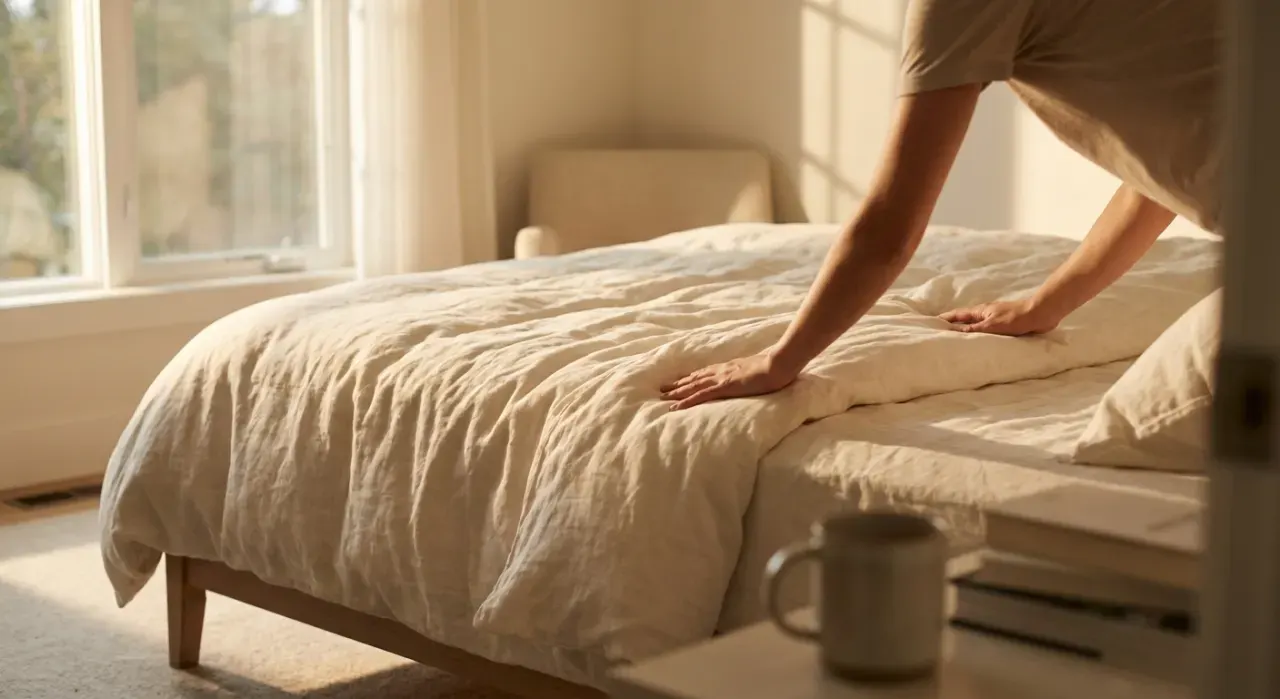
- Unbox in the morning, in the room it will live in, with a window open. Cut the plastic and remove every scrap, including any inner sleeve.
- Give it space. Both faces exposed is better than one. If you can, stand it on edge for the first few hours.
- Move air across it. A box fan aimed at the surface for a few hours does more than a day of still air. Cross-ventilation with two windows is better than one.
- Keep the room warm rather than cold. Off-gassing is temperature-dependent, so a cold room stretches the process out.
- Leave it bare. No protector, no sheets, no mattress pad until the smell has dropped off.
- If odor lingers, try baking soda. Sprinkle it lightly over the surface, leave several hours, vacuum thoroughly with an upholstery tool. It absorbs residual odor rather than removing the source.
Sleep elsewhere for the first night if you can, and definitely if the person sleeping on it is pregnant, an infant, or unusually sensitive to solvent smells. If sleeping on it immediately is unavoidable, keep the window open overnight. There is a related and more specific write-up in why does my new mattress smell.
What the certifications actually cover
Two marks appear on most US mattress listings, and they certify different things. Neither is a government program; both are third-party testing schemes, and knowing what each measures makes the label useful rather than decorative.
| Certification | What it certifies | What it does not |
|---|---|---|
| CertiPUR-US | The polyurethane foam: made without ozone depleters, PBDE flame retardants, mercury, lead, formaldehyde and certain phthalates; low VOC emissions | The cover, adhesives, coils or the finished mattress as a whole |
| GREENGUARD Gold | The finished product tested in a chamber against strict chemical emission limits, including criteria oriented to sensitive populations | What the materials are made of, or any organic claim |
| GOTS / GOLS | Organic content and processing for textiles (GOTS) and latex (GOLS) | Emissions testing of the assembled mattress |
| OEKO-TEX Standard 100 | Textiles tested for a list of harmful substances | The foam core in most constructions |
The practical reading: CertiPUR-US is about what is in the foam, GREENGUARD Gold is about what comes out of the finished mattress. If low emissions are the priority, GREENGUARD Gold is the more directly relevant mark because it tests the assembled product. CertiPUR-US is close to table stakes on foam sold in the US — useful as a floor, not as a differentiator.
What none of them promise is zero smell. A certified mattress can still off-gas noticeably in the first few days; the certification speaks to measured emission levels, not to whether your nose detects something.
The other bedroom items that off-gas
A mattress is rarely the only new thing in the room, and several bedding items behave the same way for the same reason.
- Memory foam toppers off-gas noticeably and clear in two to four days. They are thin, so airflow reaches both faces quickly — standing one on edge for an afternoon does most of the work.
- Memory foam pillows are the most concentrated case relative to their size, and they sit directly under your face. Unwrap and air for at least 48 hours before use.
- New mattress protectors with a polyurethane membrane have a faint plasticky smell that a single wash removes. Wash before first use regardless.
- New sheets smell of sizing and finishing chemicals from manufacturing rather than of VOCs from foam. One wash clears it, which is one of several reasons to wash new bedding before it goes on the bed — see how to wash bedding.
- New bed frames, particularly engineered wood, can release formaldehyde from adhesives. Assemble with the window open and give the room a day.
If you are replacing several items at once, stagger them or air the whole room together for a couple of days. The combined smell of a new mattress, topper, pillows and frame is considerably stronger than any one of them, and it is the situation in which people most often assume something is wrong.
Choosing a lower-emission mattress
If off-gassing is a real concern in your household — a nursery, a chemically sensitive sleeper, a bedroom that cannot be ventilated — the choices that reduce it are straightforward.
- Buy a construction with less foam. An innerspring or hybrid with a thin comfort layer simply has less material to release anything.
- Consider natural latex, wool and cotton. Higher cost, longer service life, and a rubbery scent instead of a chemical one.
- Prefer GREENGUARD Gold where it is available, and CertiPUR-US as the minimum on any foam bed.
- Avoid vacuum-compressed if you can. A mattress delivered flat has already done much of its airing in a warehouse.
- Plan the timing. Order so the bed arrives several days before it is needed, in warm weather if possible.
The construction trade-offs beyond emissions are covered in memory foam vs hybrid, and the ranked field, including several CertiPUR-US certified beds, is in best mattress in a box.
We never buy, sleep on or physically handle the products we rank. Every recommendation is drawn from aggregated owner reviews, star ratings, review volume and published expert consensus — see how we rank.
More from this hub: Bedding & Sleep · Why does my new mattress smell? · How long a mattress lasts · Bed frames and foundations · How we rank