 Garden
Affiliate Disclosure
Some links on this page are affiliate links. As an Amazon Associate, we earn from qualifying purchases — at no extra cost to you. We do not buy, test, or physically handle the products we cover; our rankings come from aggregated owner reviews, ratings and expert consensus. Commissions never change our verdicts. How we rank · full disclosure.
The short answer: arrange living room furniture by first picking a focal point (the TV, a fireplace, or a window), then pulling your seating into a conversation group facing it — sofa and chairs no more than about 8 feet apart, with 14 to 18 inches between seats and the coffee table and 30 to 36 inch walkways around the group. Anchor everything on a rug large enough to hold the front legs of each seat, and resist the urge to line every piece against the walls. That one habit is what makes a room feel cold and empty.
We do not stage rooms first-hand; this guidance comes from interior-design conventions and the recurring advice in owner and designer sources, as described in how we rank. The numbers below are the standard clearances professionals design to, adapted for real US living rooms.
Start with the focal point
Every well-arranged room has one thing the eye lands on first, and the furniture is organized around it. Walk in and ask what that should be. In most American living rooms it is the television, sometimes a fireplace, and in rooms blessed with a view it can be a big window. Pick one — trying to serve two competing focal points equally is what leaves a room feeling scattered.
Once you have chosen it, the main sofa faces or angles toward that point, and the secondary seating fills in around it. If your room has both a fireplace and a TV, the cleanest solution is to combine them by mounting the TV above the mantel; if that is not possible, make the fireplace the focal point and place the TV on an adjacent wall so seating can pivot between them.
Float the sofa, do not wall it off
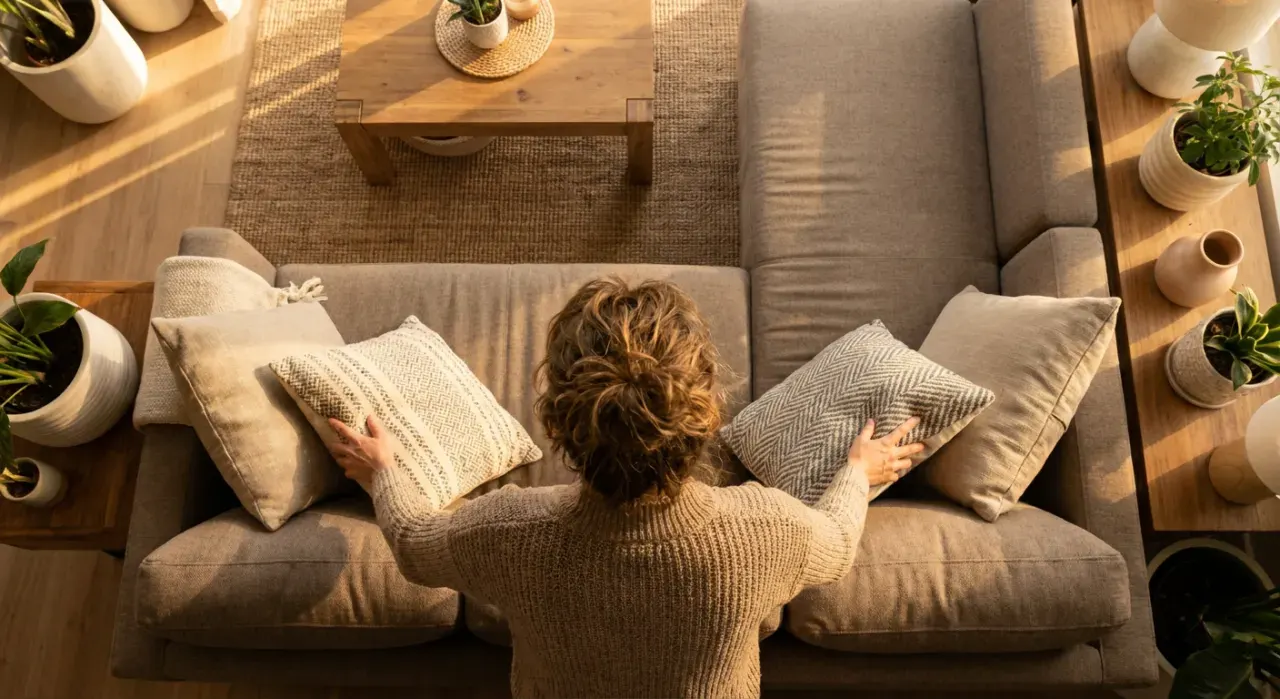
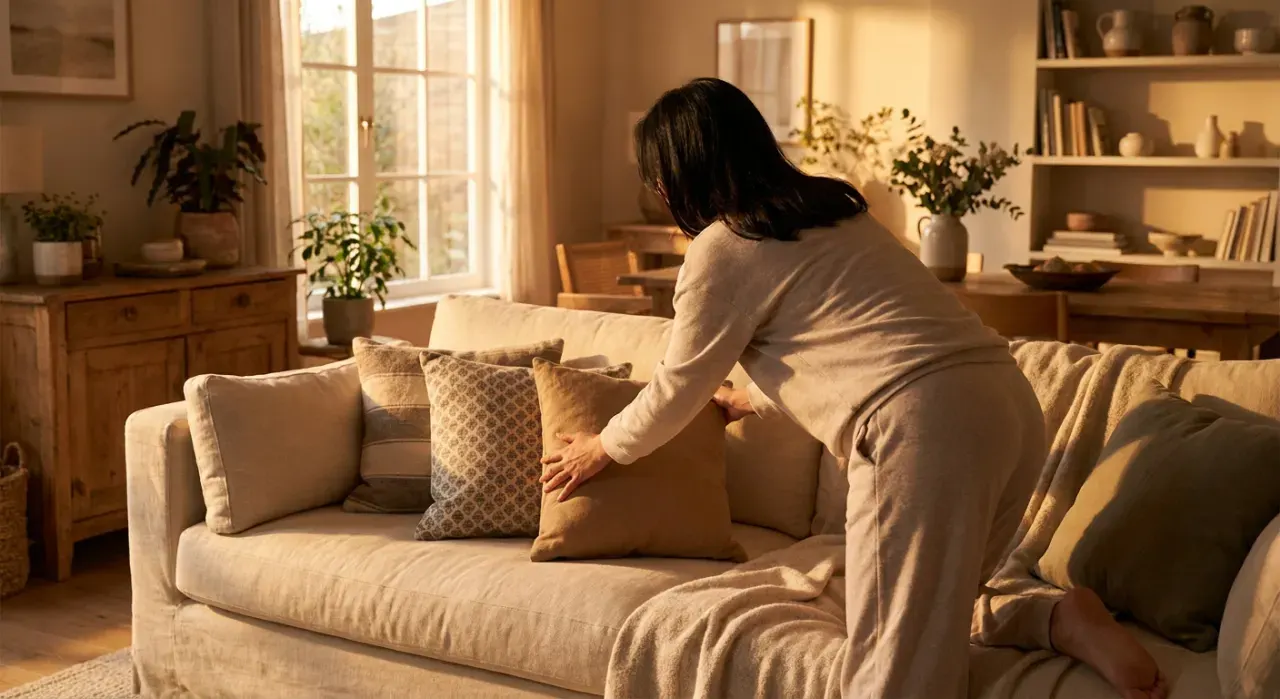
The instinct to shove every piece against a wall comes from wanting to "make space," but in anything larger than a small room it backfires: it creates a hollow middle and spreads people so far apart they have to raise their voices to talk. Instead, pull the sofa forward. Even floating it a few inches off the wall reads as intentional, and floating it a foot or two lets you slide a console table or a walkway behind it.
The exception is genuinely small rooms, where the sofa against the longest wall is the efficient choice. The test is the conversation group: seats should form a loose U or an L where no two people are more than about 8 feet apart. If floating the sofa achieves that, float it.
Build the conversation group
The heart of the room is a cluster of seats close enough for easy talk. Aim for these clearances:
| Gap | Distance | Why |
|---|---|---|
| Seat to coffee table | 14 to 18 in | Reach a drink without leaning; legroom to pass |
| Across the group, seat to seat | Up to 8 ft | Close enough to talk without raising your voice |
| Main walkways | 30 to 36 in | Two people can pass; clear traffic path |
| Tight walkways | Minimum 24 in | Absolute floor for a single-file path |
| Coffee table height | Within 2 in of seat height | Reads as part of the seating group |
A pair of accent chairs across from the sofa is the classic move, and how many you can fit depends on the room — see how many accent chairs in a living room. For the sofa-to-table gap in more detail, our page on how far a coffee table should be from a sofa walks through the reach test.
Get the rug size right
The rug is what ties the group together, and the most common mistake is one that is too small. The reliable rule: the rug should be big enough that at least the front legs of every major seat rest on it. In a typical living room that is an 8 by 10 foot rug; larger rooms want a 9 by 12. Leave a border of roughly 10 to 18 inches of bare floor between the rug and the walls so it frames the space rather than fills it wall to wall.
For the full sizing breakdown by room, see what size area rug for a living room, and if you are shopping, our ranked field is in best area rug. A rug pad underneath keeps it flat and stops it sliding on hard floors.
Plan the traffic flow
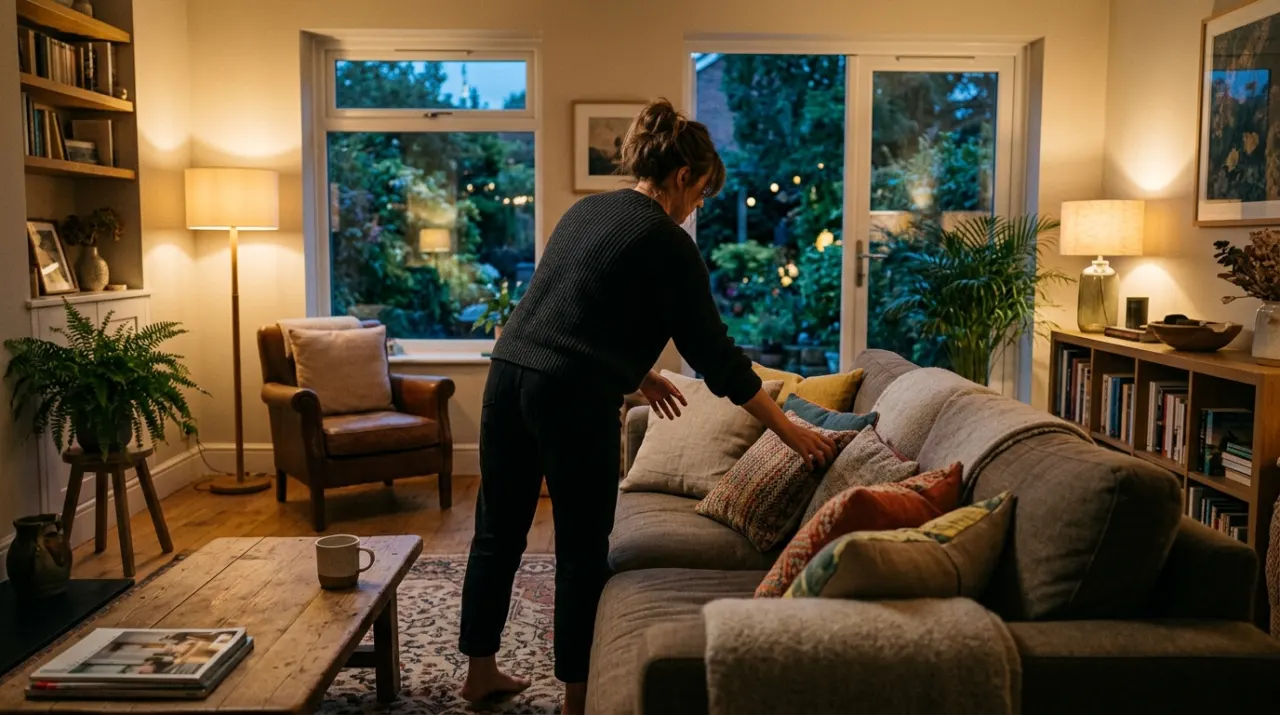
Before you commit, trace the paths people actually take: front door to the sofa, sofa to the kitchen, the route to the hallway. Keep those lanes clear at 30 to 36 inches wide, and never make someone walk through the middle of the conversation group to cross the room — route traffic around it. If the only path runs between the sofa and the TV, you have a problem to solve, usually by rotating the whole group ninety degrees.
Doorways, radiators, and outlets are fixed constraints; note where they are before you move heavy pieces. Blocking a heating vent or an air return with the back of a sofa, for instance, will make the room uncomfortable and can strain the HVAC system.
Balance visual weight
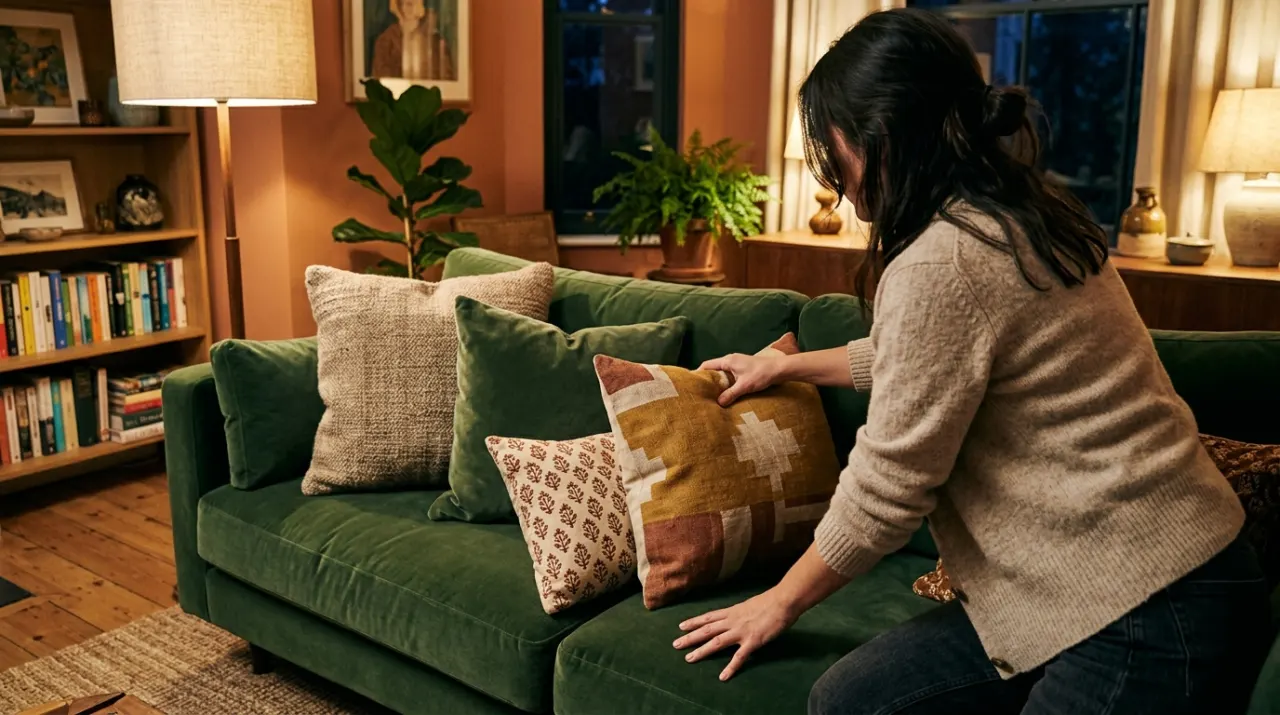
A room feels settled when the visual weight is spread around it rather than piled on one side. If a big sectional occupies one corner, balance it with something with presence on the opposite side — a bookshelf, a tall plant, a pair of chairs, or a piece of large art. Vary the heights, too: a room where everything sits at the same low level feels flat, so mix in a floor lamp, a tall shelf, or a mirror to draw the eye up.
Leave breathing room around each piece; furniture that is all crammed edge to edge feels cluttered even when the pieces themselves are fine. Angling one or two items, like turning a chair off the strict grid, adds a relaxed note and softens a boxy room.
Place the TV and lighting
Mount or set the TV on the wall the main sofa faces, centered, with the middle of the screen near seated eye level (about 42 inches off the floor for a standard sofa). Sit 7 to 9 feet back from a 55 to 65 inch screen for comfortable viewing. Keep it off a wall directly opposite a large window, where afternoon glare will wash out the picture.
Layer the lighting rather than relying on one ceiling fixture: an overhead source, plus table or floor lamps at the seating group, plus something accenting a shelf or corner. Layered light is what makes a room feel warm at night, and it lets you match the brightness to what you are doing, from reading to movie night.
Adjusting for small and awkward rooms
Small rooms reward restraint: scale the pieces down, favor seating with exposed legs and lower backs so you can see through them, and use a loveseat or a pair of compact chairs instead of a sprawling sectional. Nesting tables and a smaller-footprint coffee table keep the floor open. Float one piece at an angle to break the boxy feel, and use a single large rug rather than several small ones, which visually chops the floor into fragments.
For open-plan and combined living-dining spaces, use the furniture itself to define zones — the back of the sofa becomes the line between the living area and the dining area, with a console behind it. Just keep the standard walkways: in a dining zone, allow enough clearance to pull chairs out, covered in how much space between a dining table and the wall. The rest of our furniture guidance lives at the furniture and decor hub.