 Garden
Affiliate Disclosure
Some links on this page are affiliate links. As an Amazon Associate, we earn from qualifying purchases — at no extra cost to you. We do not buy, test, or physically handle the products we cover; our rankings come from aggregated owner reviews, ratings and expert consensus. Commissions never change our verdicts. How we rank · full disclosure.
The short answer: to clean upholstery, first find the cleaning code tag under a cushion and match your method to it — W means water-based cleaners are safe, S means solvent only (no water), WS means either, and X means vacuum only. Then vacuum thoroughly, blot (never rub) any stains with the correct cleaner tested in a hidden spot first, work the whole surface with a barely-damp cloth or upholstery extractor, and dry it fast with a fan. Over-wetting and ignoring the code are the two mistakes that ruin fabric.
We do not physically handle or launder the furniture we cover; our guidance is drawn from manufacturer care instructions, textile-care standards, and the aggregated experience reflected in thousands of owner reviews, as explained in how we rank. What follows is the method that works across the fabrics you will actually meet on a home sofa or chair.
Read the Upholstery Cleaning Code First
Every piece of upholstered furniture sold in the US carries a cleaning code, printed on a small tag stitched under a seat cushion, on the deck below the cushions, or on the frame. It is the manufacturer telling you exactly what the fabric can survive. Using the wrong solvent or wetting a solvent-only fabric is the number one cause of permanent damage, so this thirty-second check comes first, every time.
| Code | What it allows | Practical meaning |
|---|---|---|
| W | Water-based cleaners | Mild dish soap and water, or a water-based upholstery foam, are safe |
| S | Solvent only, no water | Use a dry-cleaning solvent; water leaves rings and can shrink fibers |
| WS | Water-based or solvent | Most forgiving; start with the mildest option |
| X | Vacuum only | No liquids at all; call a professional for stains |
If the tag is missing or unreadable, treat the fabric as S (solvent only) until you have tested water in a hidden area, because assuming water is safe on a code-S microfiber or rayon blend will cost you a ruined cushion.
Tools and supplies you actually need
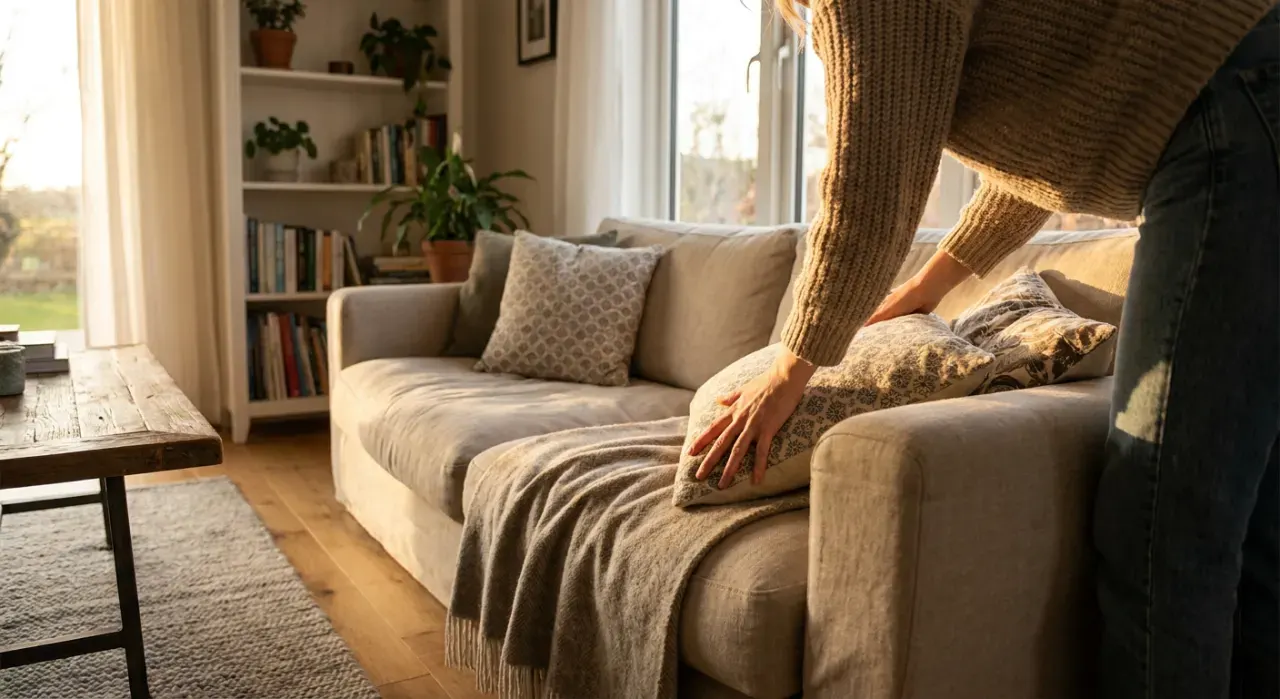
You do not need a cabinet of specialty products. A basic kit handles almost every household job:
- Vacuum with an upholstery brush and crevice tool — the most important item on the list.
- Several clean white microfiber or cotton cloths. White matters, because dyed cloths can transfer color onto light fabric.
- Mild dish soap (a clear, dye-free liquid) for W and WS fabrics.
- Distilled water if your tap water is hard, to avoid mineral rings.
- A dry-cleaning solvent for S and WS fabrics, used in a ventilated room.
- A soft-bristle brush to lift napped fabrics after cleaning.
- A box fan to force-dry, which is what prevents rings and mildew.
An enzyme cleaner is worth adding if you have pets, because enzymes break down the proteins in urine and vomit that ordinary soap only masks. Match it to the code just like anything else.
Always vacuum first
Grit is abrasive. Every time someone sits down, embedded dust and sand grind against the fibers and dull the color, which is why an un-vacuumed sofa looks tired years before its time. Vacuum the whole piece before any wet work, using the upholstery brush across the panels and the crevice tool down the seams, around buttons, and into the gap where the seat meets the back — the places crumbs and pet hair collect.
For stubborn pet hair that the vacuum skates over, drag a slightly dampened rubber glove or a rubber-edged squeegee across the fabric first; it balls the hair up so the vacuum can lift it. Doing this properly also means any cleaner you apply next reaches the fibers instead of turning surface dust into mud.
Spot-Clean Upholstery Stains the Right Way
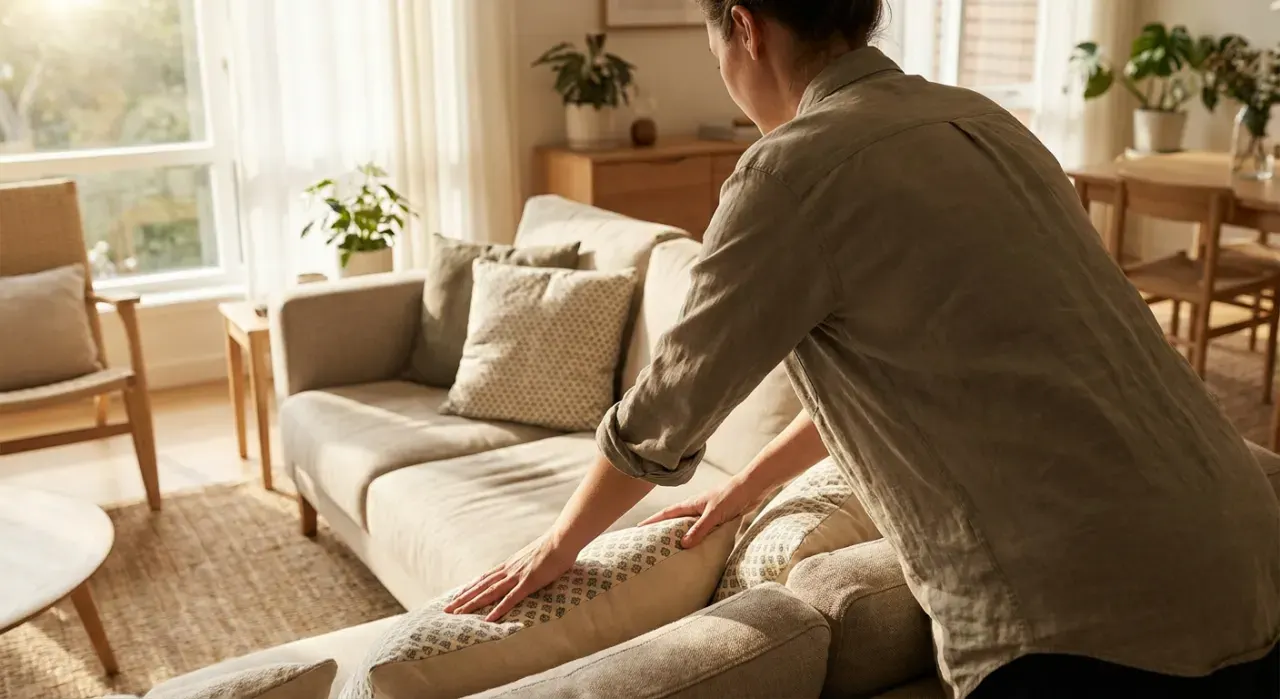
The universal rule is blot, do not rub. Rubbing drives the stain deeper and frays the surface fibers into a fuzzy, discolored patch. Work from the outside of the stain inward so you do not spread it, and always test your cleaner in a hidden spot — the back of a skirt or under a cushion — before touching the visible area.
- Lift solids first with a spoon or dull knife, scraping toward the center.
- Blot up liquid with a dry white cloth, pressing straight down.
- Apply the correct cleaner to the cloth, not the fabric. A few drops of dish soap in a cup of water for W codes; solvent for S codes. Loading the cloth rather than the seat keeps you from over-wetting the padding.
- Blot, wait, repeat. Dab, give it a minute to work, then blot with a clean section of cloth. Several gentle passes beat one aggressive one.
- Rinse (W codes only) by blotting with a cloth dampened in plain water to remove soap residue, which otherwise attracts dirt and leaves a stiff patch.
- Dry fast with a fan aimed at the spot.
Match the cleaner to the stain, too: cold water for protein stains like blood, milk, and egg (heat cooks them in), solvent for grease and oil, and an enzyme cleaner for pet accidents.
Cleaning the Whole Upholstered Piece
Once spots are handled, a full surface clean evens out the color and lifts the ground-in dullness. On a W or WS fabric, whip a tablespoon of dish soap into warm water until you have a bowl of dry suds, and apply only the foam to the fabric with a cloth or soft brush — the suds carry the cleaning power with far less moisture than the liquid, which is exactly what you want near foam padding. Work one panel at a time, wipe away the residue with a clean damp cloth, and move on.
For W and WS fabrics you can also use a portable upholstery extractor or a carpet machine with an upholstery hand tool, which sprays and immediately vacuums the moisture back out. Keep it on the lowest moisture setting, make a dry vacuum pass after each wet one, and never soak through to the cushion core. On S-coded fabric, skip water entirely and clean with a solvent-dampened cloth panel by panel.

Fabric-by-fabric notes
The code tells you water versus solvent, but each fabric has its own quirks:
| Fabric | Typical code | Watch out for |
|---|---|---|
| Cotton and cotton blends | W or WS | Can shrink and water-ring; keep moisture low and dry fast |
| Microfiber / microsuede | S or WS | Water often leaves rings; many respond best to solvent, then a soft brush to restore nap |
| Linen | W or S | Prone to shrinking and water marks; often best left to a pro |
| Wool | W or S | Cool water only, gentle cleaner, never hot or harsh |
| Polyester / olefin | W or WS | Durable and forgiving; a good candidate for extraction cleaning |
| Velvet | S or W | Blot only, then brush the pile in one direction while damp to avoid crushing |
| Leather | Not coded | No water soaking; use a dedicated leather cleaner and conditioner |
Leather is its own category. Wipe spills promptly, clean with a leather-specific cleaner, and condition a couple of times a year to keep it from drying and cracking. If your leather is already flaking, that is usually a bonded-leather coating failing rather than dirt — see why is my leather sofa peeling for what is actually happening.
Dry fast to prevent rings and mildew
Slow drying is what causes water rings, that stiff crusty feel, and the musty smell of mildew forming in damp padding. As soon as you finish, point a box fan or two at the piece and open a window; airflow, not heat, is the goal. Do not sit on or cover the furniture until it is dry all the way through, which can take several hours for a lightly cleaned surface and longer if a cushion got wet.
If you do end up with a faint ring, lightly re-dampen the whole panel with distilled water and dry it evenly under the fan, so the fabric dries as one piece instead of leaving a hard edge where wet met dry. This is the same principle behind cleaning a whole panel rather than just a spot.
When to call a professional
Do it yourself for routine care and everyday spills on W, S, and WS fabrics. Bring in a professional for anything coded X, for delicate or antique pieces, for large set-in stains you cannot lift after a couple of careful attempts, and for whole-piece odor problems that survive an enzyme treatment. A professional cleaning runs a fraction of the cost of reupholstering, and reupholstering itself is a real project — see how much it costs to reupholster a sofa before deciding a stain is fatal.
For related cleaning tasks, our step-by-step on how to clean a fabric sofa applies these methods to a full couch, and how to refinish a wood dresser covers the wood side of furniture care. When it is time to replace a worn chair, our picks are in best accent chair, and everything else lives at the furniture and decor hub. Cleaning as you go, and vacuuming weekly, is what makes any upholstered piece last a decade instead of five years.