 Garden

Affiliate Disclosure
Some links on this page are affiliate links. As an Amazon Associate, we earn from qualifying purchases — at no extra cost to you. We do not buy, test, or physically handle the products we cover; our rankings come from aggregated owner reviews, ratings and expert consensus. Commissions never change our verdicts. How we rank · full disclosure.
The short answer: for most home growers the VIVOSUN Base A & B two-part feed is the right nutrient — simple to mix, covers the whole life cycle, and cheap enough to be a low-stakes first bottle. Growers who want finer control should reach for the General Hydroponics Flora Series three-part system, and anyone chasing maximum results can step up to the Humboldts Secret Starter Kit with its full supplement lineup.
Hydroponic nutrients are the entire diet of a soilless plant — because there is no soil to hold minerals, the feed solution has to carry the complete range of macro- and micronutrients in the water. Choosing one is really choosing between simplicity and control: a two-part A & B feed that just works, a three-part system you can tune by stage, or a full supplement program for maximum results. This page ranks the feeds. Every hydroponic system needs one, so pair this with your growing apparatus at best hydroponic system, your complete setup at best hydroponic grow kit, or a countertop unit at best countertop hydroponic garden.
What Actually Separates One Nutrient From Another
Once a feed carries a complete, plant-available range of nutrients, the products separate on a short list of things:
- Format. Two-part A & B for simplicity and whole-cycle coverage; three-part for stage-by-stage tuning; a full kit for growers who supplement.
- Completeness. Does it include the secondary nutrients — calcium and magnesium — and micronutrients, or will you need a separate CalMag supplement?
- Concentration and value. A concentrated feed costs more per bottle but less per crop; a dilute budget feed is cheap up front.
- Stage focus. Some feeds are tuned for vegetative growth (nitrogen-forward), which suits the leafy greens most home growers actually grow.
- Reputation. Nutrient lines with long track records — General Hydroponics, FoxFarm, Humboldts Secret — are proven across countless grows.
The Best Hydroponic Nutrients at a Glance
Our #1 Pick: VIVOSUN Base A & B
This tops the list because it is the feed that fits the most growers with the fewest downsides. A two-part A & B system is the simplest complete nutrient there is — you add equal measures of each to the water and the plant has everything it needs — and this one covers both the vegetative and flowering stages, so a single product carries a plant from seedling to harvest.
What it does well. Simplicity and value. There is no ratio to calculate and no stage chart to follow beyond the basic dose, which makes it ideal for countertop and small-system growers who want results without a chemistry lesson. The 8oz bottles are sized sensibly for the small reservoirs those systems use, so you are not buying a gallon you will never finish, and it carries one of the strongest review records among budget A & B feeds — the sign that it reliably does its job.
Where it gives ground. It offers less control than a three-part system, so a grower chasing maximum yield or running demanding fruiting crops may outgrow it. And as a base feed it may need a CalMag supplement in some water conditions. But for the everyday job of keeping herbs and greens fed, it is the right amount of feed for the right price.
Check price on Amazon → (paid link)

The Hydroponic Nutrients, Ranked

Best for a countertop or small system grower who wants a simple, cheap, reliable two-part feed
- Two-part A & B liquid — mix, add, done
- Covers both vegetative and flowering stages
- Small 8oz bottles suited to countertop systems
- Among the best-reviewed budget A & B feeds
Why buy it: The sensible default for most home growers: a straightforward two-part feed that covers the whole life cycle of a plant, at a price that makes it a low-stakes first bottle.

Best for the lowest-cost feed for AeroGarden-style countertop pod systems
- 800ml of two-part A & B solution for the price
- Formulated for countertop hydroponic gardens
- Works across vegetables, fruits and flowers
- All-in-one solution beyond just leafy greens
Why buy it: The cheapest way to keep a countertop garden fed. It does the one job a pod-system feed needs to do, at a price that barely registers against the cost of the system.
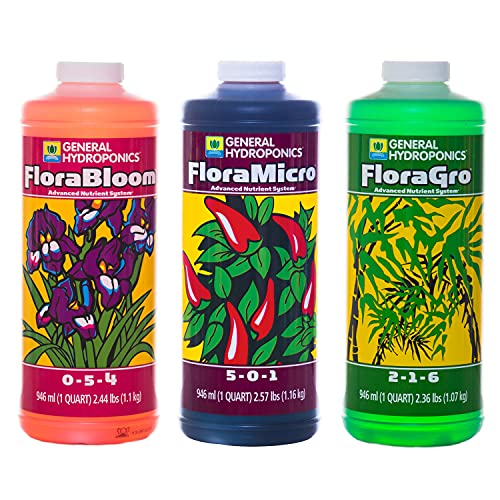
Best for the grower who wants to tune the feed precisely across growth stages
- Three parts — FloraMicro, FloraGro, FloraBloom
- Adjust the ratio to the growth stage
- The reference nutrient line for serious hydroponics
- A quart of each lasts a long time
Why buy it: The industry-standard three-part system, and the one experienced growers reach for. Splitting the feed into three lets you dial the mix to exactly what the plant needs at each stage.

Best for a grower who wants a premium two-part feed with a strong reputation
- Concentrated two-part A & B for indoor and outdoor use
- Supports vegetative growth and flowering
- Large 32oz bottles for heavier or longer grows
- A well-regarded premium brand
Why buy it: The step up for someone who liked a basic A & B and wants a more refined, concentrated version with a loyal following. Simpler than a three-part line, richer than a budget feed.

Best for pushing lush leafy and vegetative growth on greens and young plants
- 3-2-6 formula tuned for vegetative growth
- Includes earthworm castings and micronutrients
- A trusted name in plant nutrition
- Ideal for leafy greens and the veg stage
Why buy it: A FoxFarm reputation earned honestly: a nitrogen-forward feed built to drive the lush leafy growth that salad greens and vegetating plants want most.

Best for the grower who wants the full supplement lineup to maximize a serious grow
- Base A & B plus CalMag, Golden Tree and additives
- A complete regimen rather than a single bottle
- Covers deficiencies most single feeds miss
- For growers chasing maximum yield and health
Why buy it: The whole feeding program in one box. It costs far more than a single bottle because it is not one — it is the base feed plus the supplements experienced growers add for calcium, magnesium and root health.
Quick Comparison
| Product | Best for | Rating | Price | Buy |
|---|---|---|---|---|
| VIVOSUN Liquid Nutrients Base A & B Bundle, 8oz Set | Best Overall Value | — | Check (paid link) | |
| Ahopegarden A & B Hydroponic Nutrients, 800ml Set | Best Budget A & B | — | Check (paid link) | |
| General Hydroponics Flora Series, 3-Part Nutrient System, 1 qt Bottles | Best 3-Part System | — | Check (paid link) | |
| Humboldts Secret Base A & B Liquid Fertilizer, 32oz Set | Best Premium A & B | — | Check (paid link) | |
| FoxFarm Grow Big Hydroponic Plant Food, 3-2-6 Liquid | Best for Vegetative Growth | — | Check (paid link) | |
| Humboldts Secret Starter Kit — Base A & B, CalMag, Golden Tree & More | Best Complete Nutrient Kit | — | Check (paid link) |
How to Choose Your Nutrients
Most home growers, countertop or small system? The VIVOSUN Base A & B. Cheapest possible feed for a pod garden? The Ahopegarden A & B. Want to tune the feed by growth stage? The General Hydroponics Flora Series three-part system. A premium two-part with a following? Humboldts Secret Base A & B. Driving lush leafy growth? FoxFarm Grow Big. Chasing maximum yield with a full program? The Humboldts Secret Starter Kit.
The honest guidance is to start simple. A two-part A & B feed grows excellent herbs and greens, which is what most home systems actually produce, and you can always graduate to a three-part system or add supplements once you understand what your plants respond to. The bigger determinant of success is not which bottle you buy but whether you measure — a pH meter and, ideally, an EC or TDS meter tell you far more than the label does, because the same feed at the wrong pH or concentration will disappoint regardless of brand. Buy a sensible feed, then feed it correctly.

How We Research Hydroponic Nutrients
We do not buy, mix or physically test these nutrients. Every judgment draws on aggregated owner reviews, published maker documentation and the consensus of experienced hydroponic growers. We weight long-tail reviews — those written after multiple crops — over launch-window ratings, because a feed's real test is whether plants thrive on it across full cycles, not whether the bottle arrived intact. We read the formulation for completeness, note where a CalMag supplement is likely needed, and favor lines with long, proven track records. The star ratings on the cards are verified against live listing data rather than typed in by us; where a rating cannot be verified, the card shows none rather than an invented figure. Prices were current at the time of writing and change constantly. Full method on how we rank.
What Nutrient Buyers Complain About
The critical reviews share recurring themes. Needing a separate CalMag supplement leads — growers on hard or soft water who found a base feed alone left a deficiency. Overfeeding damage is common, from buyers who dosed above the chart and burned roots, which is really a measuring problem. Mixing confusion on three-part systems, from growers unsure of the ratios. Shipping leaks on liquid bottles. And slow results, usually traced to pH being out of range rather than the nutrient itself. The pattern is clear: most nutrient disappointments are dosing and pH problems, not product problems — which is why we stress measuring over brand-chasing.
The Verdict
VIVOSUN Base A & B is the hydroponic feed we would recommend to most growers: simple, complete and inexpensive. Choose the Ahopegarden A & B for the cheapest pod-garden feed, the General Hydroponics Flora Series for stage-by-stage control, FoxFarm Grow Big for lush leafy growth, and the Humboldts Secret Starter Kit for a full supplement program. Then measure your pH and concentration, because that matters more than the brand on the bottle. Pair your feed with a system at best hydroponic system or a complete setup at best hydroponic grow kit. More in the greenhouses & season extension hub. Check the current price on Amazon → (paid link)