 Garden

Affiliate Disclosure
Some links on this page are affiliate links. As an Amazon Associate, we earn from qualifying purchases — at no extra cost to you. We do not buy, test, or physically handle the products we cover; our rankings come from aggregated owner reviews, ratings and expert consensus. Commissions never change our verdicts. How we rank · full disclosure.
The short answer: the best box fan for most homes is the Lasko 3723. It is the version with the Wind Ring shroud around the blade — the single genuine design difference in a category of otherwise interchangeable fans — and owners consistently describe it as moving noticeably more air than the plain-framed models at the same price. Want the cheapest sensible option? The Lasko 3733. Fan going in an open window? The weather-resistant Lasko 3720. Garage or shop? The metal-bladed Hurricane Pro moves several times as much air.
Box fans are one of the last genuinely honest product categories: a motor, a blade, a frame and a switch, for about thirty dollars, drawing less power than a light bulb. A 20-inch box fan uses roughly 50 to 75 watts on high — about a nickel for eight hours — while a portable air conditioner draws around 1,100. Running fans before you run the compressor is the single cheapest comfort upgrade in a house. For the alternatives see best tower fan or start at the heating and cooling hub.
Top Picks at a Glance

Our #1 Pick: Lasko 3723 20 in. Box Fan
There is very little to differentiate one box fan from another, which is exactly why the one real difference matters. Most box fans are a flat blade spinning inside a square frame, and a meaningful share of the air the blade moves slips around the blade tips instead of going forward. The Wind Ring is a shroud that closes that gap, and closing it is the whole reason this fan feels stronger than the plain-frame version sitting next to it on the shelf.
Consensus Score ████████░░ 8.6 — owners who have owned both consistently describe the 3723 as noticeably stronger than the plain-frame Lasko
Everything else is deliberately ordinary, which is a virtue here. Three speeds on a rotary switch — no remote to lose, no display to glow at 2 a.m., no app. A carry handle. A slim body that fits a standard double-hung window opening. A fused safety plug, which is the one feature genuinely worth checking for on any fan you leave running unattended. If you are buying second-hand, it is worth searching the CPSC recall database for the model first.
Owners buy this fan for three quite different jobs and it does all of them: white noise and air movement in a bedroom, exhausting hot air out of an upstairs window in the evening, and drying a floor, a basement or a freshly painted room. The last of those is where box fans quietly outclass every prettier alternative.
What it is not is quiet on high. No box fan is; the physics of moving that much air through a flat grille produces noise. On low it is a soft whoosh most people find restful, and on high it is genuinely loud. Buy accordingly.
Check price on Amazon → (paid link)
Best Box Fans 2026: The Ranked Field

Best for the default box fan for a bedroom, window or workshop
- 20 in. frame with a Wind Ring shroud for higher air velocity
- Three speeds with a simple rotary switch
- Carry handle and a slim, stackable profile
- Fused safety plug, ETL listed
Why buy it: the Wind Ring shroud is the one genuine design difference in a category of near-identical fans, and it shows up as measurably more air out the front.

Best for a second or third fan you do not want to think about
- 20 in. frame, three speeds
- Around 55 W on high — cheap to run all night
- Built-in carry handle
- Fused safety plug
Why buy it: it is the cheapest fan here that is not a compromise, and it is the one most American households already own.
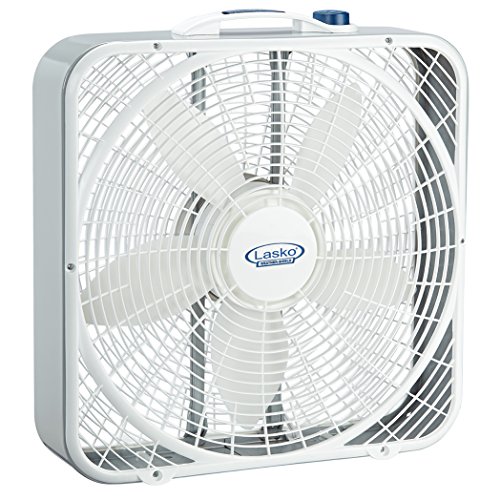
Best for a window, a screened porch or a basement
- Weather-resistant motor rated for damp locations
- Wind Ring system for up to 30% more air movement
- Three speeds, carry handle
- Designed to sit in a window opening
Why buy it: the only fan here you can leave in an open window during a rain shower without worrying about the motor.

Best for a garage, greenhouse, gym or drying a wet room
- Roughly 5,300 CFM on high — several times a plastic box fan
- All-metal blade and steel housing
- Three speeds, tilting pivot mount
- Built for continuous commercial duty
Why buy it: a metal-bladed high-velocity fan moves air on a completely different scale, and it is the right tool for a space a box fan cannot cope with.

Best for a sturdier box fan for a shop or grow space
- Around 2,400 CFM across three quiet speeds
- 20 in. box format with a reinforced frame
- Designed for continuous operation
- Carry handle and a stable base
Why buy it: it holds up to the sort of round-the-clock duty that kills a $25 household fan in a season.

Best for moving air around a whole room rather than blowing it in one direction
- Vortex airflow claimed to move air up to 100 ft
- Four speeds with push-button controls
- Chrome glide bar allows a full 90° tilt
- Five-year warranty
Why buy it: a circulator stirs the whole room instead of aiming a column at one chair, which is why it feels cooler at the same power draw.

Quick Comparison
| Product | Best for | Rating | Price | Buy |
|---|---|---|---|---|
| Lasko 20 in. 3-Speed Energy Efficient Box Fan, 3723 | Best Overall | — | Check (paid link) | |
| Lasko 3733 Box Fan, 3-Speed, 20 in. | Best Budget | — | Check (paid link) | |
| Lasko Weather-Shield Performance Box Fan, 20 in., 3720 | Best for Windows and Damp Rooms | — | Check (paid link) | |
| Hurricane Pro Heavy-Duty High Velocity Metal Blade Floor Fan, 20 in. | Best Airflow | — | Check (paid link) | |
| Hurricane Classic Floor Mount Box Fan, 20 in. | Best Metal Alternative | — | Check (paid link) | |
| Vornado 660 Large Air Circulator Fan, 4-Speed | Best Circulator Alternative | — | Check (paid link) |
How We Rank
We do not buy or physically handle these fans. Rankings come from aggregating star ratings and review volume across tens of thousands of verified owner reviews, weighting recent reviews above launch-window ones, checking published CFM, wattage, dimensions and safety listings against manufacturer documentation, and reading negative reviews for the failures that appear in the second and third summer.
Four things set the order. Airflow per dollar and per watt, which is the entire purpose of the product. Noise at a usable speed, judged from owner reports rather than from a spec sheet, because manufacturers rarely publish honest decibel figures. Durability, weighted heavily toward reports past the first season. And safety features — a fused plug, a stable base and a grille spacing that keeps fingers out. Prices were checked at time of writing. Full method: how we rank.
The Box Fans, Reviewed
1. Lasko 3723 — Best Overall
Covered above. Consensus Score ████████░░ 8.6. Strengths: the Wind Ring genuinely improves output, three simple speeds, a fused plug, a slim window-friendly body, and a price low enough to buy several. Recurring complaints: loud on high, which is unavoidable at this airflow. Owners report the plastic housing rattling if the fan sits on an uneven surface. The blade and grille collect dust rapidly and the grille is not designed to be removed for cleaning, which frustrates people. And a minority report motor failure in year two or three — these are inexpensive fans and the motors are not serviceable.
2. Lasko 3733 — Best Budget
The plain-frame version, and the fan you have probably owned at some point. Three speeds, roughly 55 watts on high, a carry handle, a fused plug. Without the Wind Ring it moves somewhat less air than the 3723, but the gap is smaller than the price difference suggests and for a spare room it is entirely adequate.
Consensus Score ████████░░ 8.3 — enormous review base, consistently good ratings, and the category's price floor
Recurring complaints: the same noise and dust issues as the 3723, plus more reports of the speed switch becoming unreliable — sticking between detents or requiring a firm push. Several owners note that the housing flexes enough that the blade can contact the grille if the fan is squeezed into a tight window frame.
3. Lasko Weather-Shield 3720 — Best for Windows and Damp Rooms
The same Wind Ring airflow with a motor rated for damp locations, which is a genuinely useful distinction. An ordinary box fan sitting in an open window during a summer storm is a fan with a wet motor; this one is built for it. It also suits screened porches, basements and any room where humidity is a fact of life.
Consensus Score ████████░░ 8.2 — strong ratings, with price relative to the standard model the main reservation
Recurring complaints: it costs noticeably more than the 3723 for a difference most buyers will never test. Some owners expect it to be fully outdoor-rated and it is not — damp location is not the same as wet location, and it should not sit in driving rain. Same noise profile on high, and the housing is heavier, which matters if you move it daily.
4. Hurricane Pro High Velocity 20 in. — Best Airflow
A different class of machine. Metal blade, steel housing, a pivoting mount so you can aim it, and roughly 5,300 CFM on high — several times what a plastic box fan produces. This is what commercial spaces, greenhouses and remediation crews use, and if your problem is a hot garage, a stuffy gym or a floor that needs drying in a hurry, it is the correct answer.
Consensus Score ████████░░ 8.4 — excellent ratings, with noise and weight the dominant complaints
Recurring complaints: it is very loud. Owners describe it as unusable in a bedroom at any speed, which is fair — it is not a household fan. It is heavy, the metal blades and open guard demand more respect around children and pets, and several reviewers report the tilt-lock loosening over time so the fan gradually droops toward the floor.
5. Hurricane Classic Floor Mount Box Fan — Best Metal Alternative
The middle ground: a box-fan format built for continuous duty, at around 2,400 CFM, with a reinforced frame and quieter speeds than the high-velocity model. Popular in grow spaces and workshops where a fan runs 24 hours a day and a $25 household model would not survive the season.
Consensus Score ███████░░░ 7.9 — good ratings on a smaller review base than the Lasko fans
Recurring complaints: at roughly the price of two Lasko fans, several owners question the value for household use — the extra durability only pays off under heavy duty cycles. It is heavier and bulkier, and a few reviewers report a hum on the lowest speed that the Lasko models do not have.
6. Vornado 660 — Best Circulator Alternative
Not a box fan, and deliberately included because it solves a different version of the same problem. A circulator throws a focused vortex across the room rather than a wide diffuse column, which sets the whole room's air in motion instead of just blowing at whatever is directly in front of it. In a closed room that produces a more even temperature and a cooler feel at the same power draw. Four speeds, a 90-degree tilt, and a five-year warranty that no box fan comes close to.
Consensus Score ████████░░ 8.3 — strong ratings, with price the recurring objection
Recurring complaints: it costs three to four times a box fan. It does not fit a window, so it cannot do the exhaust job. Owners report the lowest speed being louder than expected for a premium fan, and the grille requires disassembly with a tool to clean — which several reviewers find irritating given how much dust a fan collects.

How to Choose a Box Fan
Decide what job it is doing, because the three main jobs point at different fans. Sleeping and general room comfort: a standard 20-inch Lasko is all you need, and the low speed is the one you will use. Window exhaust: measure your window opening first — most double-hung windows take a 20-inch fan but some older sashes do not — and buy the weather-resistant version if the window will be open in rain. Garage, shop or drying: buy metal and high velocity, and accept the noise.
Check for a fused safety plug. It is a small feature that interrupts power if the cord is damaged, and every major brand now fits one. A fan without one is not worth the few dollars it saves.
Think about cleaning before you buy. Box fan grilles are usually riveted or screwed, and the blade behind them collects a startling amount of dust in a single summer. A dusty blade is out of balance, noisier and harder on the motor. If you are not going to take it apart, at least plan to vacuum the intake side monthly through the season.
And put the fan in the right place. Blowing outward from an upstairs window in the evening exhausts the day's accumulated heat and pulls cooler air in from downstairs, which is far more effective than aiming a fan at yourself in a closed room. A fan cools people, not rooms — ENERGY STAR says the same thing about ceiling fans, and the advice is identical here: if nobody is in the room, switch it off.
What Owners Actually Complain About
Four themes dominate the negative reviews, and none of them are surprising in a thirty-dollar appliance.
Noise on high is the most frequent, and it is inherent. A flat blade forcing air through a square grille is a noisy arrangement, and no plastic box fan is quiet at full speed. Owners who need silence should be shopping bladeless or DC-motor tower fans instead and accepting far less airflow.
Dust is the second, and it is the one owners underestimate. Box fans act as crude air filters, and by August the blade of a fan run nightly is visibly furred. Most models are not designed to be opened, so cleaning means a vacuum crevice tool through the grille and a certain amount of resignation.
Motor failure in year two or three is the third, and it is the honest cost of the price. These are sleeve-bearing motors in an inexpensive housing running for months at a time. Owners who run a fan continuously through summer report shorter lives than owners who use it occasionally, exactly as you would expect.
And rattles are the fourth. A box fan on an uneven floor, wedged into a window frame, or with a slightly unbalanced blade will buzz, and the housings are light enough to amplify it. A folded towel under one corner solves most of these, which is a low-tech answer but a genuinely effective one.
The Verdict
Buy the Lasko 3723. It is the best box fan for the overwhelming majority of rooms and jobs, the Wind Ring is a real improvement rather than a marketing sticker, and it is cheap enough that buying two is not a decision. Need to spend less? The Lasko 3733. Fan living in an open window? The weather-resistant 3720. Garage, gym or a wet floor to dry? The Hurricane Pro, and wear the noise. Running a fan around the clock? The Hurricane Classic will outlive three household models. And if you want the whole room stirred rather than a column of air aimed at one chair, the Vornado 660 is a genuinely different and better experience.
Check price on Amazon → (paid link)
Next: compare formats in tower fan vs box fan, see the quiet options in best tower fan, work out whether a fan is enough in do ceiling fans actually cool a room, or step up to the best portable air conditioners.