 Garden
Affiliate Disclosure
Some links on this page are affiliate links. As an Amazon Associate, we earn from qualifying purchases — at no extra cost to you. We do not buy, test, or physically handle the products we cover; our rankings come from aggregated owner reviews, ratings and expert consensus. Commissions never change our verdicts. How we rank · full disclosure.
The short answer: the best dual hose portable air conditioner is the Whynter ARC-14S. It has the highest standardized cooling figure in the category at 9,500 SACC, it is the longest-established true dual-hose design on the American market, and the owner-review record consistently shows people moving from single-hose units and being surprised at the difference. For a bedroom, the quieter ARC-122DS; for the lowest running cost, the inverter-driven Midea Duo.
Here is the honest state of the category: the dual-hose field is small. Whynter has specialized in it for years and effectively owns it, with the Midea Duo as the main outside challenger. That is not us being lazy — it is that a second duct adds manufacturing cost which does not show up in the headline BTU number most shoppers compare, so almost every other brand builds single-hose units instead. If you understand why dual hose matters, your realistic choice is between a handful of models. For the wider field see best portable air conditioner or the heating and cooling hub.
Top Picks at a Glance

Our #1 Pick: Whynter ARC-14S
To understand why this unit is worth its price, you have to understand what is wrong with the cheap alternative. A single-hose portable air conditioner needs a stream of air to carry heat away from its condenser coil. It takes that air from your room, and then blows it out the window. Your room is now missing that volume of air, so it sits at slightly negative pressure relative to outdoors, and an identical volume of hot, humid outside air gets pulled in through every crack in the envelope. You cool air, throw it away, and suck in hot replacements. On a mild day you will not notice. On a 95 °F afternoon you absolutely will.
Consensus Score ████████░░ 8.0 — owners upgrading from single-hose units repeatedly describe it as the first portable that actually cooled the room
The ARC-14S takes its condenser air from outside through a second duct and returns it outside. The room stays at neutral pressure. That single design decision is why its 9,500 SACC figure — the DOE's standardized capacity number, which accounts for duct losses — is the highest in this roundup despite the nominal BTU being no larger than several rivals.
The rest of the unit is unglamorous and well sorted: dehumidifier and fan modes, a 24-hour timer, an activated carbon filter behind a washable pre-filter, a window kit in the box, and a cabinet that has been in production long enough that the failure modes are well understood. Whynter has been selling essentially this machine, with revisions, for well over a decade.
What it is not is quiet. This is a compressor sitting inside your room, and no amount of insulation makes that silent. If sleep is the priority, take the smaller ARC-122DS or the inverter-driven Midea instead.
Check price on Amazon → (paid link)
Best Dual Hose Portables 2026: The Ranked Field

Best for a genuinely hot room up to about 500 sq ft
- 14,000 BTU (9,500 SACC) — the highest SACC in the dual-hose field
- True dual hose: condenser air comes from outdoors
- Dehumidifier and fan modes, 24-hour timer
- Carbon filter, washable pre-filter and window kit included
Why buy it: it is the reference dual-hose unit — the one every other portable in this class is measured against, and it still holds the top SACC figure.

Best for a bedroom or office up to about 400 sq ft
- 12,000 BTU (7,000 SACC), rooms up to about 400 sq ft
- Dual hose with dehumidifier and fan modes
- Quieter than the 14,000 BTU model
- Activated carbon filter, storage bag and window kit
Why buy it: noticeably quieter than the ARC-14S, which is the trade worth making in any room you sleep in.
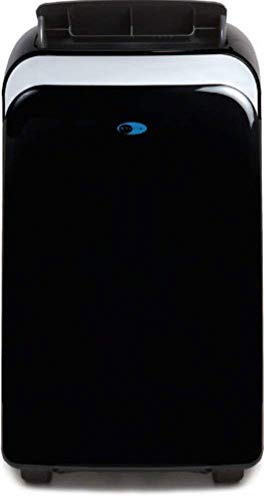
Best for allergy sufferers and dusty environments
- 12,000 BTU dual hose in a compact black cabinet
- 3M and SilverShield antimicrobial filtration
- Dehumidify and fan modes with a 24-hour timer
- Auto-drain condensate system
Why buy it: the only unit here with a serious antimicrobial filter stack rather than a token mesh screen.
Best for a room that needs cooling in summer and warmth in fall
- 12,000 BTU cooling (7,000 SACC) plus a heat mode
- Dual hose, dehumidify and fan modes
- Rooms up to about 400 sq ft
- Carbon filter and window kit included
Why buy it: the same dual-hose cooling with resistance heat added, which turns a three-month appliance into a nine-month one.

Best for the lowest running cost and the quietest operation
- 12,000 BTU (10,000 SACC) — an unusually small BTU-to-SACC gap
- Inverter compressor and a hose-in-hose dual duct
- Claimed up to 42% more efficient than comparable units
- Wi-Fi with Alexa and Google support
Why buy it: the inverter compressor and hose-in-hose duct give it the best SACC-per-watt figure of any portable here, by a clear margin.

Quick Comparison
| Product | Best for | Rating | Price | Buy |
|---|---|---|---|---|
| Whynter ARC-14S 14,000 BTU Dual Hose Portable Air Conditioner | Best Overall | — | Check (paid link) | |
| Whynter Elite ARC-122DS 12,000 BTU Dual Hose Portable Air Conditioner | Best for Small Rooms | — | Check (paid link) | |
| Whynter ARC-126MDB 12,000 BTU Dual-Hose Portable Air Conditioner | Best Filtration | — | Check (paid link) | |
| Whynter Elite ARC-122DHP 12,000 BTU Dual Hose Portable Air Conditioner and Heater | Best Year-Round | — | Check (paid link) | |
| Midea Duo 12,000 BTU High Efficiency Inverter Ultra Quiet Portable Air Conditioner | Best Efficiency | — | Check (paid link) |
How We Rank
We do not buy or physically handle these units. Rankings come from aggregating star ratings and review volume across thousands of verified owner reviews, weighting recent reviews above launch-window ones, checking published BTU, SACC, wattage, hose configuration and certification against manufacturer documentation, and reading negative reviews for the failures that appear in the second and third summer rather than the first week.
Four factors drive the order. SACC rather than nominal BTU, because SACC is the standardized figure and the only one comparable between units. Efficiency, measured as SACC per watt drawn, which is where inverter compressors pull ahead. Noise at a usable setting, judged from owner reports rather than manufacturer decibel claims. And reliability weighted by review volume, with attention to compressor and control-board failures past year one. Prices were checked at time of writing. Full method: how we rank.
The Dual Hose Units, Reviewed
1. Whynter ARC-14S — Best Overall
Covered above. Consensus Score ████████░░ 8.0. Strengths: the highest SACC figure in the dual-hose field, genuine neutral-pressure operation, serious filtration, a 24-hour timer, and a long, well-documented production history. Recurring complaints: noise leads by a distance — owners describe it as too loud for a bedroom, and the compressor cycling is audible in adjacent rooms. It weighs around 80 pounds and the casters are small, so moving it between rooms is a two-person job. The window kit is basic plastic and many owners build a better panel. And several report the exhaust hoses being shorter than they would like, forcing the unit close to the window.
2. Whynter Elite ARC-122DS — Best for Small Rooms
The same dual-hose approach in a 12,000 BTU (7,000 SACC) cabinet sized for roughly 400 square feet. Size it honestly: ENERGY STAR warns that bigger is not always better, because an oversized air conditioner wastes energy and cools no better. The important difference is noise: a smaller compressor in a smaller box is noticeably quieter, and for a bedroom or home office that is worth more than the extra capacity. Carbon filter, storage bag, window kit.
Consensus Score ███████░░░ 7.8 — good ratings with capacity the recurring limitation
Recurring complaints: 7,000 SACC is genuinely modest, and owners who put it in a sun-facing room at the top of its stated range report it running continuously without satisfying the setpoint. Price relative to a same-BTU single-hose unit draws consistent criticism. And several owners report the drain plug being awkward to reach when the unit needs emptying in humid weather.
3. Whynter ARC-126MDB — Best Filtration
Mechanically a close relative of the ARC-122DS in a compact black cabinet, with the distinguishing feature being the filter stack: 3M and SilverShield antimicrobial media rather than the token mesh screen most portables ship with. If you run an air conditioner in a dusty basement, a workshop or a household with allergies, that is a genuine difference.
Consensus Score ███████░░░ 7.7 — solid ratings on a smaller review base
Recurring complaints: replacement filters are an ongoing cost and owners note they are not cheap. Cooling capacity is the same modest 12,000 BTU class, so the same room-size caveats apply. And the black cabinet shows dust far more than the light-colored models, which several reviewers mention with some irritation.
4. Whynter Elite ARC-122DHP — Best Year-Round
The ARC-122DS with a heat mode added, which turns a summer appliance into a shoulder-season one. Useful in a converted garage, a bonus room, a sunroom — any space the central system serves badly in both directions. Dual hose, dehumidify and fan modes, carbon filter, window kit.
Consensus Score ███████░░░ 7.7 — good ratings, with heat expectations the main negative theme
Recurring complaints: the heat is electric resistance, not a heat pump, so it is a 1,500-watt space heater in a large box and it costs the same to run as one. Owners expecting heat-pump economy are disappointed. It also carries a price premium over the cooling-only ARC-122DS that only pays off if you genuinely use the heat. Same drainage and capacity notes as its sibling.
5. Midea Duo — Best Efficiency
The most technically interesting unit here. An inverter compressor modulates its speed rather than cycling on and off, which is quieter and substantially more efficient, and the hose-in-hose duct gives dual-hose behavior in a single external duct. The result is 10,000 SACC — the federal seasonally adjusted rating — from a 12,000 BTU rating — an unusually small gap, and the best efficiency figure of any portable in this roundup. Wi-Fi with Alexa and Google support is standard.
Consensus Score ██████░░░░ 6.8 — excellent on paper, with a materially weaker reliability record than the Whynter units
Recurring complaints: this is where we have to be blunt. The aggregate owner rating on this model is noticeably lower than the Whynters, and the negative reviews cluster around reliability — control board faults, error codes, and units failing within the first or second season. Owners who get a good one are enthusiastic about how quiet and efficient it is; the concern is how many do not. Buy it for the efficiency with a clear-eyed view of the risk, and keep the warranty paperwork.
How to Choose a Dual Hose Portable AC
Size on SACC, and be conservative. Roughly 20 SACC BTU per square foot is the working rule for a standard room with 8-foot ceilings — 7,000 SACC for about 350 square feet, 9,500 for about 475. Add 10 percent for heavy afternoon sun, 10 percent for a kitchen, and around 600 BTU per regular occupant beyond the first two. Resist the urge to oversize; an oversized unit satisfies the thermostat before it has run long enough to pull moisture out, which leaves a room cold and clammy rather than comfortable.
Check the window before anything else. Standard kits are made for double-hung and horizontal sliders. Casement windows, awning windows and windows with security bars need either a custom panel or a different approach entirely, and this catches out a meaningful share of buyers. Measure the opening, and look at whether the sash can hold the panel securely.
Plan for the hoses. Keep them as short and as straight as the layout allows, because a long sagging duct radiates heat straight back into the room you are trying to cool. Insulating the hoses with a foam wrap is a cheap and genuinely effective improvement that owners consistently report helping.
Finally, work out where the condensate goes. In a humid climate, connect a permanent drain hose to a floor drain, a condensate pump, or at minimum a bucket you will actually remember to empty. Every unit here has a drain port; using it removes the single most common day-to-day annoyance in the category.
What Owners Actually Complain About
Four themes dominate, and dual-hose units share three of them with every other portable.
Noise is the loudest complaint, and it is structural. The compressor is in the room with you rather than hanging outside a window, and there is no design that fixes that. Inverter models like the Midea are meaningfully quieter, but no portable is as quiet as a modern window unit or a mini-split head.
Weight and mobility is second. Portable is a generous word for an 70 to 80 pound cabinet on small casters. Owners consistently describe moving one between rooms as a genuine chore, and moving one up or down stairs as a two-person job.
Window kit quality is third, and it is a strange weak point on units costing $500 or more. The supplied panels are thin plastic, often poorly sealed, and a leaky panel undoes some of the benefit of the dual-hose design. A significant number of owners fabricate a plywood or acrylic replacement, which is worth doing.
And humid-weather draining is the fourth. Self-evaporating works well up to a point, and past that point the unit stops and asks to be emptied — usually on the hottest, most humid evening of the year. Connect a drain line at installation and the complaint disappears.
The Verdict
For a genuinely hot room, buy the Whynter ARC-14S — highest real cooling capacity in the dual-hose field, proven design, and the unit most owners describe as the first portable that actually worked for them. For a bedroom where noise matters more than capacity, the ARC-122DS. Allergy or dust concerns? The ARC-126MDB and its antimicrobial filter stack. Need heat as well? The ARC-122DHP, understanding that the heat is a resistance element. And if efficiency and quiet are the priority and you are comfortable with a weaker reliability record, the Midea Duo is technically the most advanced unit here.
Check price on Amazon → (paid link)
Next: read the full explanation in single vs dual hose portable air conditioners, size it with what size portable air conditioner do I need, add heat with the best portable AC and heater combos, or check running costs in do portable air conditioners use a lot of electricity.