 Garden

Affiliate Disclosure
Some links on this page are affiliate links. As an Amazon Associate, we earn from qualifying purchases — at no extra cost to you. We do not buy, test, or physically handle the products we cover; our rankings come from aggregated owner reviews, ratings and expert consensus. Commissions never change our verdicts. How we rank · full disclosure.
Before anything else: an evaporative cooler only works in dry air, and in humid air it makes the room worse rather than better. The cooling comes from water evaporating into the airstream. As the air gets more humid, less water can evaporate, so less cooling happens — and the moisture the unit does add stays in your room. In Phoenix that trade is superb. In Houston, Orlando or anywhere on the Gulf Coast it is a machine that will raise your indoor humidity while barely dropping the temperature, and you should not buy one.
That is not our opinion. The Department of Energy's Building America Solution Center gives the numbers: at 100°F and 10% relative humidity a good cooler delivers supply air at about 73°F — a 27-degree drop. At 95°F and 50% humidity the same equipment only reaches 84°F, an 11-degree drop. Same machine, less than half the benefit, plus added moisture.
Top Picks at a Glance
Should You Buy One? A Two-Question Test
Question one: is your summer air dry? The technical threshold from the DOE source above is wet-bulb temperature: "areas with wet-bulb temperatures of 70°F or lower are appropriate for evaporative cooling," and coolers can function where wet-bulb reaches 74°F "but high humidity will reduce performance." In plain terms that means the interior West and Southwest, the high plains, and the dry interior valleys of the Pacific states — and it rules out the Southeast, the Gulf Coast, Florida, most of the mid-Atlantic and the humid Midwest in July.
Question two: can you leave a window open? An evaporative cooler pushes humid air into the room continuously, and that air has to get out. If it cannot, the room saturates and cooling stops. The DOE requirement is roughly 2 square feet of unrestricted air relief per 1,000 CFM of delivery. If the answer to either question is no, buy a fan or a portable air conditioner instead, and we would rather tell you that than sell you the wrong machine.
| Outdoor condition | Supply air from a good cooler | Effective drop | Verdict |
|---|---|---|---|
| 100°F, 10% RH (Phoenix in June) | ~73°F | ~27°F | Excellent |
| 95°F, 20% RH (Denver, Albuquerque) | ~74–77°F | ~18–21°F | Very good |
| 95°F, 35% RH (Boise, Reno in a wet spell) | ~79–82°F | ~13–16°F | Useful |
| 95°F, 50% RH (Kansas City, Dallas) | ~84°F | ~11°F | Marginal, and adds humidity |
| 90°F, 70%+ RH (Houston, Orlando, Atlanta) | Barely below ambient | A few degrees at most | Do not buy one |
The 100°F and 95°F rows are figures published by DOE's Building America Solution Center; the middle rows are interpolated from the same psychrometric relationship. The pattern is what matters: this is a technology whose usefulness is decided by your zip code, not by the price of the unit.
An Honest Word About This Category's Ratings
Nothing on this page reaches the 4.6 to 4.8 that the leading tower fans, space heaters and portable air conditioners manage. That gap is real, and it has two causes worth separating.
The first is climate mismatch. Read through the negative reviews on any evaporative cooler and a large fraction are from people in Florida, Georgia, Louisiana or the Carolinas reporting a clammy room and no cooling. The machine did what it does; it was the wrong machine for the air. That drags the average down without telling you anything about build quality.
The second cause is genuine: build quality in this category is mediocre. Plastic cabinets crack, float valves stick, pumps fail in the second or third season, and pads develop mineral scale in hard water. The Hessaire units are the exception people keep coming back to, and that is precisely because they are built more like shop equipment than like a room appliance. Buy accordingly.
Our #1 Pick: Hessaire MC37M, 3,100 CFM
Hessaire is the brand with the deepest ownership record in this category, and the MC37M is the size that suits most real uses — a garage, a workshop, a covered patio, an open-plan living area in a dry climate. It has a rigid media pad rather than a thin fabric curtain, which is what allows a meaningful temperature drop rather than a token one, and it takes a garden hose with a float valve so it can run all day without refilling.
Owners are consistent about what it does well: it moves a lot of air, it drops the temperature noticeably in dry heat, the hose feed removes the refilling chore, and the metal cabinet and casters survive shop use. They are equally consistent about the gripes: it is loud on high, the pump is the part most likely to fail, hard water scales the pads and shortens their life, and the unit is heavy and awkward on anything other than a smooth floor.
Two practical points. Size on airflow, not on the square footage claim: an evaporative cooler needs 20 to 40 air changes per hour to work, which for an 8-foot ceiling works out at roughly 0.25 to 0.375 square feet of floor area per CFM. And plan the exhaust path before you buy — 3,100 CFM needs over 6 square feet of open window to get that air back out.
Check price on Amazon → (paid link)
The Ranked Field

Best for a dry-climate garage, workshop, patio or open living area up to roughly 950 sq ft
- 3,100 CFM three-speed blower — enough air for a genuinely large space
- Rigid media pad rather than a thin curtain, which is where cooling depth comes from
- Large reservoir plus a garden hose inlet with a float valve for continuous fill
- Casters and a metal cabinet built for shop use
Why buy it: the only evaporative cooler in the mainstream market with an ownership record long enough to judge, and the pick if you have the dry air and the open airflow it needs.
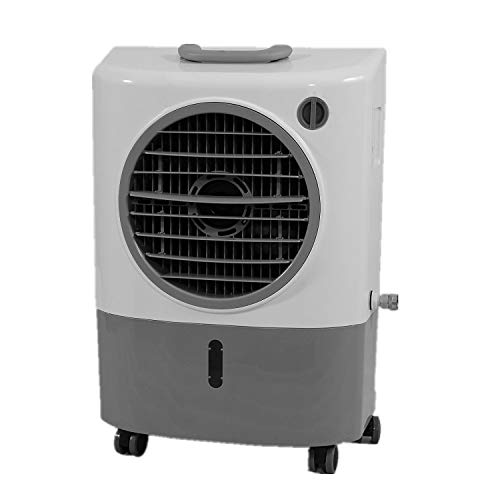
Best for one room or a two-car garage in dry air, roughly 400 to 500 sq ft
- 1,300 CFM two-speed fan, rated by the maker to about 500 sq ft
- Measured at 53.4 dB, which is quiet for the category
- Hose connection with float valve, or fill the tank manually
- Small enough to move through a doorway on its own casters
Why buy it: the sensible size for most buyers — 1,300 CFM is about what a 500 sq ft room needs for the air changes an evaporative cooler depends on, and no more.

Best for running unattended for a long stretch without plumbing in a hose
- 12-gallon reservoir — the largest in this field
- 3,100 CFM with 120-degree oscillation
- Three modes, remote control and a timer
- Ice compartment for a short-term boost to the supply air
Why buy it: a 12-gallon tank is the difference between refilling twice a day and refilling once, which matters more than any feature on the box if you cannot run a hose to it.

Best for a bedroom, home office or workshop corner in dry air
- Compact chassis with a 2-gallon tank — a personal-to-small-room unit
- Four modes including a plain fan mode with the pump off
- Three speeds and an ice compartment
- Light enough to carry between rooms
Why buy it: the honest small-space answer, and the fan-only mode matters more than it sounds — on a humid day you want to run the air without adding water to the room.

Best for throwing air across a wide open-plan space or a covered patio
- 2,800 CFM from a 35-inch cabinet with 120-degree oscillation
- 9.2-gallon reservoir with a water-level window
- Remote control and timer
- Taller outlet puts the air at seated and standing height
Why buy it: outlet height is an underrated variable — a taller cabinet moves cooled air across a room instead of along the floor, which is where a squat unit wastes most of its output.

Best for a large shop, an open garage or an outdoor covered area
- 4,800 CFM — the highest airflow in this field
- 10.6-gallon reservoir and a hose connection
- 41-inch cabinet with oscillation and remote
- Aimed at outdoor and semi-outdoor use
Why buy it: evaporative cooling is an airflow game before it is a water game, and 4,800 CFM is enough to make a difference in a space where a 1,300 CFM unit would simply disappear.
Quick Comparison
| Product | Best for | Rating | Price | Buy |
|---|---|---|---|---|
| Hessaire MC37M Portable Evaporative Cooler, 3,100 CFM | Best Overall | — | Check (paid link) | |
| Hessaire MC18M Portable Evaporative Cooler, 1,300 CFM | Best for a Single Room | — | Check (paid link) | |
| VAGKRI Evaporative Air Cooler, 3,100 CFM, 12-Gallon Tank | Biggest Reservoir | — | Check (paid link) | |
| 4-in-1 Evaporative Air Cooler, 3 Speeds, 2-Gallon Tank | Best for a Small Room | — | Check (paid link) | |
| VAGKRI 2,800 CFM Evaporative Air Cooler, 35 in, 9.2-Gallon Tank | Best Tall Cabinet | — | Check (paid link) | |
| Uthfy 41 in Evaporative Air Cooler, 4,800 CFM, 10.6-Gallon Tank | Most Airflow | — | Check (paid link) |
Sizing by Airflow, Not by Marketing Square Footage
Manufacturers quote coverage figures that assume ideal conditions. The honest way to size an evaporative cooler is by air changes per hour, because a cooler that cannot turn the room's air over often enough will simply humidify it. Most manufacturers target 20 to 40 ACH.
| Unit airflow | Floor area at 20 ACH | Floor area at 30 ACH | Open window needed |
|---|---|---|---|
| 1,300 CFM | ~490 sq ft | ~325 sq ft | ~2.6 sq ft |
| 1,800 CFM | ~675 sq ft | ~450 sq ft | ~3.6 sq ft |
| 2,800 CFM | ~1,050 sq ft | ~700 sq ft | ~5.6 sq ft |
| 3,100 CFM | ~1,160 sq ft | ~775 sq ft | ~6.2 sq ft |
| 4,800 CFM | ~1,800 sq ft | ~1,200 sq ft | ~9.6 sq ft |
Assumes 8-foot ceilings, and the relief area follows the DOE figure of 2 square feet per 1,000 CFM. Use the 30 ACH column if the space gets direct sun or has a lot of glass, and the 20 ACH column for a shaded, well-insulated room. If the open-window figure in the last column looks impractical for your space, that is a reason to reconsider the technology rather than to buy the unit anyway.
Water Hygiene, Which Is Not Optional
An evaporative cooler is a warm plastic tray full of standing water with air blown across it. That is a microbial growth environment, and the DOE source above states it directly: "standing water left in the pan can become a breeding ground for mosquitos and bacteria, including Legionella (the cause of Legionnaires' Disease)."
The routine that prevents it is not onerous:
- Never leave it standing full. If the unit will not run for more than a day or two, drain the pan and leave it dry with the lid off.
- Empty and rinse weekly in heavy use. Fresh water, a wipe of the pan, and check the pads for slime.
- Full clean twice a year minimum. DOE guidance is maintenance "at least twice a year, when the unit is first started up in the spring and when it is shut down in the winter." Pull the pads, scrub the pan, descale the pump and distribution tubes.
- Deal with mineral scale. In hard water, dissolved minerals concentrate as water evaporates and cake onto the pads. Larger installations use an auto-flush or dump pump that empties the pan every 8 to 12 hours of operation; on a portable unit you do this by hand.
- Replace pads on schedule. A scaled, stiff pad both cools less and holds more growth. Most portable units want new pads every season or two.
- Do not add bleach or scented additives to a unit that blows into occupied space unless the manufacturer specifies it — you are aerosolizing whatever is in the pan.
One more practical point: an unattended reservoir outdoors is a mosquito breeding site within about a week. If the cooler lives on a patio, the drain-down habit matters for that reason too.
How We Rank
We do not buy, run or physically handle these machines. Rankings come from aggregated owner ratings across the most-owned portable evaporative coolers in the US market, read with attention to which negative reviews reflect a climate mismatch rather than a product fault, and cross-checked against published airflow, reservoir and pad specifications. Four things carry the weight: real airflow, since evaporative cooling is an air-changes problem first; pad type and depth, because a rigid media pad cools far more than a thin curtain; reservoir size and whether it takes a hose, which decides whether you actually use the thing; and serviceability of the pump and pads, as the pump is the component that fails. Prices were checked at the time of writing. Full method: how we rank.
The Field, Reviewed
1. Hessaire MC37M, 3,100 CFM — Best Overall
Covered above. Owners praise: serious airflow, a real temperature drop in dry heat, the hose feed and float valve, and a cabinet that survives a workshop. Owners gripe about: noise on high, pump failures in year two or three, mineral scale on the pads in hard water, and weight. Check price (paid link).
2. Hessaire MC18M, 1,300 CFM — Best for a Single Room
The right size for most buyers and the quietest unit here at a measured 53.4 dB. Its 1,300 CFM lines up almost exactly with what a 400 to 500 square foot room needs for adequate air changes, which is why the maker's coverage claim is one of the more honest in the category.
Owners praise: noticeably quieter than larger units, easy to move through doorways, effective in a garage, and the hose option. Owners gripe about: a small reservoir if you fill by hand, pads that need replacing after a hard season, and a plastic housing that feels lighter-duty than the MC37M. Check price (paid link).
3. VAGKRI 3,100 CFM, 12-Gallon Tank — Biggest Reservoir
Same airflow class as the MC37M with the largest tank in the field, plus oscillation, a remote and a timer. The pick if running a hose to the unit is impractical.
Owners praise: long run time between fills, oscillation covering a wide area, and useful remote and timer functions. Owners gripe about: plastic construction that flexes, a float valve that can stick, and an ice compartment whose effect is brief and modest. Check price (paid link).
4. 4-in-1 Evaporative Air Cooler, 2-Gallon Tank — Best for a Small Room
A genuinely small unit for a bedroom, office or shop corner, and the highest-rated of the compact options. The feature that earns its place is the plain fan mode: on a humid day you want air movement without adding water to the room, and a cooler that cannot turn its pump off is useless then.
Owners praise: the size, the fan-only mode, the price, and that it is light enough to carry. Owners gripe about: a 2-gallon tank that needs frequent refilling, limited reach in anything larger than a bedroom, and a modest temperature drop compared with the big units. Check price (paid link).
5. VAGKRI 2,800 CFM, 35 in Cabinet — Best Tall Cabinet
The taller cabinet is the reason to consider this over a squat unit of similar airflow: the outlet sits at seated and standing height, so the cooled air crosses the room rather than pooling along the floor.
Owners praise: good reach across an open room, a big reservoir with a level window, and remote and timer control. Owners gripe about: a tall narrow body that can be knocked over, plastic build, and pump noise that carries at night. Check price (paid link).
6. Uthfy 41 in, 4,800 CFM — Most Airflow
The highest airflow here, aimed at large shops and covered outdoor areas where anything smaller vanishes. Remember that 4,800 CFM also needs nearly 10 square feet of relief opening, which is why this is an open-space unit rather than a house unit.
Owners praise: the sheer volume of air, a big tank with hose connection, and effectiveness in an open garage. Owners gripe about: noise at full speed, a newer model with a shorter ownership record than the Hessaires, and physical size. Check price (paid link).
What Owners Actually Complain About
"It made the room humid and did not cool it." The dominant one-star review, and in most cases the buyer lives in a humid state or ran the unit in a closed room. Both are the technology working as designed in the wrong conditions.
Pump failure. The component that dies first across every brand. It is usually a cheap part and often replaceable, which is worth checking before you buy.
Mineral scale. In hard water the pads stiffen and whiten within a season. Draining the pan regularly slows it considerably; larger systems automate this with a dump pump every 8 to 12 hours of running.
Smell. A musty or sour smell from the pan is neglected standing water, and it is a signal to drain, scrub and replace the pads — not to add a fragrance.
Noise. A cooler that moves 3,000 CFM through a plastic cabinet is not quiet. If noise matters, size up on cabinet quality or accept running on a lower speed.
The Verdict
If you live in dry air and can leave a window open, the Hessaire MC37M is the machine to buy: real airflow, a rigid media pad, a hose feed, and the only ownership record in this category worth calling a record. For one room, the MC18M is correctly sized and quieter. For a big shop, the Uthfy 4,800 CFM has the air to fill it.
And if you live anywhere humid, the honest recommendation is to buy none of these. An evaporative cooler in Gulf Coast or Southeast summer air adds moisture to a room it cannot cool, and a portable air conditioner or a good fan is the right purchase. Check price on Amazon → (paid link)
More from this hub: heating & cooling · do evaporative coolers work in humidity · evaporative cooler vs air conditioner · how much water does a swamp cooler use · how we rank.