 Garden


Affiliate Disclosure
Some links on this page are affiliate links. As an Amazon Associate, we earn from qualifying purchases — at no extra cost to you. We do not buy, test, or physically handle the products we cover; our rankings come from aggregated owner reviews, ratings and expert consensus. Commissions never change our verdicts. How we rank · full disclosure.
A swamp cooler only cools dry air, and it adds humidity to whatever room it is in. Those two facts together decide whether one belongs in your house. In Phoenix, Albuquerque, Denver, Reno or Boise the trade is excellent: you get a 20-plus degree drop in supply air for the running cost of a fan and a small pump. In Houston, New Orleans, Tampa or Charleston it is a machine that makes an already-muggy room muggier while barely touching the temperature, and no amount of extra capacity fixes that.
Also worth clearing up: the name is about smell, not climate. Early units used aspen-fiber pads that stayed damp and went musty, and the nickname stuck across the western states where these became standard equipment. It has misled a lot of buyers into thinking a swamp cooler is for swampy weather. It is precisely the opposite.
Top Picks at a Glance

Does Your Climate Suit One? The Wet-Bulb Test
The proper technical measure is wet-bulb temperature, which is the lowest temperature air can reach by evaporating water into it. The Department of Energy's Building America Solution Center puts it plainly: "areas with wet-bulb temperatures of 70°F or lower are appropriate for evaporative cooling," and units can function where wet-bulb runs "as high as 74°F but high humidity will reduce performance." At 100% humidity, wet-bulb equals dry-bulb and "evaporative cooling cannot occur" at all.
| Region | Typical summer conditions | Swamp cooler verdict |
|---|---|---|
| Desert Southwest — AZ, NV, southern CA, west TX | Very hot, very dry | Ideal — this is the technology's home turf |
| Interior Mountain West — NM, UT, CO, ID, WY | Hot, dry, cool nights | Excellent |
| Inland Pacific Northwest — eastern WA and OR | Hot dry afternoons | Very good |
| High Plains — western KS, NE, the Dakotas | Hot with variable humidity | Works, with weaker spells in humid weather |
| Central and lower Midwest, north TX, OK | Hot and often humid | Marginal — good on dry days, poor on muggy ones |
| Southeast, Gulf Coast, Florida, mid-Atlantic | Hot and humid | Do not buy one — it will add moisture and not cool |
If you are in the bottom two rows, we would rather lose the sale than sell you the wrong machine. A portable air conditioner removes moisture instead of adding it, and a good tower fan costs a fraction of either.
Our #1 Pick: Hessaire MC37M
Hessaire has been building these for the dry-state market long enough that the ownership record is worth something, and the MC37M is the size that fits most real uses: a garage, a workshop, a covered patio, an open living area. Two construction details separate it from the cheaper field. It uses a rigid media pad rather than a thin fabric curtain, which is what produces a meaningful temperature drop rather than a token one. And it takes a garden hose with a float valve, so it runs all day without anyone carrying buckets.
The praise in the ownership record is consistent: a lot of air, a real drop in dry heat, the hose feed removing the refill chore, and a steel cabinet on casters that copes with a shop floor. So are the complaints: it is loud on high, the water pump is the part that fails first and usually in the second or third season, hard water scales the pads within a season, and it is heavy to maneuver on anything other than smooth concrete.
Before you buy, work out the exhaust path. At 3,100 CFM this unit needs more than 6 square feet of open window to get its air back out — about a 2.5-foot square. If you cannot provide that, the machine will humidify the room instead of cooling it, and that is a design requirement rather than a defect.
Check price on Amazon → (paid link)
The Ranked Field

Best for a dry-climate garage, shop, patio or open living space
- 3,100 CFM three-speed blower with a rigid media pad
- Garden hose inlet and float valve for continuous fill
- Steel cabinet on casters, built for shop conditions
- Drainable pan for the end-of-day dry-down
Why buy it: the swamp cooler with by far the deepest ownership record in the US market, and the only one where the failure modes are genuinely well documented.

Best for running a full day where you cannot plumb in a hose
- 12-gallon reservoir, the largest here
- 3,100 CFM with 120-degree oscillation
- Remote, timer and three modes
- Ice compartment for a short-term boost
Why buy it: twelve gallons is the difference between two fills a day and one, and on a patio with no spigot nearby that beats any feature on the spec sheet.
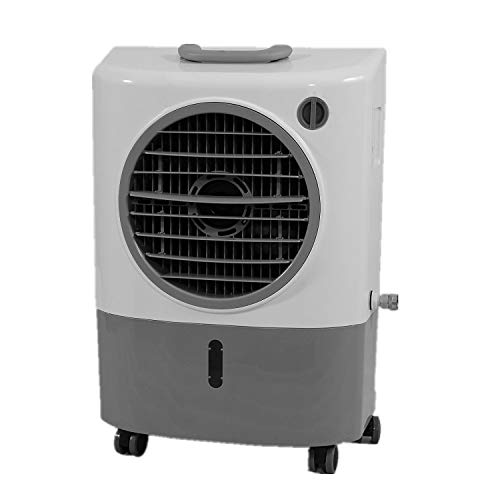
Best for a single room or a two-car garage, roughly 400 to 500 sq ft
- 1,300 CFM two-speed fan, rated to about 500 sq ft
- 53.4 dB measured — the quietest unit in this field
- Hose connection with float valve
- Fits through a standard doorway on its casters
Why buy it: correctly sized rather than optimistically sized: 1,300 CFM is close to what a 500 sq ft room actually needs for the air turnover this technology depends on.

Best for a large shop, an open garage bay or a covered outdoor area
- 4,800 CFM, the highest airflow here
- 10.6-gallon reservoir plus hose connection
- Oscillating 41-inch cabinet with remote
- Designed for outdoor and semi-outdoor use
Why buy it: in a big open space, airflow is the whole game — a 1,300 CFM unit simply disappears in a three-bay shop while this one does not.

Best for throwing cooled air across a wide open-plan room
- 2,800 CFM from a 35-inch cabinet
- 9.2-gallon tank with a water level window
- 120-degree oscillation, remote and timer
- Outlet height puts air at standing and seated level
Why buy it: outlet height decides how far the cool air travels — a low outlet dumps it along the floor where nobody is sitting.
Best for a bedroom or living room in a dry climate where floor space is tight
- Tall slim tower format rather than a boxy cabinet
- 80-degree oscillation and a fan-only mode
- Ice compartment and remote control
- Smaller footprint than any box-style cooler here
Why buy it: the format most people actually want indoors — it looks and stands like a tower fan, which is what makes it acceptable in a living room.

Quick Comparison
| Product | Best for | Rating | Price | Buy |
|---|---|---|---|---|
| Hessaire MC37M Portable Swamp Cooler, 3,100 CFM | Best Overall | — | Check (paid link) | |
| VAGKRI Swamp Cooler, 3,100 CFM, 12-Gallon Tank | Biggest Reservoir | — | Check (paid link) | |
| Hessaire MC18M Swamp Cooler, 1,300 CFM | Best for One Room | — | Check (paid link) | |
| Uthfy 41 in Swamp Cooler, 4,800 CFM, 10.6-Gallon Tank | Most Airflow | — | Check (paid link) | |
| VAGKRI 2,800 CFM Swamp Cooler, 35 in, 9.2-Gallon Tank | Best Tall Cabinet | — | Check (paid link) | |
| DREO 43 in Evaporative Swamp Cooler, Oscillating Floor Unit | Best Slim Profile | — | Check (paid link) |
The Airflow Math Manufacturers Skip
Coverage claims on these boxes are optimistic. The honest way to size a swamp cooler is by air changes per hour, because the machine only cools if it can keep replacing the room's air — otherwise it is just adding humidity to air it has already saturated. Most manufacturers design around 20 to 40 ACH.
| Airflow | Area at 20 ACH | Area at 30 ACH | Relief opening required |
|---|---|---|---|
| 1,300 CFM | ~490 sq ft | ~325 sq ft | ~2.6 sq ft |
| 2,800 CFM | ~1,050 sq ft | ~700 sq ft | ~5.6 sq ft |
| 3,100 CFM | ~1,160 sq ft | ~775 sq ft | ~6.2 sq ft |
| 4,800 CFM | ~1,800 sq ft | ~1,200 sq ft | ~9.6 sq ft |
Assumes 8-foot ceilings. The relief figures follow the DOE guidance of about 2 square feet of unrestricted air relief for every 1,000 CFM delivered. Use the 30 ACH column for a sunny room with a lot of glass, and the 20 ACH column for something shaded and well insulated.
Portable Unit or Whole-House System?
Everything on this page is a portable unit, and it is worth knowing what you are giving up. In the dry states a permanently installed whole-house evaporative cooler — mounted on the roof or a side wall, ducted into the house, plumbed and drained — is a serious cooling system. It handles the whole building, it uses an auto-flush to control mineral buildup, and it is what many older homes in New Mexico and Arizona were built around.
| Portable unit | Whole-house system | |
|---|---|---|
| Coverage | One room to one open area | The whole house |
| Water supply | Fill by hand or garden hose | Plumbed, with float valve and drain |
| Scale control | Manual draining | Auto-flush or dump pump, typically every 8 to 12 hours of running |
| Cost | $150–$400 | $1,500–$4,000+ installed |
| Exhaust | Open a window in that room | Designed relief through vents or a partly open window |
| Winter | Drain and store | Must be winterized and covered |
If you own in a dry climate and cooling the whole house matters, get quotes on a fixed system as well. A portable unit is the right answer for a garage, a shop, a patio, a rental, or one room you actually use.
The Drain-Down Routine, and Why It Matters
A swamp cooler is a warm plastic tray of standing water with a fan blowing across it. That is a microbial growth environment, and the DOE source above says so directly: "standing water left in the pan can become a breeding ground for mosquitos and bacteria, including Legionella (the cause of Legionnaires' Disease)." Neglecting it is also where the swampy smell that gave the category its nickname comes from.
- Drain the pan when the unit goes idle. Anything more than a day or two unused should be emptied and left dry with the lid off. This is the single most important habit.
- Empty and rinse weekly in heavy use. Fresh water, wipe the pan, check the pads for slime or a sour smell.
- Full clean twice a year minimum — DOE guidance is maintenance "at least twice a year, when the unit is first started up in the spring and when it is shut down in the winter." Remove the pads, scrub the pan, and descale the pump and distribution tubes.
- Manage hard water. Evaporation concentrates dissolved minerals, which cake onto the pads and cut cooling. Fixed systems automate a dump every 8 to 12 hours of running; on a portable unit, draining it daily does the same job.
- Replace pads on schedule. A stiff scaled pad cools less and holds more growth. Budget for new pads every one to two seasons.
- Outdoor units breed mosquitos. A patio cooler left standing full for a week is a mosquito nursery. Drain it.
How We Rank
We do not buy, run or physically handle these machines. Rankings come from aggregated owner ratings across the most-owned portable swamp coolers in the US market, read with attention to which negative reviews are climate mismatches rather than product faults, and cross-checked against published airflow, pad and reservoir specifications. Four things carry the weight: real airflow, because air changes come first in this technology; pad type and depth, since rigid media outperforms a thin curtain by a wide margin; water handling — reservoir size, hose inlet, and how easily the pan drains; and whether the pump and pads are replaceable, as the pump is the part that dies. Prices were checked at the time of writing. Full method: how we rank.
The Field, Reviewed
1. Hessaire MC37M — Best Overall
Covered above. Owners praise: genuine airflow, a real temperature drop in dry heat, the hose feed and float valve, and a cabinet that takes shop abuse. Owners gripe about: noise on high, pump failure in year two or three, mineral scale on the pads, and weight. Check price (paid link).
2. VAGKRI 3,100 CFM, 12-Gallon — Biggest Reservoir
Same airflow class as the Hessaire with three times the tank, plus oscillation, remote and timer. The right pick where a hose cannot reach.
Owners praise: long unattended run time, wide oscillation coverage, and useful remote functions. Owners gripe about: flexing plastic panels, float valves that stick, and an ice compartment whose effect is brief. Check price (paid link).
3. Hessaire MC18M — Best for One Room
The quietest unit here at a measured 53.4 dB, and honestly sized: 1,300 CFM is roughly what a 500 square foot room needs for adequate turnover, which is unusual candor in this category.
Owners praise: low noise for a swamp cooler, easy to move between rooms, effective in a garage, and the hose option. Owners gripe about: a small tank for hand filling, pads needing replacement after hard use, and lighter-duty housing than the MC37M. Check price (paid link).
4. Uthfy 41 in, 4,800 CFM — Most Airflow
The biggest air mover here and the answer for a large shop or open garage bay. Bear in mind that this airflow needs close to 10 square feet of relief opening, which is why it is an open-space machine.
Owners praise: volume of air, large tank and hose connection, and real effect in a big space. Owners gripe about: noise at full speed, a shorter ownership record than the Hessaire units, and physical bulk. Check price (paid link).
5. VAGKRI 2,800 CFM, 35 in — Best Tall Cabinet
A taller outlet sends the cooled air across a room at seated and standing height rather than pooling it along the floor, which is a bigger deal than the modest airflow difference suggests.
Owners praise: reach across an open room, a large tank with a level window, and remote and timer control. Owners gripe about: a tall narrow body that can be knocked over, plastic build quality, and pump noise at night. Check price (paid link).
6. DREO 43 in Evaporative Swamp Cooler — Best Slim Profile
A tower-shaped unit rather than a box, which is what makes it tolerable in a living room. Smaller reservoir and less airflow than the cabinet units, and a fan-only mode so you can run air without adding water on a humid day.
Owners praise: the footprint, tower-fan looks, oscillation, and quiet operation on low. Owners gripe about: a modest temperature drop compared with the big cabinets, frequent refilling, and a newer design with a limited ownership record. Check price (paid link).
What Owners Actually Complain About
"It just made the room humid." The most common one-star review, and nearly always either a humid climate or a closed room. Both are the technology working correctly in conditions it cannot work in.
Pump failure. The universal weak point. Often a cheap replaceable part — check availability before buying.
Scale on the pads. Hard water stiffens and whitens pads within a season. Daily draining slows it a lot.
Musty smell. Neglected standing water, every time. The answer is draining and new pads, not air freshener.
Noise. Moving 3,000 CFM through a plastic cabinet is not a quiet activity. The MC18M and the slim DREO are the two most livable here at night.
The Verdict
In dry air, with a window you can leave open, the Hessaire MC37M is the swamp cooler to buy — rigid pad, real airflow, hose feed, and the only long ownership record in the category. Size down to the MC18M for one room, up to the Uthfy 4,800 CFM for a shop, or take the DREO tower if it has to live in a living room. Then drain the pan every time you stop using it, and budget for pads.
And if you are in the Southeast, on the Gulf Coast, or anywhere else where summer air is heavy, buy none of them. That is the honest recommendation, and it is the same one we would give a neighbor. Check price on Amazon → (paid link)
More from this hub: heating & cooling · best evaporative coolers · how much water does a swamp cooler use · do evaporative coolers work in humidity · how we rank.