 Garden
Affiliate Disclosure
Some links on this page are affiliate links. As an Amazon Associate, we earn from qualifying purchases — at no extra cost to you. We do not buy, test, or physically handle the products we cover; our rankings come from aggregated owner reviews, ratings and expert consensus. Commissions never change our verdicts. How we rank · full disclosure.
The short answer: for most home orchids, buy the 3-Size Slotted Set — slotted sides give roots the airflow they must have, drainage holes stop them sitting wet, and three sizes mean you always have the right pot for repotting day. Prefer to see the roots? The 8-pack of clear slotted pots is the grower's choice; want a finished look? Reach for the ceramic set.
An orchid pot has one job most planters do not: it has to let the roots breathe. Popular orchids are epiphytes that grow with their roots in open air, so a solid pot that traps moisture is the surest way to rot them. Every good orchid pot answers that with slots, holes or a breathable body — and after airflow, the choices come down to whether you want to see the roots, display the plant, or size up. This page ranks the pots that get it right.
Orchid Pots at a Glance
Our #1 Pick: The 3-Size Slotted Set
The three-size slotted set wins here because it gets the fundamentals right and removes the friction of repotting day. The slotted sides deliver the airflow orchid roots depend on, the holes drain fast so roots never stand in water, and — the part that quietly matters — it arrives as a graduated set rather than a single size.
What it does better than the others. It anticipates how orchids are actually kept. An orchid does not need repotting on a schedule so much as when its bark breaks down or its roots climb out, and when that day comes you want the next size up on hand, not a new order to place. This set covers 4.3, 5.5 and 6.1 inches with two of each, which spans the range most home phalaenopsis pass through and leaves spares. The slotting is generous, the drainage is real, and the price is low enough that having the right pot waiting is effortless.
It is plastic rather than a showpiece, but that is the point of a working orchid pot — and if display matters, it drops neatly inside a decorative outer.
Consensus Score ████████░░ 8.9 — the orchid pot most often praised for airflow, drainage and having the right size ready.
Where it is weak. The walls are not clear, so you lose the see-the-roots advantage that helps with watering phalaenopsis — for that, the clear 8-pack is better. And as plain plastic it is made to work, not to be seen, so an orchid on show wants a decorative or ceramic pot instead.
Check price on Amazon → (paid link)
The Orchid Pots, Ranked

Best for most home orchids, and having the right size ready for repotting day
- Three sizes covered — 4.3, 5.5 and 6.1 inches
- Slotted sides for the airflow orchid roots need
- Six pots, so you have spares and step-up sizes
- Drainage holes stop roots sitting in water
Why buy it: Orchid roots rot in stagnant moisture, and these slotted pots give them the constant airflow and fast drainage they need, in the three sizes most orchids pass through.

Best for a small collection wanting clear pots across four sizes
- Four sizes from 3 up to 6 inches, two of each
- Clear walls let light reach the roots
- Heavily slotted for maximum air to the roots
- Lets you watch root health and moisture
Why buy it: Clear slotted pots let light reach orchid roots and let you see when they need water, which for phalaenopsis is the single most useful thing a pot can do.
Best for repotting several orchids at once without overpaying
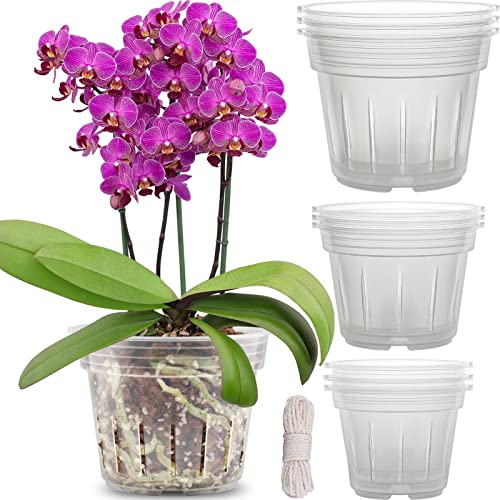
- Nine pots across three larger sizes
- Clear slotted design for light and airflow
- Roughly the lowest cost per pot here
- Sizes suited to maturing orchids
Why buy it: Nine clear slotted pots at this price is the cheapest sensible way to repot a whole shelf of orchids at once.

Best for displaying an orchid on show while keeping its roots airy
- Slotted inner pot for airflow and drainage
- Ceramic-look outer hides the working pot
- Two-piece design lifts out for watering
- Presentable enough for a living room
Why buy it: The slotted inner does the growing while the decorative outer does the display, so an orchid on a shelf looks finished without sacrificing root airflow.
Best for a big, mature orchid or a specimen that has outgrown standard pots
- Generous 8-inch size for a large plant
- Includes a matching saucer to catch runoff
- Double-layer design for airflow and drainage
- Also suits snake plants and other houseplants
Why buy it: A large orchid needs a large pot that still breathes, and the included saucer keeps runoff off the furniture.
Best for the buyer who prefers a solid ceramic pot to plastic
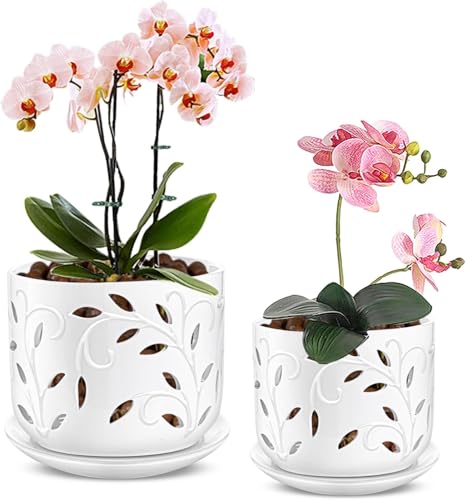
- Two ceramic pots, 5 and 6 inch
- Drainage holes plus matching trays
- Breathable body for airflow to the roots
- Heavier base resists a top-heavy orchid tipping
Why buy it: For those who dislike plastic, a breathable ceramic pot delivers drainage and a heavier, tip-resistant base with a more finished look.
Quick Comparison
| Product | Best for | Rating | Price | Buy |
|---|---|---|---|---|
| Orchid Pots with Holes, Slotted Plastic Orchid Planters, 2 Each of 4.3in, 5.5in & 6.1in (6-Pack) | Best Overall — 3-Size Slotted Set | — | Check (paid link) | |
| Growers Assortment 8 Slotted Clear Orchid Pots, 2 Each of 3, 4, 5 & 6 Inch, with Holes for Repotting | Best Clear Assortment — 8-Pack | — | Check (paid link) | |
| REMIAWY Orchid Pots with Holes, 9-Pack, 3 Each of 4.8, 5.7 & 6.4 Inch, Clear Slotted Planters | Best Value Bulk — REMIAWY 9-Pack | — | Check (paid link) | |
| Double-Layer Orchid Pot with Holes, Imitation-Ceramic Outer with Slotted Inner, 5 Inch (2-Pack) | Best Decorative — Double-Layer Ceramic Look | — | Check (paid link) | |
| 8 Inch Orchid Pot with Holes and Saucer, Double-Layer Plastic Planter for Orchids & Houseplants | Best for Large Orchids — 8in with Saucer | — | Check (paid link) | |
| EFISPSS Ceramic Orchid Pots, 5+6 Inch, White with Drainage Holes & Tray, Breathable | Best Ceramic — EFISPSS Breathable | — | Check (paid link) |
How to Choose an Orchid Pot
Airflow is non-negotiable; after that, three questions decide it:
- Do you want to see the roots? Clear pots let light reach the roots and let you judge watering by looking — the grower's choice for phalaenopsis. Opaque slotted pots work fine if you water by feel.
- Is the orchid on display? A decorative double-layer or a ceramic pot presents well; keep a slotted inner doing the actual growing.
- What size? Only slightly bigger than the root ball — orchids like to be snug, and overpotting traps wet medium. A multi-size set means the next size up is always to hand.
Whatever you choose, pair it with an airy bark-based medium rather than dense soil, and repot when the bark breaks down. Orchid medium and care guides are in the houseplants hub.
How We Researched These
We do not buy, test or physically handle orchid pots. We read the record owners and manufacturers leave. Star ratings are read across the whole review base, because a pot that photographs well but is later reported to crack, arrive with sharp molding or hold water is not a safe buy. We weight the reports that matter for an orchid — whether the slots really moved air, whether drainage was genuine, and whether the sizing matched the listing — over first impressions. Published dimensions are checked against what owners describe potting into them. Prices were current at the time of writing. Full method on how we rank.
Related Orchid Guides
A pot is only half the setup — what goes in it matters just as much. See best soil for orchids for the bark-based medium that keeps roots airy, and for other plants, best soil for succulents and best potting mix for indoor plants cover the same ground. Everything else is in the houseplants hub.
The Verdict
For most home orchids, the 3-Size Slotted Set is the pot we would recommend first: real airflow, real drainage, and the right size always ready. Choose the clear 8-pack if you want to watch the roots and water by sight, and the EFISPSS ceramic set if you want a finished pot for display. Check the current 3-Size Slotted Set price on Amazon → (paid link)