 Garden

Affiliate Disclosure
Some links on this page are affiliate links. As an Amazon Associate, we earn from qualifying purchases — at no extra cost to you. We do not buy, test, or physically handle the products we cover; our rankings come from aggregated owner reviews, ratings and expert consensus. Commissions never change our verdicts. How we rank · full disclosure.
For small and medium portions, yes — an air fryer usually uses less electricity than a full-size oven, because it heats a much smaller space, needs little or no preheat, and cooks faster, so it draws power for less time. A typical air fryer runs at about 1,200 to 1,800 watts versus a wall oven’s 2,000 to 5,000 watts, and finishes sooner. The oven wins only when you are cooking a large batch that the small basket would force into multiple rounds.
Why does the air fryer usually win?
Three things stack up in its favor for small jobs. First, volume: an air fryer heats a tiny cavity, while an oven heats a large box whether it is full or nearly empty, wasting energy on empty space. Second, preheat: an air fryer needs little or none, whereas an oven often wants 10 to 15 minutes of preheating before you even put food in. Third, speed: the small, fan-driven space cooks faster, so the appliance runs for less time. Energy is power multiplied by time, and the air fryer wins on the time side even though its peak wattage is only modestly lower.
What the math looks like
| Air fryer | Wall oven | |
|---|---|---|
| Typical power | ~1,200–1,800 W | ~2,000–5,000 W |
| Preheat | Little to none | ~10–15 min |
| Example cook | 20 min ≈ 0.5 kWh (at 1,500 W) | 40 min + preheat ≈ ~2 kWh (at 3,000 W) |
| Approx. cost* | ~8–9¢ | ~34¢ |
*At the US average residential rate of about 17 cents per kWh, per the US Energy Information Administration's published average retail price of electricity to residential customers for 2024. Your rate is on your utility bill and varies by state. The figures are illustrative, but the several-times-more pattern for a small job is consistent.
When is the oven the better choice?
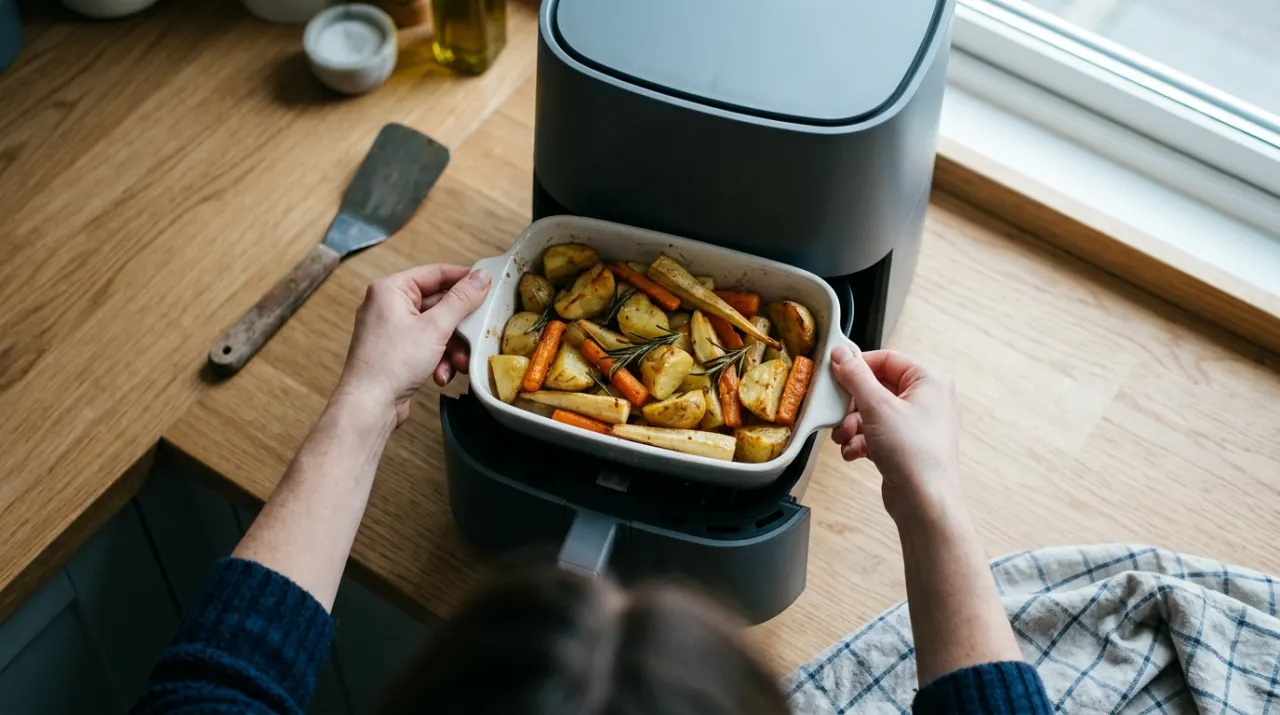
Capacity flips the result. When you need to cook a large quantity — a full sheet-pan dinner, a family roast, or several dishes at once — the air fryer’s small basket forces multiple batches, and each batch reheats the appliance, so the total time and energy can climb past a single oven run that handles everything together. For big meals the oven’s larger cavity makes it more efficient per serving. The rule of thumb: small portions favor the air fryer, large portions favor the oven.

The summer bonus
An air fryer also dumps far less heat into the kitchen than a full oven, because it heats a small enclosed space rather than radiating from a big cavity and door. In hot weather that keeps the room cooler and can slightly reduce air-conditioning load — a small secondary saving on top of the direct electricity difference. It is one reason many people default to the air fryer or a toaster oven when it is warm out.
Where to go next
For the underlying numbers, see how many watts an air fryer uses. Comparing countertop options? The best toaster ovens and the best air fryers rank models on owner ratings, and many toaster ovens now air-fry too. Everything sits under the small kitchen appliances hub.
We never buy or physically test the products we rank — recommendations come from aggregated owner reviews and expert consensus, and the method is on how we rank. Check your appliance rating labels and your own utility rate for exact figures, and the US Energy Information Administration's published average retail price of electricity to residential customers for the current national average. Cooking time is also not the finish line: doneness is, and the USDA safe minimum internal temperature chart, which puts poultry at 165 degrees Fahrenheit and whole cuts of beef, pork and lamb at 145 is the standard.