 Garden


Affiliate Disclosure
Some links on this page are affiliate links. As an Amazon Associate, we earn from qualifying purchases — at no extra cost to you. We do not buy, test, or physically handle the products we cover; our rankings come from aggregated owner reviews, ratings and expert consensus. Commissions never change our verdicts. How we rank · full disclosure.
Downspout extensions are the cheapest fix in home drainage and the one most often skipped. One inch of rain on a 1,000 square foot roof produces roughly 600 gallons of water. If four downspouts split that evenly, each is delivering about 150 gallons — and if it lands a foot from the wall, it lands on backfill: the disturbed, looser soil replaced around the foundation after construction, which is the easiest path down that water will ever find.
Getting that discharge four to ten feet out is a thirty-dollar, ten-minute job that resolves a meaningful share of wet basements, soggy foundation beds and eroded corners. It is also the first thing to try before anyone digs a trench.
Top Picks at a Glance

How Far Is Far Enough?
| Situation | Minimum discharge distance | Best format |
|---|---|---|
| Sandy or loamy soil, ground falls away | 4 ft | Flexible extender or splash block |
| Typical suburban lot, mixed soil | 6 ft | Flexible extender |
| Clay soil | 10 ft+ | Long flexible run or buried line |
| Ground slopes toward the house | Beyond the low point | Buried line to a lower outlet |
| Finished basement below | 10 ft+ | Buried line, solid pipe |
| Tight side yard, property line close | As far as legal | Buried line to the front or back — check local rules |
Two things to check alongside distance. First, the ground itself should fall away from the house — a common code guideline is roughly six inches of drop over the first 10 feet. An extension discharging onto ground that slopes back toward the wall simply delivers the water more efficiently to the same place. Second, where the water ends up matters legally: discharging onto a neighbor's property or into a storm sewer is regulated in many jurisdictions, so check locally before you bury a line to the property line.
Our #1 Pick: plusgutter Flexible Downspout Extensions
There is nothing clever about this product and that is exactly why it wins. It is a flexible corrugated tube with a clamp adapter that fits standard 2x3 and 3x4 inch downspout outlets, it extends to reach several feet from the house, and it retracts so you can mow. It is the most-owned downspout extension in the United States by a wide margin, and it costs about the same as lunch.
What matters more than the product is the installation, and this is where nearly every complaint in the category originates. Put one self-tapping screw through the clamp into the downspout. That single screw converts an extension that works loose over a season into one that stays put for years. Then pin the far end of the tube with a landscape staple so a full pipe does not creep downhill.
The honest limits: it is visible, it is in the mower's path unless you route it along a bed edge, and flexible corrugated pipe holds a little water and silt at its low points. If those bother you, the buried catch basin further down this list is the same fix done properly, for about twice the money and considerably more digging.
Check price on Amazon → (paid link)
The Ranked Field

Best for moving roof water 4 to 6 feet clear of the foundation, cheaply
- Flexible corrugated extender that clamps to a standard downspout outlet
- Extends and retracts so you can mow past it
- Fits 2x3 inch and 3x4 inch rectangular downspouts
- Sold in white, black and brown to match trim
Why buy it: by far the most-owned downspout extension in the country, and the reason is that it solves the single most common drainage problem — roof water dumping at the foundation — for the price of a pizza.

Best for dispersing water where an extension would be a trip hazard
- Molded poly composite that will not crack like concrete
- Ridged channel spreads flow instead of scouring a hole
- Sits flat on soil or mulch, no fixings
- Light enough to reposition, heavy enough to stay put
Why buy it: the right answer beside a door, a path or a driveway where a run of flexible pipe would be tripped over — it does not move water far, but it stops the scour hole and the splash-back on siding.
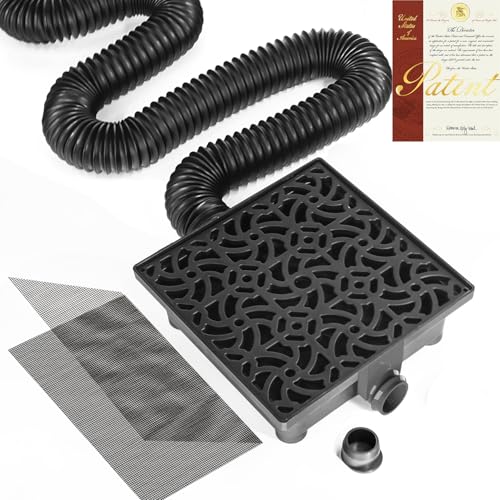
Best for sending roof water underground to a lower point in the yard
- Catch basin that sits flush at grade below the downspout
- Grated lid so surface water enters as well
- Connects to standard 4-inch corrugated drain pipe
- Low profile — mowable once bedded in
Why buy it: the step up from a surface extension: it takes the water out of sight and out of the mower path, which is why surface extenders so often get removed and never put back.

Best for downspouts that must swing out of the way for mowing or parking
- Hinge fitted into the downspout so the lower section flips up
- Fits square and rectangular downspouts
- Stays up on its own when raised
- Rigid metal downspout stays the drainage path
Why buy it: the fix for the real reason extensions disappear — people take them off to mow and never reattach them. A hinge means the extension never has to come off at all.

Best for getting water well past a foundation on a tight lot
- 11.5 feet of flexible 4-inch corrugated pipe
- Adapter for standard rectangular downspout outlets
- Can be trimmed to length
- Larger bore handles a full roof surge without backing up
Why buy it: six feet is the usual advice and it is often not enough on clay soil or a lot that slopes back toward the house — this gets the discharge genuinely out of the foundation zone.
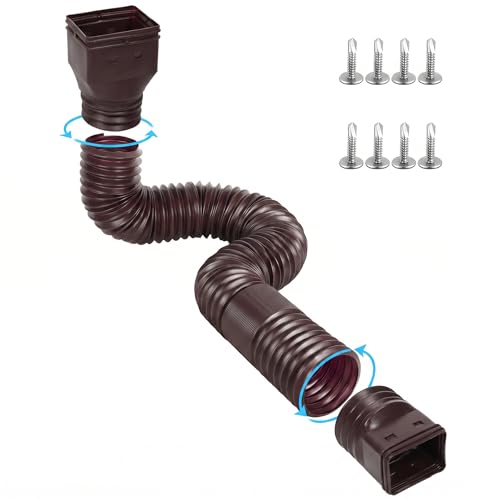
Best for doing all four corners of a house in one order
- Flexible extendable design, retracts for storage
- Clamp fitting to standard downspout outlets
- Multiple color options
- Cheap enough to fit every downspout at once
Why buy it: downspout drainage is only fixed when every downspout is fixed — leaving one dumping at a corner keeps that corner wet, so buying in pairs is the sensible unit.

Quick Comparison
| Product | Best for | Rating | Price | Buy |
|---|---|---|---|---|
| plusgutter Rain Gutter Downspout Extensions, Flexible, 2-Pack, White | Best Overall | — | Check (paid link) | |
| Suncast Easy Assembly Downspout Splash Block, Poly Composite, Light Taupe | Best Splash Block | — | Check (paid link) | |
| NAACOO Gutter Downspout Extensions, 12 x 12 Inch Low-Profile Catch Basin with Extender | Best Buried Solution | — | Check (paid link) | |
| Zip Hinge Downspout Gutter Hinge, Flip-Up Extension Hinge, White | Best Flip-Up Hinge | — | Check (paid link) | |
| plusgutter 11.5 Foot Gutter Downspout Extension, Flexible, 4 Inch Diameter | Best Long Run | — | Check (paid link) | |
| Ogutter Rain Gutter Downspout Extensions, Flexible Extender for Rainwater Drainage | Best Value Multi-Pack | — | Check (paid link) |
Fitting One Properly (Ten Minutes)
- Clear the downspout first. There is no point extending a blocked pipe. Flush it from the top with a hose and confirm a steady discharge at the bottom.
- Fit the adapter to the outlet and slide the extension on. It should be a firm push fit before any fastening.
- Put one screw through the joint. A short self-tapping sheet-metal screw. This is the step that decides whether the extension is still there next spring.
- Route it along an edge. Follow a bed line, a path or a fence rather than crossing open lawn — extensions that live in the mowing path get removed.
- Pin the far end. One or two landscape staples over the pipe stop it creeping or being dragged.
- Give the outlet somewhere to go. Discharging onto bare soil scours a hole and splashes mud onto siding. A splash block, a patch of river stone or a spread of mulch at the outlet disperses it.
- Watch it rain. Genuinely — stand outside during the next real downpour and look at all four corners. Ten minutes of watching tells you more about your drainage than any amount of guessing.
How We Rank
We do not buy or install these products. Rankings come from aggregated owner ratings across the most-owned downspout extensions on the US market, read with particular attention to reviews written after a full year — because everything in this category works on day one and the differences appear at month twelve. Four things carry the weight: attachment security, since separation at the downspout outlet is the dominant complaint; survivability around mowers and trimmers, which is why hinges and buried options rank well; flow capacity, because a narrow extender backs up during a heavy roof surge and overflows at the joint; and whether owners still have it fitted a year later, which is the only outcome that actually matters. Prices were checked at the time of writing. Full method: how we rank.

The Field, Reviewed
1. plusgutter Flexible Downspout Extensions — Best Overall
Covered above. Owners praise: the price, that it fits standard outlets without modification, color choices that match trim, and that it visibly dries out a wet foundation bed. Owners gripe about: clamps working loose without a screw, corrugated pipe holding a little standing water, and needing staking on a slope. Check price (paid link).
2. Suncast Splash Block — Best Splash Block
Does one thing and does it well: stops the scour hole and the mud splash under a downspout where a run of pipe would be in the way. Poly composite instead of concrete means it does not crack in a freeze or break when you move it.
Owners praise: that it stays put, disperses flow evenly, and looks tidy against a foundation. Owners gripe about: that it moves water only a couple of feet, which is not enough on clay, and that it can be undermined by heavy flow if not bedded level. Check price (paid link).
3. NAACOO Low-Profile Catch Basin — Best Buried Solution
The proper fix. A grated basin at grade under the downspout, connected to solid 4-inch pipe running to a lower outlet, gets roof water away invisibly and permanently. Use solid pipe, never perforated — perforated pipe leaks the roof water back into the ground beside the house.
Owners praise: nothing visible above grade, mowable once bedded, and that it also collects surface water from the surrounding lawn. Owners gripe about: the digging involved, the need to buy pipe separately, and silt collecting in the basin, which means lifting the grate once a season. Check price (paid link).
4. Zip Hinge Downspout Hinge — Best Flip-Up Hinge
Addresses the actual failure mode of this whole category, which is human rather than mechanical: extensions get taken off to mow and never go back on. A hinge in the rigid downspout lets the lower section flip up and stay up, then drop back into position.
Owners praise: that it stays up on its own, is invisible once painted, and keeps a proper metal downspout rather than adding plastic. Owners gripe about: fiddly installation requiring the downspout to be cut, and hinges loosening over years of use. Check price (paid link).
5. plusgutter 11.5 Foot Extension — Best Long Run
For when six feet is not enough, which on clay soil is most of the time. Larger 4-inch bore also matters more than people expect: a narrow extender can back up under a full roof surge and overflow at the joint, defeating the entire point.
Owners praise: genuine distance from the house, capacity under heavy rain, and that it can be trimmed. Owners gripe about: how visible a long run is across a lawn, and that it really needs staking along its length. Check price (paid link).
6. Ogutter Flexible Downspout Extensions — Best Value Multi-Pack
The pragmatic buy. Drainage is only fixed when every downspout is fixed, and leaving one corner dumping at the wall keeps that corner wet no matter what you do elsewhere. Pairs are the right unit.
Owners praise: price per unit, straightforward fitting, and color options. Owners gripe about: lighter plastic than premium options, and the same clamp-loosening issue that affects the whole class. Check price (paid link).
What Owners Actually Complain About
Separation at the outlet. The dominant complaint across every brand, and it is solved by one screw. Fit the screw.
Roll-out sleeves that stop retracting. The unfurling type that extends under water pressure is a popular idea with consistently poor ratings — they jam, tear at the folds and stay half-open. Owners are unusually blunt about this format.
Standing water and mosquitoes. Flexible corrugated pipe laid flat holds water at every low point. Give it fall, or accept emptying it after storms.
Freezing. In cold climates, a shallow or flat extension ices up, and roof meltwater then backs up at the downspout. Steeper fall helps; some owners simply disconnect for winter.
Discharging into the neighbor's yard. Not a product complaint but a real one. Where the water ends up is regulated in many jurisdictions — check before you commit an outlet.
The Verdict
Start with the cheapest thing that works: plusgutter flexible extensions on every downspout, one screw each, routed along a bed edge. If mowing is the obstacle, add a Zip Hinge. If you want it gone from view for good, dig once and fit the NAACOO catch basin to solid pipe. And do this before you consider a French drain — a surprising number of drainage projects turn out to be four downspouts discharging at the foundation. Check price on Amazon → (paid link)
More from this hub: Landscaping & Hardscaping · How to stop water pooling in a yard · How to install a French drain · Yard drainage solutions · How we rank.