 Garden
Affiliate Disclosure
Some links on this page are affiliate links. As an Amazon Associate, we earn from qualifying purchases — at no extra cost to you. We do not buy, test, or physically handle the products we cover; our rankings come from aggregated owner reviews, ratings and expert consensus. Commissions never change our verdicts. How we rank · full disclosure.
The short version: if your stump is alive and sprouting, you need a cut-stump herbicide, and the best of them is a triclopyr concentrate like Fertilome Brush Killer Stump Killer, painted onto a freshly cut surface within minutes of cutting so it travels into the root system. If the stump is already dead and you simply want it gone, you need a completely different product: potassium nitrate granules like Spectracide Stump Remover, which accelerate decay so the wood softens enough to break apart. Buying the wrong category is by far the most common mistake here.
Below is the ranked field, the timing that decides whether treatment works, and the local rules on burning that catch people out.
Top Picks at a Glance
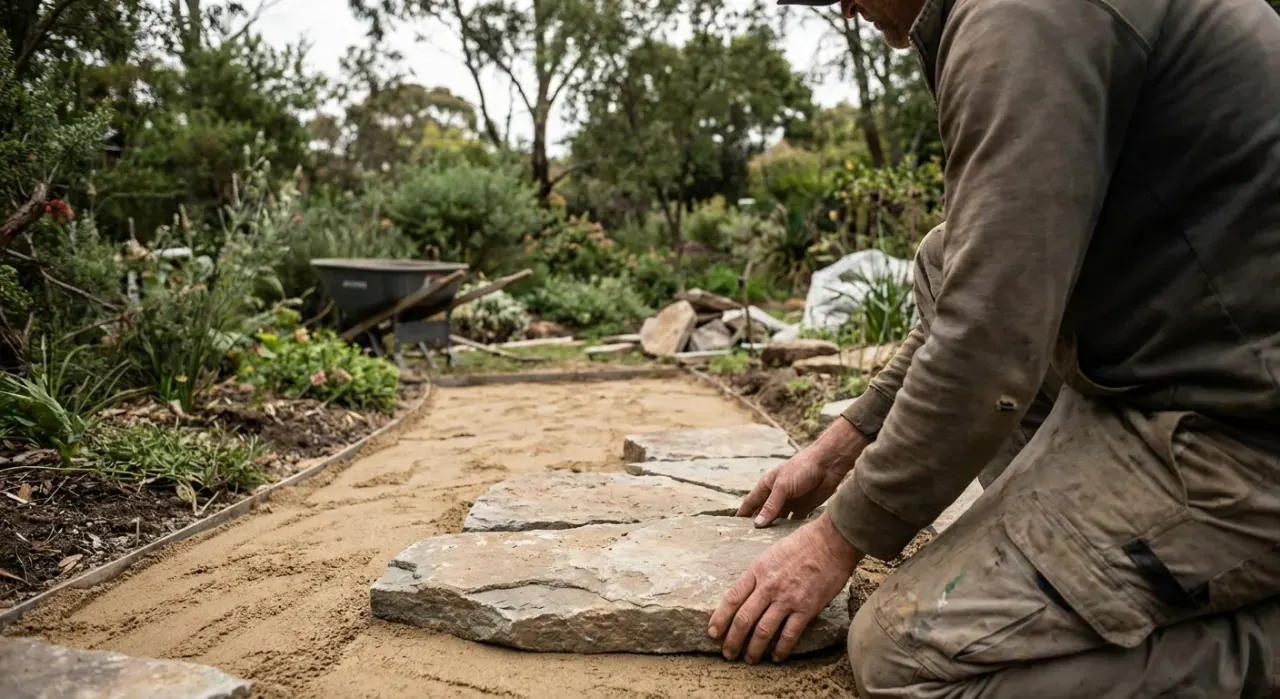
Our #1 Pick: Fertilome Brush Killer Stump Killer
This is a triclopyr ester concentrate, and triclopyr is the active ingredient forestry and utility crews use for cut-stump work on hardwoods for a straightforward reason: it is highly effective on woody species, it translocates well into root systems, and it handles the species that shrug off glyphosate. Maple, oak, elm, willow, ailanthus and privet all resprout enthusiastically from a cut stump, and triclopyr is what stops them; Penn State Extension identifies glyphosate and triclopyr as the two active ingredients used for cut-stump work.
The application matters more than the product. A tree that has just been cut is still moving fluid downward, and herbicide applied to that fresh surface within a few minutes rides along with it into the roots — Penn State Extension advises treating the living tissue immediately after cutting, with late-summer and fall applications preferred. Paint it around the outer ring of the cut — the cambium, the living layer just inside the bark — rather than flooding the dead heartwood in the middle, because the cambium is the only part that transports anything. On a large stump, the outer inch or two is the target.
A 32 ounce bottle treats a great many stumps, which is why it is the cost-effective choice for anyone clearing brush or dealing with several trees.
Consensus Score ████████░░ 8.5
The complaints are consistent. Timing failures account for most of the negative reviews — the stump was cut days or weeks earlier, the cut had sealed, and the treatment did not take. Price per bottle is high for a single stump, which is why the 8 ounce version exists. Collateral damage is a genuine risk: reviewers describe killing grass and shrubs from runoff, and in a few cases neighboring trees of the same species through shared root grafts. It smells strongly of solvent and requires gloves and eye protection. And it does not remove anything — you are left with a dead stump that still has to be dug, ground or rotted out, which surprises a surprising number of buyers.
Check price on Amazon → (paid link)
Best Stump Killers 2026: The Ranked Field
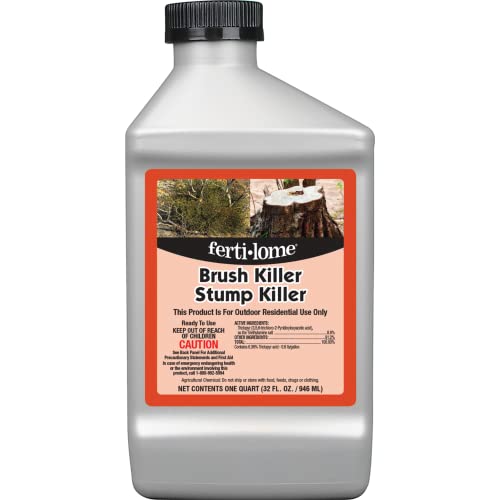
Best for killing the stump and the root system so it never resprouts
- Triclopyr ester concentrate for cut-stump treatment
- Applied undiluted or diluted to a freshly cut surface
- Kills the root system, not just the visible stump
- 32 oz treats a great many stumps
Why buy it: triclopyr applied to a fresh cut travels down into the roots, which is the only reliable way to stop a hardwood stump sending up suckers for years.
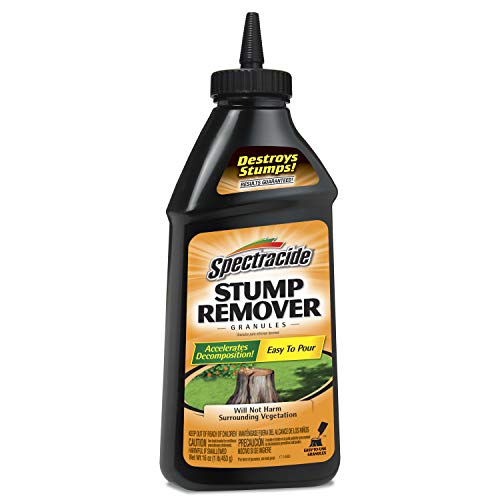
Best for softening an already-dead stump so it can be removed
- Potassium nitrate granules poured into drilled holes
- Speeds natural decomposition, makes the wood porous
- Works on stumps that are already dead
- One pound treats one large stump
Why buy it: the cheapest way to make a dead stump soft enough to break apart with an axe, which is a very different job from killing a living one.
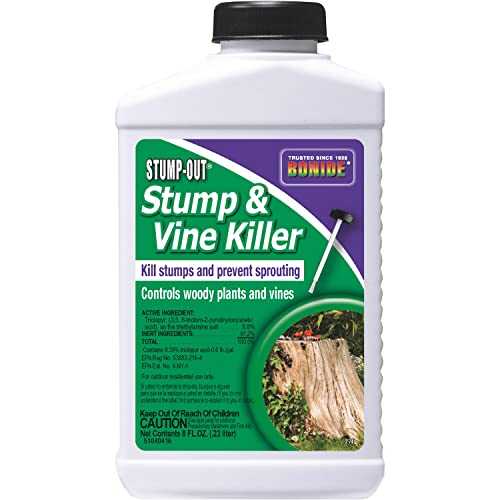
Best for one or two stumps with no mixing
- Ready-to-use formula with a built-in applicator brush
- Paint directly onto a freshly cut surface
- Also treats woody vines and suckers
- No measuring or dilution
Why buy it: the applicator brush in the cap means you paint the cut surface accurately instead of splashing herbicide across a lawn you like.

Best for accelerating decay in an old dead stump
- Fast-acting granules for drilled holes
- Makes the stump porous over several weeks
- Outdoor use, one pound per large stump
- No mixing required
Why buy it: the same potassium nitrate approach as the market leader, usually a couple of dollars cheaper, and equally dependent on the stump already being dead.

Best for poison ivy, wisteria, bamboo and stump suckers
- Concentrate with an integrated applicator
- Targets woody vines as well as cut stumps
- Small bottle sized for spot treatment
- Works on cut surfaces and fresh stems
Why buy it: woody vines regrow from the root exactly like stumps do, and this is the same cut-and-paint chemistry sized for a bottle you will actually finish.
Best for a single stump without buying a quart
- Same triclopyr formulation in a smaller bottle
- Enough for several stump treatments
- Cut-stump and basal bark application
- Less product to store afterwards
Why buy it: the same effective chemistry as the quart in a size that suits one tree, which matters because herbicide you store for five years is herbicide you throw away.
Quick Comparison
| Product | Best for | Rating | Price | Buy |
|---|---|---|---|---|
| Fertilome Brush Killer Stump Killer Concentrate, 32 oz | Best Overall | — | Check (paid link) | |
| Spectracide Stump Remover Granules, 1 lb | Best Decomposition Accelerator | — | Check (paid link) | |
| Bonide Stump-Out Stump and Vine Killer, 8 oz with Applicator | Best Ready-to-Use | — | Check (paid link) | |
| Bonide Stump-Out Granules, 1 lb, Do-it-Yourself Stump Removal Pellets | Best Value Granules | — | Check (paid link) | |
| Bonide Vine and Stump Killer Concentrate, 8 oz with Applicator | Best for Vines and Suckers | — | Check (paid link) | |
| Fertilome Brush Killer Stump Killer Concentrate, 8 oz | Best Small Bottle | — | Check (paid link) |
What Each Product Actually Does
| Product | Type | Kills living roots | Speeds decay | Timeframe |
|---|---|---|---|---|
| Fertilome Brush Killer 32 oz | Triclopyr herbicide | Yes | No | Weeks to months |
| Spectracide Stump Remover | Potassium nitrate granules | No | Yes | 4–8 weeks+ |
| Bonide Stump-Out RTU 8 oz | Ready-to-use herbicide | Yes | No | Weeks to months |
| Bonide Stump-Out Granules | Potassium nitrate granules | No | Yes | 4–8 weeks+ |
| Bonide Vine and Stump Killer | Herbicide concentrate | Yes | No | Weeks to months |
| Fertilome Brush Killer 8 oz | Triclopyr herbicide | Yes | No | Weeks to months |
How We Rank
We never buy, mix or apply the products on this site, and we say so on every ranking page. These rankings are built from aggregated owner reviews, star ratings, review volume, product labels and horticultural consensus from university extension services and established gardening publications. For stump products we weight four things: whether the product does what buyers expected, which in this category is the dominant driver of satisfaction, reported effectiveness on hardwood resprouting, ease and precision of application, and label clarity, since herbicide labels are legally binding instructions and vague ones cause misuse. Full method on how we rank.
The Stump Products, Reviewed
1. Fertilome Brush Killer Stump Killer 32 oz — Best Overall
Covered above. What owners like: that it genuinely stops resprouting on stubborn hardwoods, that a quart goes a long way, and that it works on brush and saplings as well as stumps. What they complain about: failures when applied to an old cut, price for one stump, damage to nearby plants from runoff, strong solvent odour, and the fact that it kills but does not remove. Check price (paid link).
2. Spectracide Stump Remover — Best Decomposition Accelerator
This is potassium nitrate, and it is not a herbicide. Drill a grid of one-inch holes eight to twelve inches deep into the top of a dead stump, pour the granules in, fill with water, and the nitrogen feeds the fungi and bacteria that are already breaking the wood down. Over several weeks the outer wood becomes soft and porous enough to break apart with an axe or a mattock. On a small dead stump it genuinely works.
Consensus Score ███████░░░ 7.8
Recurring complaints: the biggest by far is buyers using it on a living stump and getting nothing — this product cannot kill anything. Speed is the second: the packaging implies weeks and large hardwood stumps routinely take a full season and several applications. Drilling the holes is real work and needs a long auger bit most people do not own. And the burning that the traditional method suggests is prohibited in a great many jurisdictions, which limits the finish for a lot of users.
3. Bonide Stump-Out Stump and Vine Killer RTU — Best Ready-to-Use
A ready-to-use herbicide with an applicator brush built into the cap. For one or two stumps, that removes the two things people get wrong with concentrates: mixing the wrong ratio, and spraying rather than painting. You cut, you brush the cut surface, you are done.
Consensus Score ███████░░░ 7.6
Recurring complaints: 8 ounces goes a short distance and reviewers with several stumps run out. Ready-to-use is a dilute formulation, so on large or particularly stubborn hardwood stumps it is reported as less reliable than an ester concentrate. The applicator brush is small and slow on a wide cut. And the same timing rule applies — applied to an old sealed cut it does very little.
4. Bonide Stump-Out Granules — Best Value Granules
The same potassium nitrate approach as Spectracide, usually a little cheaper, in a one-pound container sized for one large stump. Same method — drill, fill, water, wait — and the same honest limitation.
Consensus Score ███████░░░ 7.4
Recurring complaints: identical to its competitor and for the same structural reason: buyers expecting it to kill a live stump or dissolve a dead one are disappointed on both counts. Several reviewers describe no visible change after months, which usually reflects a very large or very dry stump. The instructions on hole spacing and depth are thin. And a pound does not go far on anything above about a foot in diameter.
5. Bonide Vine and Stump Killer — Best for Vines and Suckers
The same cut-and-paint chemistry aimed at woody vines: poison ivy, wisteria, English ivy, bittersweet and the suckers that come up around a treated stump. Vines regrow from the root exactly like stumps do, and cutting them without treating the cut is why they come back every year.
Consensus Score ███████░░░ 7.5
Recurring complaints: the small bottle is quickly used up on an established vine infestation. Multiple applications are usually needed on things like wisteria and bamboo, and reviewers expecting a single treatment to finish the job say so. The applicator is fiddly on thin stems. And, as with every product here, precision matters — reviewers describe damaging surrounding plants when working in a dense tangle.
6. Fertilome Brush Killer Stump Killer 8 oz — Best Small Bottle
The same triclopyr formulation as our top pick in a size that suits a single tree. This matters more than it sounds: herbicide concentrate stored in a shed for five years is herbicide that gets thrown away, and disposal of unused pesticide is itself a regulated nuisance in many areas.
Consensus Score ████████░░ 8.2
Recurring complaints: the cost per ounce is far higher than the quart, so anyone treating more than two or three stumps is better off with the larger bottle. It is a concentrate, so you still need to read and follow the dilution instructions, and there is no applicator included. And it shares every characteristic of the larger bottle, including the strong odour and the need for gloves and eye protection.
What Owners Actually Complain About
Five themes account for nearly every low rating in this category, and the first two are about expectations rather than products. Bought the wrong type is first: granules purchased to kill a living stump, or herbicide purchased to dissolve a dead one, and neither works. Too slow is second, particularly for the granular removers, where marketing implies weeks and reality is often a season. Stump still there is third — no product on this page removes a stump, and a great many buyers expect one to. Killed nearby plants is fourth, from runoff, overspray or shared root grafts. Resprouting after treatment is fifth, and in the majority of those reviews the application went onto a cut that was days or weeks old.
How to Choose a Stump Killer
Start by working out which problem you have. Is the stump sending up shoots, or is the tree still alive? You need a cut-stump herbicide, applied within minutes of a fresh cut, painted around the outer living ring. Late summer to fall is the most effective window. Is the stump gray, dry and dead, and just in the way? You need decomposition granules, a long drill bit, and patience — or, honestly, a rented grinder or a professional, which for a large stump is often the better use of a weekend.
Whichever you choose, follow three rules. Read the label and treat it as instructions rather than guidance — pesticide labels in the US are legally binding, application rates are not suggestions, and some products are restricted in particular states. Paint rather than spray, using an applicator brush, to keep the chemical on the stump and off everything you want to keep. And check local rules before considering burning a treated stump: open burning is regulated at state, county and city level, seasonal bans are common, and a stump fire can travel along roots and smoulder underground for days.
If the stump is part of a larger clearing job, our guide on what it costs to remove a large tree covers the professional route, and planning a yard layout covers what to do with the space afterwards.
The Verdict
For a living stump that will otherwise resprout for years, Fertilome Brush Killer Stump Killer applied to a fresh cut is the most reliable option, with the 8 ounce bottle for a single tree. For a stump that is already dead, Spectracide Stump Remover granules will soften it enough to break apart, given time. Buy for the problem you actually have, and remember that neither product makes a stump disappear on its own. Check price on Amazon → (paid link)
More from this hub: Landscaping & Hardscaping · Cost to remove a large tree · Best time of year to plant shrubs · How to plan a yard layout · Landscaping cost · How we rank