 Garden


Affiliate Disclosure
Some links on this page are affiliate links. As an Amazon Associate, we earn from qualifying purchases — at no extra cost to you. We do not buy, test, or physically handle the products we cover; our rankings come from aggregated owner reviews, ratings and expert consensus. Commissions never change our verdicts. How we rank · full disclosure.
Fix it in order of cost, not in order of drama. Extend the downspouts, check that the ground falls away from the house, aerate compacted lawn, and topdress shallow low spots. Those four steps cost under $150 in total and resolve most yards. Only when they fail does digging make sense: a swale to redirect surface flow, a dry well where there is nowhere lower to send water, or a French drain where there is. Standing water should clear within 24 hours of the rain stopping; longer than that means something on this list needs doing.
Find out what kind of wet you have
Three different problems produce the same puddle, and each has a different fix. Spend ten minutes identifying yours before you buy anything.
| What you observe | The problem | The fix |
|---|---|---|
| Puddles only near the house, only after rain | Roof runoff | Downspout extensions |
| Water sits in one low area, drains in a day | Grade — a genuine hollow | Topdress or regrade |
| Whole lawn puddles, water sits 24–48 hrs | Compaction | Core aerate and topdress |
| Water sits for days; soil is heavy and sticky | Clay soil, poor infiltration | Amend soil, or drain to an outlet |
| Water appears without rain, or seeps uphill | High water table or a spring | Drain to a lower outlet; surface fixes will not work |
| Water crosses from next door | Off-site flow | Swale or berm to intercept |
The perc test settles the compaction-versus-water-table question. Dig a hole 12 inches deep, fill it with water and let it drain completely, then fill it again and time the second drain. Faster than about 2 inches per hour is good soil; slower than 1 inch per hour is genuinely poorly draining. If the hole refills on its own overnight, you have a high water table and no amount of topsoil will help. Our why water pools after rain guide goes deeper on diagnosis.
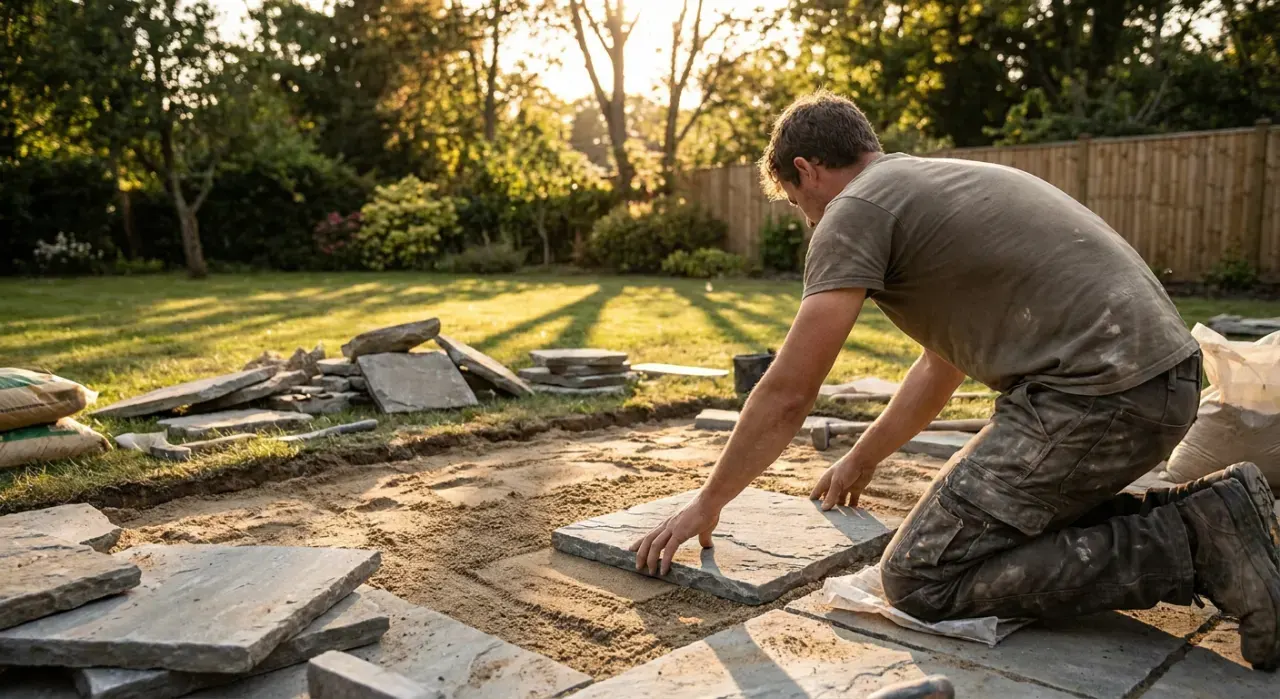
1. Extend every downspout (under $30, ten minutes)
Always first, because it is nearly free and it is the cause more often than anything else. One inch of rain on a 1,000 square foot roof yields roughly 600 gallons, and a downspout dumping its share a foot from the wall is delivering that volume onto the loosest soil on the property. Get the discharge 4 to 6 feet out on well-draining soil, 10 feet or more on clay, and put a screw through the clamp so it stays attached. See downspout extension picks, or run flexible extenders (paid link) on every downspout for the price of a takeout dinner.
2. Check the grade at the house (free)
The ground should fall away from the foundation — a widely used guideline is about 6 inches of drop over the first 10 feet. Check it with a string line and a level, not by eye, because a 5 percent slope is invisible to human judgment. Where beds have been mulched year after year, the grade often ends up running back toward the wall, and every gallon that lands there follows it. Correcting it is topsoil and a rake, and it is one of the highest-value hours you can spend on a wet property.
3. Core aerate and topdress (about $80 rented, a Saturday)
Compacted soil sheds water almost like paving. Core aeration pulls plugs out and opens pore space; topdressing with a half-inch of compost afterward, then overseeding, rebuilds structure over two or three seasons rather than overnight. Aerate when the grass is actively growing — early fall for cool-season lawns, late spring for warm-season — and on soil that is moist but not saturated. This will not cure a low spot or a high water table, but for a lawn that simply refuses to absorb rain it is the correct and cheapest structural fix.
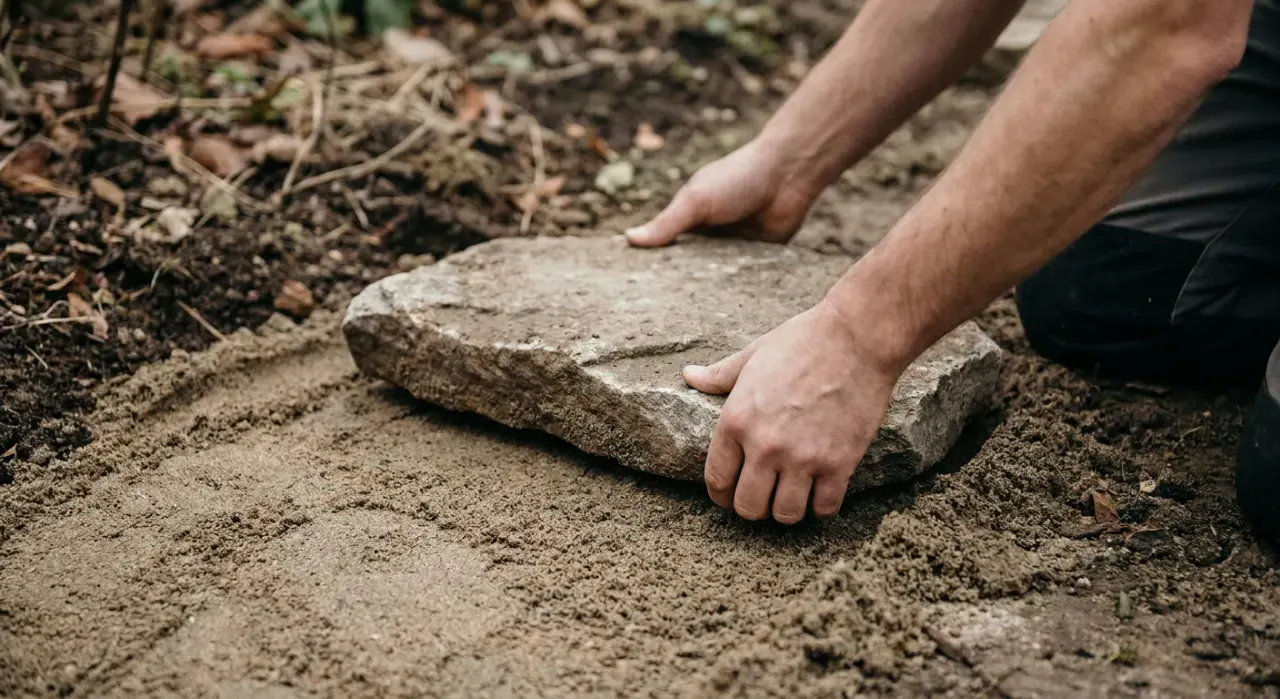
4. Topdress or regrade the low spot (a weekend)
For shallow depressions, add no more than half an inch to an inch of topsoil at a time over the existing grass, let the grass grow through, and repeat every few weeks until the hollow is gone. Burying turf deeper than an inch in one pass kills it and leaves bare mud. For deeper hollows, strip the sod, fill in compacted layers with a topsoil and sand blend, and re-sod. Always finish the repair sloping toward somewhere lower — filling a hollow flat just moves the puddle a few feet.
5. Cut a swale (a weekend, some digging)
A swale is a broad shallow channel that intercepts surface flow and guides it somewhere useful — a rain garden, a lower corner, a ditch. It is the right answer when water arrives from a neighboring property or from a large paved area, because it deals with the water before it reaches the place you care about. Make it wide and shallow rather than narrow and deep so it mows like the rest of the lawn, and give it a continuous fall of at least 1 to 2 percent.
6. Dry well or rain garden (a weekend, real digging)
When there is nowhere lower to send water, you have to store it while it soaks in. A dry well is a buried chamber or gravel pit that holds a surge and infiltrates over hours; a rain garden does the same job at the surface using plants that tolerate periodic flooding. Both require soil that will actually accept water — run the perc test first, because in heavy clay a dry well simply fills and stays full, and that is the most common way this fix disappoints.
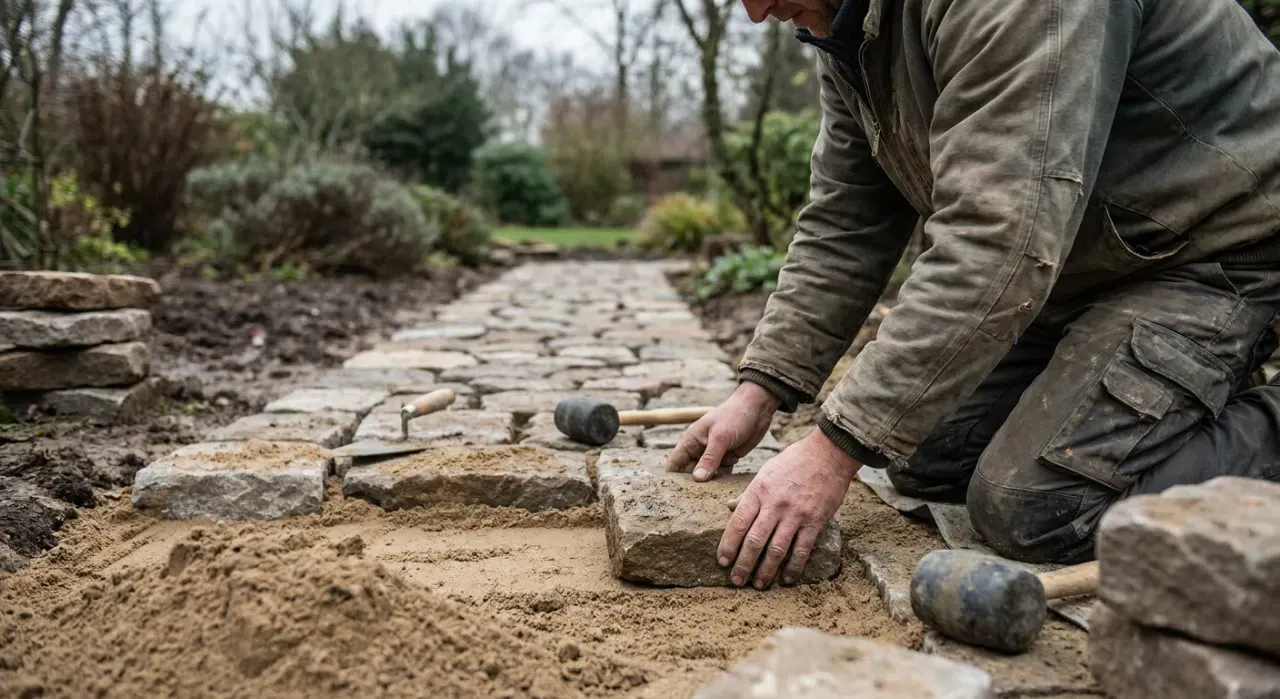
7. French drain (a weekend or two, the biggest job)
The last resort on this list, not the first — which is the opposite of how it is usually recommended. A French drain moves water sideways to a lower outlet, so it only works if a lower outlet exists. Built properly, with washed stone, non-woven filter fabric wrapping the stone, continuous fall of 1/8 to 1/4 inch per foot and a screened outlet, it lasts decades. Built badly it silts up within three to five years, and the usual culprits are woven weed fabric instead of non-woven geotextile, unwashed gravel carrying its own fines, or a belly in the run where sediment settles. Our full French drain installation walkthrough covers the build, and how deep it should be sets the depth by problem type.
Before you dig or redirect anything
Call 811 to have buried utilities located — it is free and, in most states, legally required before any excavation. Then check where the water is allowed to go. Discharging onto a neighboring property, into a storm sewer or into a wetland is regulated in many jurisdictions, and several states hold property owners liable for altering natural drainage onto adjoining land even where no permit is required. One call to the county stormwater or building department settles it, and it is a far cheaper call than the alternative.
The bottom line
Downspouts, grade, aeration, topsoil — in that order, and stop as soon as the problem stops. The great majority of soggy yards are roof water discharging at the foundation plus a lawn too compacted to absorb it, and both are fixed for the price of a nice dinner. Save the trenching for the yards that genuinely need it, and when you do trench, build it properly the first time.
We never buy, test or physically handle the products we rank. Recommendations come from aggregated owner reviews, star ratings, review volume and expert consensus — see how we rank.
More from this hub: Landscaping & Hardscaping · Yard drainage solutions · Why water pools after rain · How to install a French drain · How we rank.