 Garden

Affiliate Disclosure
Some links on this page are affiliate links. As an Amazon Associate, we earn from qualifying purchases — at no extra cost to you. We do not buy, test, or physically handle the products we cover; our rankings come from aggregated owner reviews, ratings and expert consensus. Commissions never change our verdicts. How we rank · full disclosure.
Water pools in a yard for four common reasons: poor grading that sends water toward a low spot or the house, compacted or heavy clay soil that will not absorb it, a genuine low depression with no outlet, or downspouts dumping roof water all in one place. Diagnosing which one you have decides the fix. Water sitting more than a day, or pooling against the foundation, is the version to act on — the rest is a matter of comfort. Start by watching where water flows during rain, then match the fix to the cause.
How do you figure out which cause it is?
Watch the yard during a real downpour — it tells you more than any guess afterward. Note where water arrives from, where it collects, and how long it stays. Then run a simple percolation test: dig a hole about a foot deep, fill it with water, and time the drop. Draining slower than an inch or two per hour means an infiltration problem (compaction or clay); draining fine but still pooling means a flow problem (grading or a low spot). Check your downspouts too — if the puddle sits right where roof water lands, that is your answer.
| Symptom | Likely cause | Matching fix |
|---|---|---|
| Water flows toward the house | Grade slopes the wrong way | Regrade away from foundation |
| Puddle where downspout ends | Concentrated roof runoff | Extend downspouts several feet out |
| Water sits > 24 hrs, ground hard | Compacted soil | Core aerate, topdress with compost |
| Slow perc test, sticky soil | Heavy clay, low infiltration | Amend soil, French drain, or rain garden |
| Water collects in one dip | Low spot with no outlet | Fill and regrade, or dry well |
Why grading is the usual culprit
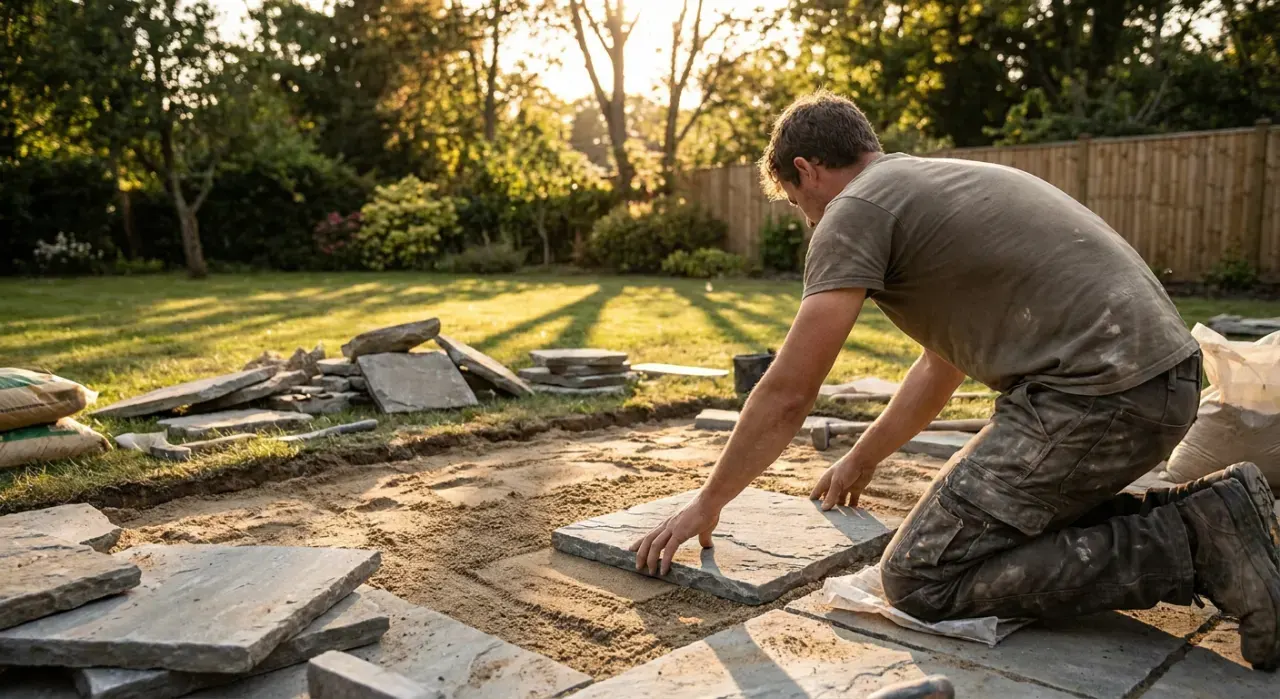
More pooling problems trace to grade than to soil. Yards settle over years, construction leaves the ground uneven, and landscaping added over time can block the path water used to take. The fix is to reshape the surface so water runs to where you want it — away from the house and toward a swale, a drain, or a lower part of the lot. The standard target is roughly 6 inches of fall over the first 10 feet away from the foundation. Regrading addresses the cause rather than the symptom, which is why it usually beats installing a drain to catch water you could simply route elsewhere.
When to treat it as urgent
Water against the foundation is the case to fix first, because it does structural damage: saturated soil against footings exerts pressure, freeze-thaw amplifies it, and water finds its way into basements and crawl spaces. The immediate steps are to extend downspouts several feet from the wall and to build up the grade so soil slopes away. Pooling far from the house — a soggy back corner — is lower stakes, though standing water anywhere over about a week can breed mosquitoes and drown turf. Prioritize by proximity to the building.

What are the fixes, from simplest up?
Work up the ladder. Extend downspouts and clear any blocked drains first — cheap and often enough. Core-aerate and topdress with compost if soil is compacted, improving infiltration over a season or two. Regrade to eliminate a slope toward the house or a shallow low spot. For a persistent wet area that cannot be graded out, add a French drain to carry water to a lower outlet, a dry well to hold and slowly release it, or a rain garden planted to absorb it. Match the tool to the cause — aeration will not fix bad grade, and a drain with nowhere lower to discharge does nothing.
The bottom line
Identify the cause — grade, soil, low spot, or downspouts — and the fix follows. Our yard drainage solutions guide compares every option side by side, and if the answer is a French drain, how deep it should be covers the build. For reshaping the yard as a whole, see how to plan a yard layout.
We never buy, test or physically handle the products we rank. Recommendations come from aggregated owner reviews, star ratings, review volume and expert consensus — see how we rank.
More from this hub: Landscaping & Hardscaping · Yard drainage solutions · French drain depth · How to plan a yard layout · How we rank