 Garden
Affiliate Disclosure
Some links on this page are affiliate links. As an Amazon Associate, we earn from qualifying purchases — at no extra cost to you. We do not buy, test, or physically handle the products we cover; our rankings come from aggregated owner reviews, ratings and expert consensus. Commissions never change our verdicts. How we rank · full disclosure.
The short answer: the best lawn edger for most homeowners is the WORX WG896 — a 12-amp corded machine with a 7.5-inch steel blade, three depth settings and a trenching mode. It suits anyone cutting or restoring a real border along a driveway, path or bed. For badly overgrown edges the BLACK+DECKER LE750 is the traditional workhorse, and for curved planting beds the manual Radius Garden 206 PRO is cheaper, quieter and genuinely better at following a curve.
We do not buy, use, or physically handle any edger. These rankings come from aggregated owner reviews, star ratings, review volume and expert consensus — see how we rank. If you only need to maintain an edge rather than cut one, a trimmer may be all you need: see best string trimmer. The full lawn routine lives in our lawn care hub.
Top Picks at a Glance

Our #1 Pick: WORX WG896
An edge is one of the few things in lawn care where the difference between good and bad is instantly visible from the street, and the reason is mechanical. A steel blade cuts a true vertical line; string line flexes on impact and leaves a scalloped, wandering edge. That single distinction is why owners who upgrade from a trimmer to this machine describe the result as a step change rather than an improvement.
The WG896 gets the practical details right. The 12-amp motor spins the 7.5-inch blade at 4,700 rpm, which is enough to cut compacted soil at the concrete line without bogging. Three depth stops at 1, 1¼ and 1½ inches let you go deep on the first cut of spring and shallow for maintenance. At about 14 lb it is light enough to steer accurately along a curving path. And the trenching mode is not a gimmick: reviewers use it to cut clean channels for low-voltage lighting cable and drip irrigation, which is genuinely tedious work by spade.
What owners complain about is worth knowing before you buy. The cord is the recurring gripe — edging follows the perimeter of a property, which is exactly where dragging 100 feet of cable is most awkward, and several reviewers describe cutting through their own extension lead. Depth adjustment is a lever, not a dial, so intermediate settings are not available. And it is a wheeled machine, which means it cannot follow a tight curve around a planting bed; for those, buy the manual edger and keep this one for the hard surfaces.
Consensus Score █████████░░░ 8.7
Check price on Amazon → (paid link)
The Ranked Field
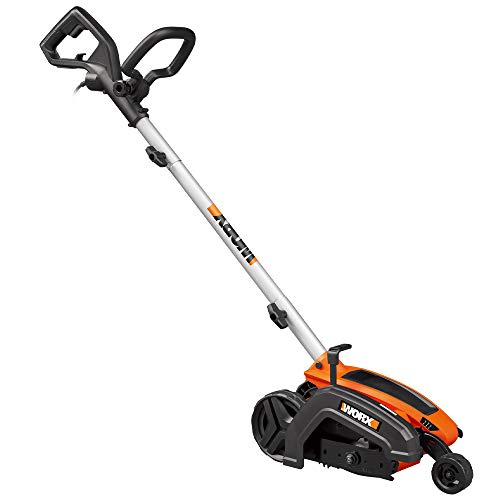
Best for cutting and maintaining crisp borders along drives, paths and beds
- 12-amp motor spinning the blade at 4,700 rpm
- Three cutting depths: 1, 1¼ and 1½ inches
- Doubles as a trencher for cable and hose runs
- About 14 lb — light to push and steer
Why buy it: a steel blade cutting a true vertical line, which is the difference between a real edge and a scalloped string-trimmer approximation.

Best for overgrown edges that have not been cut in years
- 12-amp motor for stubborn overgrown edges
- Three-position blade depth adjustment
- Three-wheel design for stable tracking
- About 12.4 lb
Why buy it: the long-running default in this category, and the one owners reach for when turf has crept two inches over the concrete.
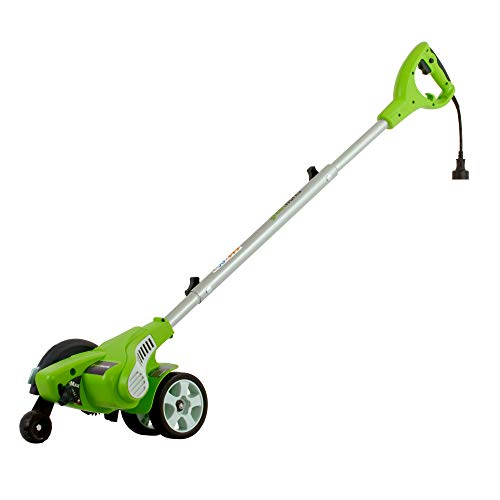
Best for long straight runs along a sidewalk or driveway
- 12-amp motor with 7.5-inch double-edged blade
- Spring-assist front wheel for depth control
- Cushioned auxiliary handle
- Corded — no runtime limit
Why buy it: the spring-assisted front wheel makes depth easy to hold steady, which is what keeps a long edge looking straight.

Best for bed borders, curves and small yards where a power tool is overkill
- Stainless steel blade resists rust and soil sticking
- O-shaped ergonomic handle spreads load across the hand
- Cuts clean curves a wheeled edger cannot follow
- No cord, no battery, no noise
Why buy it: the highest-rated edger here by a distance, and the only one that will follow the curve of a planting bed properly.
Best for maintaining an edge that already exists, without a second tool
- Two 20V MAX batteries and charger included
- Converts from trimmer to wheeled edger
- EASYFEED line advance, no bumping
- Two-speed control to trade power for runtime
Why buy it: if your edges are already cut, string line maintains them fine — and this saves buying and storing a dedicated machine.

Best for small yards, curved beds and anyone who finds a wheeled edger heavy
- Two 20V batteries and charger included
- Head pivots 90 degrees to edge
- 5.5 lb — the lightest tool here
- Command Feed line advance on the handle
Why buy it: light enough to edge one-handed around beds where a 14 lb wheeled machine simply cannot follow the shape.
Quick Comparison
| Product | Best for | Rating | Price | Buy |
|---|---|---|---|---|
| WORX WG896 12 Amp 7.5″ Electric Lawn Edger and Trencher | Best Overall | — | Check (paid link) | |
| BLACK+DECKER LE750 2-in-1 12-Amp Edger and Trencher | Best Budget Corded | — | Check (paid link) | |
| Greenworks 27032 12 Amp Corded Electric Edger | Best Tracking | — | Check (paid link) | |
| Radius Garden 206 PRO Stainless Steel Edger | Best Manual Edger | — | Check (paid link) | |
| BLACK+DECKER LSTE525 20V MAX Trimmer and Wheeled Edger | Best Cordless Combo | — | Check (paid link) | |
| WORX WG163 GT 3.0 20V Trimmer and Lawn Edger | Best Lightweight Combo | — | Check (paid link) |
The Edgers, Reviewed
1. WORX WG896 — Best Overall
Covered above. Owners praise: clean vertical cut, useful depth range, the trenching function, light weight and easy steering. Owners complain about: cord management, a depth lever with only three positions, no ability to follow tight curves, and a blade that needs replacing after heavy use in gritty soil.
2. BLACK+DECKER LE750 — Best Budget Corded
This machine has been in production long enough to have a review base spanning decades of American front yards, and it earned it on one job: reclaiming an edge that has been ignored. The 12-amp motor and three-wheel chassis will chew through turf that has crept well over the concrete. Owners praise: raw cutting power, stable three-wheel tracking, low weight at 12.4 lb, and a price that undercuts most rivals. Owners complain about: vibration through the handle — OSHA notes that tools transmitting sustained vibration can contribute to hand-arm vibration syndrome — a depth adjustment that some found stiff, plastic wheels that wear on abrasive concrete, and the same cord frustration as every corded edger.
3. Greenworks 27032 — Best Tracking
The spring-assisted front wheel is the reason this one is worth considering. Holding a consistent depth is what separates a straight edge from a wandering one, and the spring lets the wheel follow surface irregularities without you fighting the machine. The double-edged blade lasts longer before replacement because you can flip it. Owners praise: straight tracking on long runs, the cushioned auxiliary handle, blade longevity, and quiet operation relative to gas — worth something given OSHA's workplace threshold of around 85 decibels for hearing-damage risk. Owners complain about: less brute force than the LE750 in badly overgrown turf, a fixed guard that clogs with wet soil, and assembly instructions several reviewers found unclear.
4. Radius Garden 206 PRO — Best Manual Edger
The highest-rated tool in this guide, and it has no motor at all. A manual half-moon edger does one thing a wheeled machine physically cannot: follow a curve. Around a circular bed, a kidney-shaped border or a tree ring, this is the correct tool and everything else is a compromise. The stainless blade sheds soil instead of caking, and the O-shaped handle spreads pressure across the whole hand rather than concentrating it on a grip. Owners praise: the handle design, blade quality, silence, and results on bed edges. Owners complain about: it being genuine physical work on compacted or clay soil, being slow over long runs, and needing occasional sharpening to keep slicing cleanly.
5. BLACK+DECKER LSTE525 — Best Cordless Combo
If your edges already exist and only need maintaining, a trimmer that converts to a wheeled edger is the pragmatic answer — one tool, one charger, one storage hook. EASYFEED advances line at a button press, and the two included batteries mean the perimeter gets finished. Owners praise: the two-battery bundle, easy conversion, low price, and light weight. Owners complain about: string line struggling to cut a new edge, modest runtime on small packs, batteries fading after a few seasons, and a plastic guard that flexes.
6. WORX WG163 GT 3.0 — Best Lightweight Combo
At 5.5 lb this is the tool that gets used by people who find a 14 lb wheeled edger unmanageable. The head pivots 90 degrees for edging and tilts for slopes, and a spacer guard protects young plants along a bed. Owners praise: weight, one-handed control around beds, two batteries included, and Command Feed line advance. Owners complain about: limited power for restoring a neglected edge, a 12-inch swath that makes long runs slow, and spool caps some reported as fragile.
What Owners Actually Complain About
Edger reviews are unusually blunt, and four complaints dominate. Cord management tops corded models — you are working the property perimeter, which is where an extension lead is most in the way, and cut cords appear regularly in reviews. Blade wear is second and surprises people: cutting soil against concrete is abrasive work, and a blade in gritty or sandy soil may need replacing annually rather than every few years. Depth adjustment stiffness is third, usually after soil packs into the mechanism, and rinsing after use prevents most of it. Underestimating the first cut is fourth and is really a user issue — reclaiming an edge that has not been cut in three years is heavy work regardless of machine, and owners who expected a five-minute job are the most frustrated group in the reviews. One safety note that recurs: always check for irrigation lines and low-voltage lighting cable before cutting to full depth near a bed.

How to Cut a New Edge Properly
Most disappointing edging results come from technique, not the tool. Do it in this order.
- Mow first. Shorter grass lets you see the line you are cutting.
- Mark the line. A garden hose laid on the ground is the classic guide for a curve; a stringline works for straight runs.
- Cut at full depth on the first pass, moving slowly. Rushing produces a wandering line that is hard to correct later.
- Clear the debris with a stiff brush or blower while the soil is still loose. Left in place, it packs back into the trench and the edge disappears within two weeks.
- Maintain shallow. Every subsequent cut can be at the lowest depth setting, which is faster and easier on the blade.
For beds rather than hard surfaces, cut the vertical face on the lawn side and slope the soil away on the bed side. That V-profile is what keeps mulch in the bed and grass runners out of it, and it is why a manual half-moon edger remains the right tool there.
How We Rank Lawn Edgers
We never buy or physically handle the products on this site. We read the owner-review record at scale, and here we weighted four things. Cut quality on a first pass through neglected turf, which is what separates a real edger from a trimmer in edging mode. Depth control — whether owners can hold a consistent line without fighting the machine. Durability of the blade and depth mechanism, weighted from reviews left a season or more after purchase. And practicality: weight, cord or battery handling, and whether the machine can follow the shapes in a real yard. Ratings and prices move; the complaint pattern does not.
The Verdict
The WORX WG896 is the lawn edger the owner-review record supports most strongly — enough power to cut a real edge, sensible depth control, and a trenching mode that earns its place. Take the BLACK+DECKER LE750 if your edges are badly overgrown and price matters, and buy the manual Radius Garden 206 PRO alongside whatever you choose, because curved bed edges need it and it costs less than a bag of fertiliser.
Next: pair it with a trimmer from best string trimmer, match your mower to the yard in best lawn mower, or plan the whole season with our lawn care calendar.