 Garden

Affiliate Disclosure
Some links on this page are affiliate links. As an Amazon Associate, we earn from qualifying purchases — at no extra cost to you. We do not buy, test, or physically handle the products we cover; our rankings come from aggregated owner reviews, ratings and expert consensus. Commissions never change our verdicts. How we rank · full disclosure.
The short answer: a new lawn on 1,000 square feet takes 5 to 10 lb of grass seed; overseeding the same area takes 3 to 5 lb. The exact figure is species-driven — 2 to 3 lb of Kentucky bluegrass, 6 to 9 lb of perennial ryegrass, 6 to 10 lb of tall fescue — in the same range NC State Extension's seeding-rate table gives for that species — and 1 to 2 lb of bermudagrass. As of 2026, the seed alone costs roughly $25 to $70 for a new seeding at that size, plus starter fertilizer and a topdressing.
One thousand square feet is about a 32 by 32 ft square. It is the unit every seed and fertilizer label in the US is written around, which is why it is worth learning your lawn in those blocks — the same 1,000 sq ft basis university extension seeding-rate tables use. We do not test seed first-hand; our rankings come from aggregated owner reviews and expert consensus, described in how we rank, with the ranked field in best grass seed.
Pounds needed by grass type
| Grass type | New lawn | Overseeding | Seed cost, new (2026) |
|---|---|---|---|
| Kentucky bluegrass | 2 – 3 lb | 1 – 2 lb | $14 – $30 |
| Perennial ryegrass | 6 – 9 lb | 4 – 6 lb | $25 – $55 |
| Tall fescue | 6 – 10 lb | 4 – 6 lb | $30 – $70 |
| Fine fescue | 4 – 5 lb | 2 – 3 lb | $22 – $45 |
| Bermudagrass (hulled) | 1 – 2 lb | 0.5 – 1 lb | $12 – $30 |
| Zoysia | 1 – 2 lb | 0.5 – 1 lb | $25 – $60 |
| Centipede | 0.25 – 0.5 lb | 0.25 lb | $15 – $35 |
| Retail sun and shade blend | 5 – 8 lb | 3 – 4 lb | $25 – $55 |
Prices are 2026 US retail and vary a good deal by region and by whether you buy a branded consumer bag or a 50 lb sack from a farm supply or turf distributor, which is usually 30 to 50 percent cheaper per pound for the same species. Coated or mulch-blended seed is priced per bag, not per pound of live seed, and a large fraction of that bag weight is coating — convenient for patch repair, expensive for whole areas.
The full cost of doing 1,000 square feet
| Item | New seeding | Overseeding |
|---|---|---|
| Seed | $25 – $70 | $15 – $40 |
| Starter fertilizer | $15 – $25 | $15 – $25 |
| Compost topdressing (about 1 cu yd) or 1 bale straw | $10 – $60 | $10 – $30 |
| Core aerator rental (half day, shared across a whole yard) | — | $70 – $110 |
| Water, roughly 3 to 4 weeks of light daily irrigation | $8 – $25 | $8 – $25 |
| Typical total | $60 – $180 | $50 – $230 |
By comparison, sod for the same 1,000 sq ft runs roughly $400 to $900 installed as of 2026 and $300 to $600 laid yourself. Seed is a fifth of the price and takes a season to get there. Hiring out an overseeding and aeration job on a 1,000 sq ft area typically costs $150 to $300, since minimum-visit pricing dominates at small sizes.
Setting the spreader for 1,000 square feet
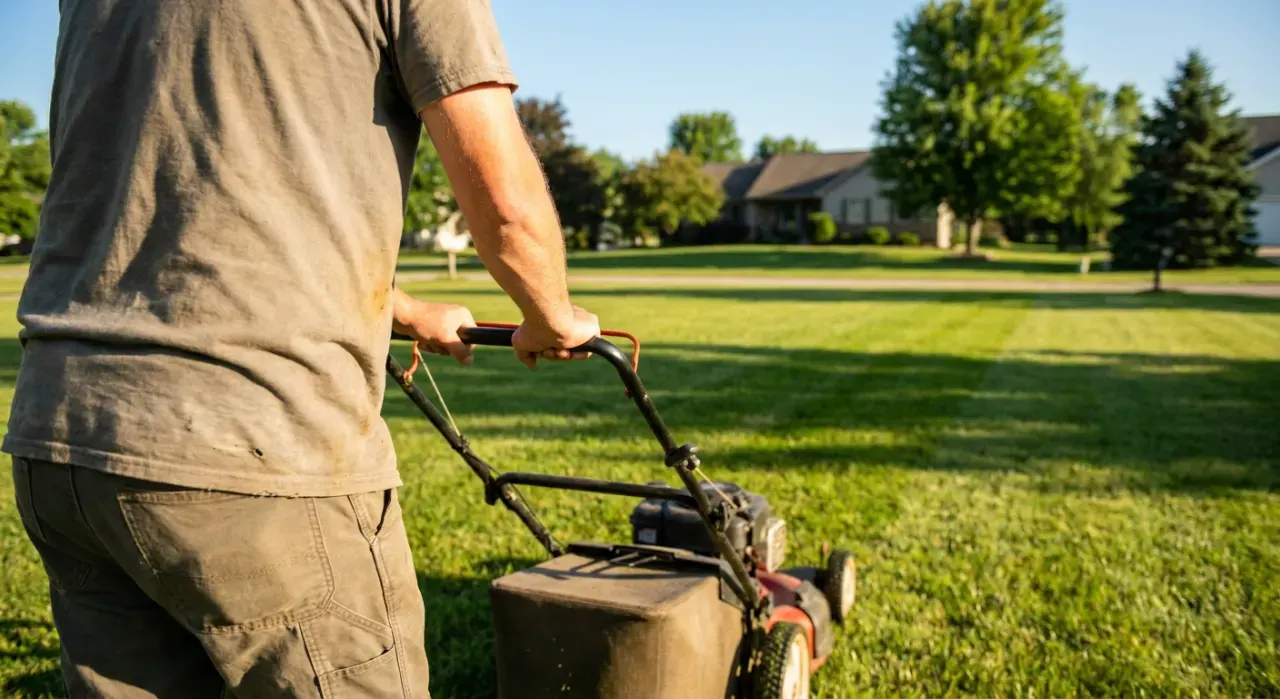
Weigh the seed rather than trusting the spreader dial. Broadcast spreader calibration on consumer models is frequently off by 20 percent or more, and the numbers printed on the hopper refer to a particular product density.
- Weigh out the total pounds you calculated for the area and put half of it in the hopper.
- Walk the first half in north-south passes at a steady pace, with the spreader set roughly one third to one half of the setting listed for the product.
- Refill with the second half and walk east-west passes at right angles to the first. The crosshatch is what eliminates striping.
- If you run out early, you were set too heavy — slow the pace or close the gate slightly for the remaining area rather than leaving strips bare.
- Sweep or blow seed off hard surfaces so it does not wash into storm drains.
Add about 15 to 20 percent above the calculated weight as insurance against washout and birds, and no more. Deliberately over-seeding produces crowded, spindly seedlings that compete with one another and are markedly more prone to damping-off disease.
For the underlying rates in other units, see how much grass seed per square foot and how much a bag of grass seed covers. To protect what you just spent, how to keep birds from eating grass seed and how often to water new grass seed cover the two weeks that decide the outcome. Everything else is at the lawn care hub.