 Garden


Affiliate Disclosure
Some links on this page are affiliate links. As an Amazon Associate, we earn from qualifying purchases — at no extra cost to you. We do not buy, test, or physically handle the products we cover; our rankings come from aggregated owner reviews, ratings and expert consensus. Commissions never change our verdicts. How we rank · full disclosure.
Almost everything sold as "concrete safe" ice melt is misdescribed, because the thing that damages concrete is not usually the chemistry. With two important exceptions, common deicers do not dissolve cured concrete. What they do is keep the slab surface wet at temperatures where it would otherwise be frozen solid, and every time that water freezes and thaws again it expands about 9% inside the pores of the top few millimeters. Do that a few hundred extra times in a winter and the surface flakes away. That is scaling, and it is what people are looking at when they say salt ate their driveway.
The exceptions are worth naming: magnesium chloride reacts with the cement paste itself and is genuinely chemically aggressive to concrete despite being marketed as the gentle option, and ammonium sulfate or ammonium nitrate — occasionally found in cheap blends and in fertilizer used as an improvised deicer — is aggressive enough that it is sold commercially as a concrete etcher. Neither belongs on a driveway.
Top Picks at a Glance

The five chemistries, honestly compared
Ice melt is a short list of active ingredients dressed in a long list of brand names. Read the back of the bag, not the front.
| Active ingredient | Works to | Effect on concrete | Notes |
|---|---|---|---|
| Sodium chloride (rock salt) | ~15 °F | Increases freeze-thaw scaling; corrodes rebar | Cheapest; hardest on plants and metal |
| Calcium chloride | ~−25 °F | Increases scaling; corrosive to metal | Exothermic, fastest acting, works when nothing else does |
| Magnesium chloride | ~−13 °F | Chemically attacks cement paste | Marketed as gentle; avoid it on concrete specifically |
| Potassium chloride | ~25 °F | Moderate; still a chloride | Gentler on vegetation, poor cold performance |
| CMA (calcium magnesium acetate) | ~20 °F | Low — no chloride to reach the rebar | Usually blended in rather than sold alone; expensive |
| Chloride-free (urea/glycol/amide blends) | ~0 °F | Lowest risk of the practical options | Several times the cost per pound; slower |
| Sand or grit | Any temperature | None | Does not melt anything — pure traction; must be swept up |
That last row is not a joke entry. On a first-winter slab, on decorative concrete, or on a day so cold that nothing chemical is going to work anyway, sand is the correct product. It costs almost nothing and it does the thing you actually want, which is stopping people from falling over.
Our #1 Pick: Snow Joe Premium Enviro Blend
This is the pragmatic default rather than the theoretical best. It is a chloride blend with calcium magnesium acetate mixed in, and CMA is the ingredient doing the work that matters here — it melts without contributing chloride, so a given weight of product carries a lower chloride load to your rebar and to the storm drain than a straight salt would.
Two practical features are worth more than they sound. The green coating makes the application visible, and since over-application is the defining mistake in this category, being able to see where you have spread is genuinely useful. And the rated working range of roughly −10 °F covers the great majority of American winters, which means you are not reaching for a second, harsher product on cold mornings.
The honest caveats: it is still a chloride product, so on a brand-new slab or on stamped decorative concrete you should be reaching for a chloride-free product instead. And like every coated deicer it will track colored residue onto light-colored flooring if you do not put a mat down.
Check price on Amazon → (paid link)
The Ranked Field

Best for the default choice for a normal concrete driveway and walkway
- Chloride blend with calcium magnesium acetate (CMA) added
- Green coating shows coverage so you can see where you have spread
- Rated to about −10 °F working temperature
- Formulated to be gentler on vegetation and concrete than straight rock salt
Why buy it: the most-owned ice melt in this class by a wide margin, and the CMA content is the part that matters — it reduces the chloride load doing the damage without giving up melting speed.

Best for new concrete, stamped or decorative concrete, and anywhere near metal
- Contains no chloride salts of any kind
- Modified crystalline amide and glycol formula
- Non-corrosive to rebar, metal railings and vehicle undersides
- Traction agent built into the pellet as it works
Why buy it: if chloride is the mechanism that damages concrete and corrodes rebar, a chloride-free product removes the mechanism — which is why this is the one to use on concrete you actually care about.

Best for steps, a front walk and a small patio rather than a whole driveway
- Same chloride-free formula in a smaller, easier-to-store pack
- Two 8 lb jugs with a built-in scoop-friendly opening
- Works down to around −2 °F
- Leaves no white chloride residue tracked indoors
Why buy it: chloride-free products are expensive per pound, so buying them in a size that matches the area you actually treat is how you make the economics work.

Best for cold-climate driveways where straight rock salt stops working
- Blend of calcium, magnesium, potassium and sodium chlorides
- Melts at lower temperatures than sodium chloride alone
- Granular, spreads evenly through a broadcast spreader
- Widely used by municipalities and contractors
Why buy it: a multi-chloride blend keeps working well below the point where plain rock salt gives up, which means less product on the ground overall.

Best for sub-zero mornings and thick ice that nothing else will touch
- Pure calcium chloride pellets
- Effective to around −25 °F, the lowest practical working range available
- Exothermic — releases heat as it dissolves, so it burns down through ice
- Round pellets drill through ice rather than sitting on top
Why buy it: calcium chloride is the only common deicer that generates its own heat, and it is the honest answer when the temperature is below what a blend can handle — used sparingly and rinsed off in spring.
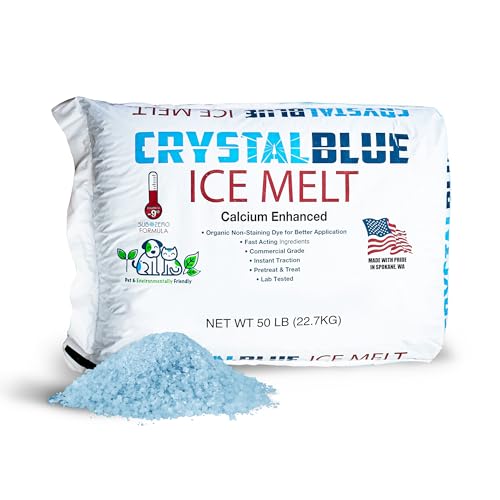
Best for long driveways and multi-storm winters where you buy by the bag
- 50 lb bag sized for a season of a full driveway
- Blue-tinted crystals so you can see application rate
- Blend formulated for fast initial melt
- Works well in a broadcast spreader
Why buy it: the visible tint is genuinely useful, because over-application is the most common mistake in this category and you cannot correct what you cannot see.

Quick Comparison
| Product | Best for | Rating | Price | Buy |
|---|---|---|---|---|
| Snow Joe Premium Enviro Blend Ice Melt, Green-Coated Deicer Crystals | Best Overall | — | Check (paid link) | |
| Safe Paw Ice Melt, Salt- and Chloride-Free Deicer, 35 lb | Safest for Concrete | — | Check (paid link) | |
| Safe Paw Pet-Safe Snow and Ice Melter, Salt- and Chloride-Free, 8 lb, 2-Pack | Best Chloride-Free Value | — | Check (paid link) | |
| Scotwood Industries Road Runner Premium Ice Melter, 20 lb | Best Blend | — | Check (paid link) | |
| Snow Joe MELT8CCP-J Calcium Chloride Pellets Ice Melter | Best for Extreme Cold | — | Check (paid link) | |
| Snow Joe Crystal Blue Snow and Ice Melter, Heat-Generating Crystals, 50 lb Bag | Best Large Bag | — | Check (paid link) |
New concrete: use nothing
This is the one piece of advice in this article that will save real money. Concrete continues gaining strength and freeze-thaw resistance for months after it is placed, and its surface pore structure stays open longer than that. A slab poured in fall and deiced through its first winter is the textbook cause of a driveway that begins flaking in year two — and once scaling starts it does not stop, because the exposed layer beneath is weaker than the finished surface was.
So for the first winter, and preferably for a full twelve months: shovel promptly and often, use sand for traction, and accept that the walk will be a bit slower to clear. After that first year, apply a penetrating silane or siloxane sealer. Sealing is what genuinely protects concrete — it reduces how much water gets into the pores in the first place, which is the actual variable in freeze-thaw damage — and it costs a fraction of a replacement slab.
How to apply it without wrecking anything
- Shovel first, always. Deicer is for the bonded layer you cannot lift, not for the six inches of snow on top of it. Applying to deep snow wastes almost all of it. See our snow shovel picks.
- Apply thin and even. Roughly 4 ounces per square yard — about a coffee mug — is a standard light rate. If the ground looks white, you have used several times too much.
- Use a broadcast spreader for anything larger than a walkway. Hand-scattering produces heavy patches and bare patches in equal measure.
- Pre-treat before the storm where you can. A light application on dry pavement before snow arrives prevents ice bonding to the concrete, and prevention takes a fraction of the product that removal does.
- Shovel the slush off once it releases. The deicer's job is to break the bond; leaving the resulting brine sitting on the slab is what drives the freeze-thaw cycling.
- Sweep up the residue when the thaw comes, rather than hosing it into the grass or the storm drain.
- Keep it off the lawn edge. Chloride accumulation in the top few inches of soil is why the strip beside a salted walk is dead every spring.

The part the bags do not mention
Chloride is permanent. Once it reaches groundwater or a lake there is no practical mechanism to remove it, which is why states with heavy deicing programs treat it as a growing, cumulative pollutant rather than a seasonal one. The Minnesota Pollution Control Agency puts the figure at one teaspoon of salt permanently polluting about five gallons of water, and runs a Smart Salting training program for exactly this reason. The advice that comes out of that work is straightforward and happens to be the same advice that protects your concrete: shovel first, apply less, pre-treat, and sweep up what is left.
If you want a formal shortcut on product selection, the EPA Safer Choice product database lists deicers that have been screened for their ingredient profile — a more reliable filter than the words "eco" or "safe" on a bag, which mean nothing in particular.
How We Rank
We do not buy or apply these products. Rankings come from aggregated owner ratings across the most-owned consumer deicers, cross-checked against declared active ingredients, published effective temperatures and established materials guidance on chloride attack and freeze-thaw scaling. Four things carry the weight: chemistry, since the active ingredient determines both performance and damage; effective temperature, because a product that does not work at your coldest mornings is not a product; concrete and metal impact; and application control — visibility, granule consistency and spreader compatibility, because how evenly it goes down decides how much you use. Prices were checked at the time of writing. Full method: how we rank.
What Owners Actually Complain About
White residue indoors. Every chloride product tracks in on boots and dries to a white crust on floors and rugs. Mats at every door, and a damp mop rather than a dry sweep.
Dead grass along the edges. Salt spray and runoff kill turf and shrub roots at the margins of a treated walk. Spread narrower than you think you need to, and keep the spreader deflector on the pavement side.
Split bags in shipping. A recurring gripe across brands with 40 and 50 lb bags — heavy paper sacks do not travel well. Buckets and jugs are more robust if you have somewhere to store them.
It stopped working. Nearly always temperature, not quantity. A blend rated to −10 °F is genuinely finished at −20 °F, and adding more of it changes nothing.
Pet paw irritation. Chloride products are abrasive and drying on paw pads. If that is your concern, see our pet-safe ice melt picks, and read the honest caveats there about what "pet safe" does and does not mean.
The Verdict
For an established concrete driveway, Snow Joe Premium Enviro Blend is the sensible default — good cold performance, CMA in the mix, and visible coverage so you use less. For new, stamped or decorative concrete, or anywhere near metal railings you want to keep, pay the premium for chloride-free Safe Paw. Keep a small tub of calcium chloride pellets for the handful of mornings each winter when nothing else will melt anything. And on a slab in its first winter, the right product is a bucket of sand and a shovel used more often — nothing you buy will protect concrete as well as not putting chemicals on it in the first place. Check price on Amazon → (paid link)
More from this hub: leaf blowers & yard cleanup · best ice melt for pets · best snow shovel · how to prevent ice dams · how we rank.