 Garden


Affiliate Disclosure
Some links on this page are affiliate links. As an Amazon Associate, we earn from qualifying purchases — at no extra cost to you. We do not buy, test, or physically handle the products we cover; our rankings come from aggregated owner reviews, ratings and expert consensus. Commissions never change our verdicts. How we rank · full disclosure.
"Pet safe" on a bag of ice melt means nothing in law. There is no federal standard, no certification and no legal definition for the phrase in the United States, and it appears on products ranging from genuinely chloride-free formulas to ordinary rock salt with a green dye added. The only useful information on the package is the active ingredients panel on the back. If it lists sodium, calcium, magnesium or potassium chloride, you are buying salt, whatever the front says.
That matters because chloride is the specific thing that hurts paws. The crystals are abrasive and they draw moisture out of the pad, so repeated exposure produces dryness, cracking and raw skin between the toes — and because dogs lick their feet afterward, the same salt arrives in the stomach and causes vomiting, diarrhea and excessive thirst. A chloride-free product removes that mechanism. Everything else is a question of how much.
Top Picks at a Glance

Reading the back of the bag
| Active ingredient | Works to | Paw and ingestion risk | Effect on concrete |
|---|---|---|---|
| Sodium chloride (rock salt) | ~15 °F | Highest — abrasive, drying, most GI complaints | Increases freeze-thaw scaling |
| Calcium chloride | ~−25 °F | High — exothermic, can irritate wet pads | Increases scaling; corrodes metal |
| Magnesium chloride | ~−13 °F | Lowest of the chlorides | Chemically attacks cement paste |
| Potassium chloride | ~25 °F | Moderate; poor cold performance | Still a chloride |
| Urea (carbonyl diamide) | ~15 °F | Often labeled pet safe; still causes GI upset, and it is a fertilizer that pollutes runoff | Low direct effect |
| Chloride-free amide/glycol blends | ~0 °F | Lowest practical risk | Lowest risk |
| Sand, grit, clay litter | Any temperature | None — but melts nothing | None |
Two entries deserve a flag. Urea is frequently marketed as the pet-friendly option and it is milder than rock salt, but it still causes stomach upset when eaten and it is nitrogen fertilizer — the runoff feeds algae in whatever water it reaches. And magnesium chloride, the gentlest chloride on paws, is the harshest of them on concrete, so a product that is kinder to your dog may be quietly damaging your driveway. If the slab is the priority, see best ice melt for concrete.
Our #1 Pick: Safe Paw 35 lb
Safe Paw is the product most often recommended by people who have already tried the alternatives, and the reason is structural rather than promotional: it contains no chloride salts of any kind. Its formula is a modified crystalline amide with a glycol component, and the pellet includes a traction element that works as it dissolves. That means it is not corroding your railings, not pitting the underside of your car, and not putting abrasive salt crystals between your dog's toes.
It is not magic and the trade-offs are real. It is several times the price per pound of rock salt. It works to roughly −2 °F, which is genuinely cold but not as cold as calcium chloride. And it melts more slowly than an aggressive chloride, so it rewards pre-treating before a storm rather than waiting for ice to form. Owners who are disappointed almost always applied it to ice that had already bonded hard and expected the speed of a salt.
The 35 lb sack is the right size for a walkway, steps and a dog run through a full winter. For a whole driveway, the honest arithmetic often points to a chloride blend on the drive and Safe Paw only on the surfaces the dog actually walks on.
Check price on Amazon → (paid link)

The Ranked Field

Best for households where dogs walk the treated surface every day
- Contains no chloride salts at all
- Modified crystalline amide and glycol formula
- Non-corrosive to metal, concrete and vehicle undersides
- Traction agent built into the pellet as it dissolves
Why buy it: chloride is what abrades and dries paw pads, so removing it entirely is the only product change that meaningfully reduces the risk — everything else is a matter of degree.

Best for a front walk, a set of steps and a dog run rather than a driveway
- Same chloride-free formula in two 8 lb jugs
- Easier to store and to pour than a 35 lb sack
- Effective to around −2 °F
- Leaves no white chloride crust to be tracked indoors
Why buy it: chloride-free deicer is expensive per pound, and buying it in the size that matches the area your dog actually uses is what makes the cost defensible.

Best for treating a whole driveway when chloride-free pricing is not realistic
- Chloride blend with calcium magnesium acetate added
- Green coating shows coverage so you apply less
- Works to about −10 °F
- Formulated to be gentler on paws and vegetation than rock salt
Why buy it: the honest compromise — it is still a chloride product and it is not paw-neutral, but the CMA content lowers the chloride load and the price makes treating a full driveway possible.

Best for quick melting where the surface is asphalt or pavers, not new concrete
- Pure magnesium chloride rather than a mixed-chloride blend
- Among the least irritating of the chloride family on paws
- Works to around −13 °F
- Melts noticeably faster than chloride-free formulas
Why buy it: magnesium chloride is the gentlest chloride on paws and plants — but it is chemically aggressive to concrete, so this is the wrong pick for a slab you care about.

Best for northern winters where gentler formulas simply stop working
- Rated effective to around −30 °F
- Anti-corrosion formulation
- Marketed as safer for concrete than standard rock salt
- Granular and spreads evenly by hand or spreader
Why buy it: a chloride-free product that quits at 0 °F is not protecting anything on a −15 °F morning, and this covers the gap without reaching for straight rock salt.
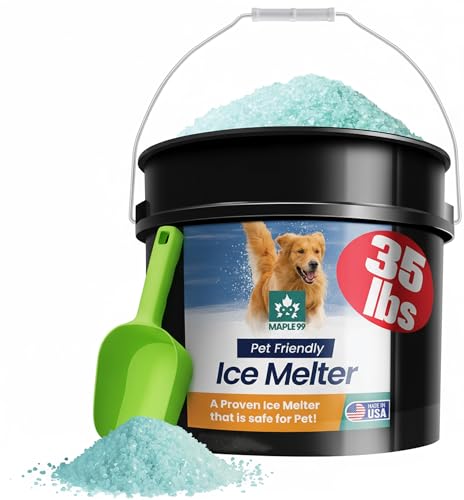
Best for multi-storm winters and larger paved areas on a budget
- 35 lb bag at a lower cost per pound than the premium formulas
- Green-tinted granules so coverage is visible
- Marketed as pet-friendly and concrete-safer
- Spreads well through a broadcast spreader
Why buy it: the lowest cost per pound in this group, with the honest caveat that it carries the lowest rating here and reviewers are more mixed on melting speed.
Quick Comparison
| Product | Best for | Rating | Price | Buy |
|---|---|---|---|---|
| Safe Paw Pet-Safe Ice Melt, Salt- and Chloride-Free Deicer, 35 lb | Best Overall | — | Check (paid link) | |
| Safe Paw 2-Pack Pet-Safe Snow and Ice Melter, Salt- and Chloride-Free, 8 lb | Best Small Pack | — | Check (paid link) | |
| Snow Joe Premium Enviro Blend Ice Melt, Green-Coated Deicer Crystals | Best for a Full Driveway | — | Check (paid link) | |
| FIREKI Pet-Safe Ice Melt, Pure Magnesium Chloride, 15 lb | Fastest Melt | — | Check (paid link) | |
| ECO-ST Pet-Safe Ice Melt, Anti-Corrosion, Effective to −30 °F, 11 lb | Best for Deep Cold | — | Check (paid link) | |
| Maple99 Pet-Safe Ice Melt, Safer for Concrete, 35 lb | Best Bulk Value | — | Check (paid link) |
The part that matters more than the product
Here is the uncomfortable truth for a page like this one: your neighbors, your city and the plow driver are all using rock salt, and your dog walks on their sidewalks. Buying a gentler deicer for your own walk changes a fraction of the exposure. What changes the rest is paw care.
- Booties are the single most effective measure, and worth persisting with even if the first attempts are comical. Most dogs adapt within a week of short sessions.
- Rinse or wipe after every winter walk. Warm water and a cloth, paying attention to the webbing between the toes where crystals lodge and where the raw patches appear.
- Use a paw balm before walks to reduce moisture loss from the pad, and after to help it recover.
- Keep the fur between the pads trimmed in winter — long tufts collect both ice balls and salt crystals.
- Watch for limping, licking or a reluctance to walk on treated ground. That is discomfort, not stubbornness.
- Sweep up residue from your own paths once the thaw comes, rather than leaving crystals for the dog to find in March.
Both the ASPCA and the American Veterinary Medical Association publish winter pet guidance along these lines, and both make a point that is worth repeating here: the deicer is not the biggest winter chemical hazard to a pet. Antifreeze is. Ethylene glycol tastes sweet, pets seek it out, and a very small quantity is lethal. A puddle under a parked car in a driveway is a genuine emergency in a way that a scattering of ice melt is not.

How We Rank
We do not buy or apply these products. Rankings come from aggregated owner ratings across the most-owned consumer deicers marketed for pet households, cross-checked against declared active ingredients, published effective temperatures and published veterinary and materials guidance. Four things carry the weight: chloride content, since that is the mechanism behind paw irritation; ingredient transparency, because unlabeled blends are unreviewable; effective temperature, as a product that stops working is not protecting anyone; and cost per pound, because a deicer too expensive to use on the surfaces that matter does not help. Prices were checked at the time of writing. Full method: how we rank.
What Owners Actually Complain About
Price per pound. Chloride-free products cost several times what rock salt does, and that is the dominant complaint across the category. The realistic response is to use them selectively rather than across a whole driveway.
Slower melting. Gentler chemistry means slower action. Pre-treating before the storm rather than fighting bonded ice afterward changes this more than switching brands does.
Working temperature. A formula rated to 0 °F genuinely stops working at −15 °F, and adding more of it does nothing. Northern buyers need to check this figure before buying.
Residue tracked indoors. Less of a problem with chloride-free products, which do not leave the white crust, but tinted and coated formulas still mark light flooring.
Bags arriving split. A recurring gripe on 35 and 50 lb paper sacks across every brand. Jugs and buckets survive shipping better.
The Verdict
Buy Safe Paw for the surfaces your dog actually uses — the walk, the steps, the run — and accept that a chloride blend like Snow Joe Premium Enviro Blend is the practical choice for a full driveway. Skip anything that says "pet safe" without an ingredients panel you can read. And then spend the rest of your effort on the things that genuinely protect paws: booties, wiping down after walks, trimmed fur between the pads, and shoveling promptly enough that you need less chemistry in the first place. The bag helps at the margin; the routine is what does the work. Check price on Amazon → (paid link)
More from this hub: leaf blowers & yard cleanup · best ice melt for concrete · best snow shovel · how to shovel snow safely · how we rank.