 Garden
Affiliate Disclosure
Some links on this page are affiliate links. As an Amazon Associate, we earn from qualifying purchases — at no extra cost to you. We do not buy, test, or physically handle the products we cover; our rankings come from aggregated owner reviews, ratings and expert consensus. Commissions never change our verdicts. How we rank · full disclosure.
The PSI number on the box is the least useful figure on it. Pressure washers are sold on a single large number, and that number is a "max PSI" measured at unloader bypass — the pressure in the system at the instant the trigger is released, not the pressure you clean with. Worse, PSI alone does not determine how fast a surface actually gets clean. Pressure loosens the dirt; water volume carries it away. Multiply the two and you get cleaning units, the only figure in this category that compares machines honestly.
It is why a 3400 PSI gas washer is not "48% better" than a 2300 PSI electric, as the headline numbers imply — it is more than twice as fast, because it also moves half as much water again. And it is why two electric machines advertising 2300 and 2500 PSI clean at almost the same speed, since their flow rate is identical.
Top Picks at a Glance
Cleaning Units: The Number Nobody Prints
Cleaning units are simply PSI × GPM. Manufacturers know the figure and rarely lead with it, because it flattens the marketing gap between models. Here is what the machines above actually produce:
| Machine | Max PSI | GPM | Cleaning units |
|---|---|---|---|
| Westinghouse ePX3100 | 2300 | 1.76 | ~4,050 |
| Sun Joe SPX3000 | 2030 | 1.76 | ~3,570 |
| Westinghouse ePX3500 | 2500 | 1.76 | ~4,400 |
| Simpson Clean Machine | 3400 | 2.5 | ~8,500 |
| Westinghouse WPX3400 | 3400 | 2.6 | ~8,840 |
Read that table once and the category makes sense. The three electrics are separated by about 20%, not by the 23% spread their PSI badges suggest, and any of them will clean a car or a deck perfectly well. The gas machines are in a different league entirely — roughly double — which is the honest case for spending twice as much and accepting the fuel, oil and noise.
Our #1 Pick: Sun Joe SPX3000
The SPX3000 is not the most powerful machine in this list, and on the cleaning-units table it sits last among the electrics. We still rank it first, for a reason that matters more than a 15% difference in cleaning speed: it is the most-owned pressure washer in the country, and that produces something no spec sheet can — a genuinely reliable picture of how the machine behaves in year three.
What that ownership record shows is a machine that does the domestic jobs well, with two failure modes owners repeat consistently. The plastic hose fittings are the weak point and will weep before anything else does; several seasons in, the pump can lose pressure if the unit has been stored wet through a freeze. Both are known, both are cheap to pre-empt, and neither is a surprise — which is worth more than a slightly larger number on the carton.
The dual detergent tanks are more useful than they sound, letting you keep a wood cleaner and a general degreaser loaded at once. The total-stop system means the motor only runs while the trigger is held, which is both a safety feature and the main reason these motors survive as long as they do.
Check price on Amazon → (paid link)
The Ranked Field

Best for the household that wants one machine for the driveway, the deck and the car
- 2030 max PSI at 1.76 GPM from a 14.5-amp motor
- Five quick-connect nozzles: 0°, 15°, 25°, 40° and soap
- Two onboard 0.9-litre detergent tanks
- Total stop system cuts the pump when the trigger is released
Why buy it: the most-owned pressure washer in America by a wide margin, and the ownership record is the reason — it is not the most powerful machine here, but it is the one whose failure modes are best understood.
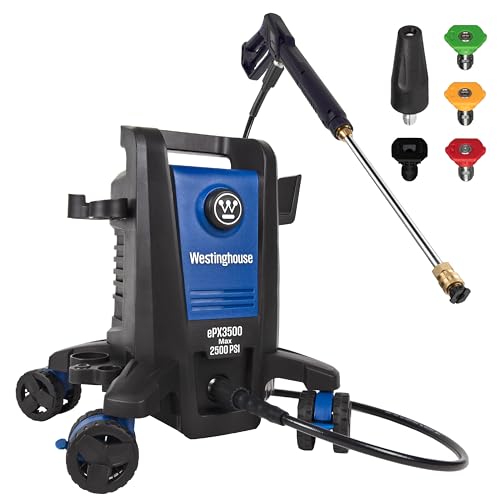
Best for ground-in driveway grime, algae-black fences and older concrete
- 2500 max PSI at 1.76 max GPM
- Induction motor rather than a universal motor
- Onboard soap tank and five nozzles
- Anti-tip base with a wider stance than the Sun Joe
Why buy it: the induction motor is the real upgrade — it runs quieter, cooler and markedly longer than the universal motors in cheaper machines, which is where most electric washers die.

Best for a first pressure washer without buying at the bottom of the market
- 2300 max PSI at 1.76 max GPM
- Soap tank, four nozzles and a 20-foot hose
- Compact upright body for shelf storage
- Same chassis family as the ePX3500
Why buy it: close to the ePX3500 in real cleaning speed because GPM is identical, and GPM matters more than the PSI figure on the box — this is where the value sits.

Best for long driveways, farm use and anywhere without a convenient outlet
- 3400 PSI at 2.6 GPM — roughly triple the cleaning units of the electrics
- Axial cam pump with a 212cc engine
- Five quick-connect nozzles plus a soap applicator
- Onboard storage and 12-inch never-flat wheels
Why buy it: gas is a different class of machine, not a bigger version of the same one: 2.6 GPM strips a driveway several times faster than any 1.76 GPM electric, and no cord limits where you go.

Best for buyers who intend to keep a gas machine for a decade
- 3400 PSI at 2.5 GPM with a Simpson CRX engine
- Welded steel frame rather than moulded plastic
- 25-foot MorFlex hose
- Serviceable pump with replaceable parts
Why buy it: Simpson build a frame and pump you can actually service, which is what separates a machine that lasts ten seasons from one that is landfill when the pump goes.

Best for cars, patio furniture, bikes and anyone who has to carry it up steps
- Compact corded body built to be carried one-handed
- Quick-connect nozzles including a soap tip
- Short footprint for apartment and garage storage
- Gentle enough for vehicle paint with the right nozzle
Why buy it: the machine people actually keep using, because the reason a pressure washer sits unused is almost never power — it is the hassle of dragging it out.
Quick Comparison
| Product | Best for | Rating | Price | Buy |
|---|---|---|---|---|
| Sun Joe SPX3000 Electric Pressure Washer, 2030 Max PSI, 1.76 GPM | Best Overall | — | Check (paid link) | |
| Westinghouse ePX3500 Electric Pressure Washer, 2500 Max PSI, 1.76 Max GPM | Best for Stubborn Jobs | — | Check (paid link) | |
| Westinghouse ePX3100 Electric Pressure Washer, 2300 Max PSI, 1.76 Max GPM | Best Value | — | Check (paid link) | |
| Westinghouse WPX3400 Gas Pressure Washer, 3400 PSI, 2.6 GPM | Best Gas | — | Check (paid link) | |
| Simpson Clean Machine 3400 PSI Gas Pressure Washer, 2.5 GPM, CRX engine | Best Gas Build Quality | — | Check (paid link) | |
| CRAFTSMAN Electric Pressure Washer, Cold Water, Lightweight Corded Power Washer | Best Lightweight | — | Check (paid link) |
What Pressure Each Surface Actually Wants
More pressure is not better; it is how decks get furred, siding gets water behind it and cars lose badges. Match the nozzle to the surface and you will do less damage and less work.
| Surface | Working pressure | Nozzle | The mistake to avoid |
|---|---|---|---|
| Concrete driveway | 2500–3500 PSI | 25° or surface cleaner | Wand stripes — use a surface cleaner for an even finish |
| Wood deck | 500–1200 PSI | 25°–40° | Raising the grain; the fuzz is permanent |
| Vinyl siding | 1300–1600 PSI | 40° | Spraying upward and driving water under the laps |
| Car or truck | 1200–1900 PSI | 40°, held well back | Any narrow tip near paint, trim or badges |
| Brick and masonry | 1500–3000 PSI | 25° | Blasting out old mortar joints |
| Painted surfaces | Below 1200 PSI | 40° | Stripping the paint you meant to wash |
| Roof shingles | Do not pressure wash | — | Soft washing is the correct method; pressure removes granules |
The Injury Nobody Warns You About
Pressure washers are sold as garden equipment and are treated accordingly, but the stream from a narrow nozzle carries enough energy to break skin. A high-pressure injection injury forces water, grit and bacteria into the tissue under the skin through a puncture that can look trivial — often a small mark on a finger or foot with little bleeding. The danger is that the visible wound badly understates the internal damage, and delay makes outcomes substantially worse. Emergency medicine treats these as surgical emergencies rather than wounds to clean and dress at home.
The practical rules are short. Never point a wand at anyone, including yourself, and never steady the spray by bracing a hand in front of the tip. Treat the red 0° nozzle as one you almost never fit — it concentrates the full output into a pencil-width jet and is the tip most often involved in injuries and in accidental damage. Wear closed shoes and eye protection, because grit comes back at you at the same speed it left. Release the trigger and disconnect power before changing a nozzle, and bleed the pressure from the hose before you unclip anything. If a jet does break the skin, treat it as an emergency and say explicitly that it was a pressure washer injection injury.

How We Rank
We do not buy, run or test these machines. Rankings come from aggregated owner ratings across the most-owned pressure washers, weighted toward long-ownership reviews where pump and fitting failures show up, and cross-checked against published specifications for pressure and flow. Four things carry the weight: real cleaning throughput, computed as cleaning units rather than taken from the PSI badge; durability, especially pump life and the plastic fittings that fail first; usability, since the machine you can carry out in one trip is the machine you will use; and serviceability, because a sealed pump makes a repairable machine disposable. Prices were checked at the time of writing. Full method: how we rank.
The Field, Reviewed
1. Sun Joe SPX3000 — Best Overall
Covered above. Owners praise: the price, the dual detergent tanks, how quickly it strips a season of green off a fence, and that spare parts are easy to find. Owners gripe about: leaking plastic hose fittings, a hose that coils badly in cold weather, and pressure loss after a few seasons if it was stored without draining. Check price (paid link).
2. Westinghouse ePX3500 — Best for Stubborn Jobs
The strongest electric here, and the induction motor is the reason to pay the premium rather than the extra 200 PSI. Induction motors run cooler and quieter and last considerably longer than the universal motors used in cheaper machines, which is precisely where budget electrics die.
Owners praise: noticeably quieter operation, a stable base that does not tip when you pull the hose, and strong results on old concrete. Owners gripe about: weight, a short power cord that usually needs an outdoor-rated extension, and the price against the ePX3100. Check price (paid link).
3. Westinghouse ePX3100 — Best Value
The sweet spot of the electric range. Identical flow rate to the ePX3500 means it cleans at nearly the same speed for meaningfully less money, and it shares the same chassis family rather than being a cheaper design.
Owners praise: the compact upright body that stores on a shelf, quick nozzle changes, and value against the Sun Joe. Owners gripe about: a soap tank that is fiddly to refill, and the same short-cord complaint that affects the whole class. Check price (paid link).
4. Westinghouse WPX3400 — Best Gas
The point at which the category changes character. At 2.6 GPM this moves half as much water again as any electric here, and on a long driveway that is the difference between an afternoon and a morning.
Owners praise: genuine speed on large concrete areas, never-flat wheels that survive gravel, and freedom from cords. Owners gripe about: the noise, pull-starting after winter storage, and the oil-change and fuel-stabiliser routine that electric owners never think about. Check price (paid link).
5. Simpson Clean Machine 3400 — Best Gas Build Quality
Marginally slower on paper than the Westinghouse and built to a visibly higher standard. The welded steel frame and the serviceable pump are what you are buying — this is the gas machine to choose if you expect to still own it in ten years.
Owners praise: frame rigidity, a hose that stays flexible in the cold, and a pump with parts you can actually replace. Owners gripe about: weight, price, and an assembly process that takes longer than expected. Check price (paid link).
6. CRAFTSMAN Electric Pressure Washer — Best Lightweight
The honest answer for anyone whose real obstacle is effort rather than power. Light enough to carry one-handed up steps, small enough to store in an apartment, and perfectly matched to cars, bikes and patio furniture.
Owners praise: how easy it is to get out and put away, which is the reason it gets used, and gentle-enough output for vehicle paint. Owners gripe about: it is outclassed on driveways and old concrete, and the hose is short. Check price (paid link).
What Owners Actually Complain About
Fittings and hoses, not motors. The single most common complaint across every brand is a leaking connection. Plastic quick-connects weep first; brass replacements are inexpensive and fix most of it.
Pump failure after winter. Water left in a pump through a freeze cracks it, and the machine that "lost pressure over winter" is usually this. Draining and adding pump antifreeze before storage prevents it.
The cord. Nearly every electric ships with a cord too short to be useful, and many owners discover their household extension lead is not rated for the draw.
Expecting gas performance from electric. A large share of one-star reviews describe a machine working exactly as specified while the buyer expected roughly double the throughput.
The Verdict
For the great majority of households the Sun Joe SPX3000 remains the sensible buy — not because it is the strongest machine here but because it is the best-understood one, and it does every domestic job asked of it. Step up to the Westinghouse ePX3500 if you want the induction motor and expect hard use, and take the Westinghouse WPX3400 if you have real acreage of concrete or no outdoor outlet, accepting the maintenance that comes with an engine. Whatever you buy, shop on cleaning units rather than the PSI badge, and fit the 0° nozzle roughly never. Check price on Amazon → (paid link)
More from this hub: leaf blowers & yard cleanup · best electric pressure washer · best gas pressure washer · how to use a pressure washer · how we rank.