 Garden


Affiliate Disclosure
Some links on this page are affiliate links. As an Amazon Associate, we earn from qualifying purchases — at no extra cost to you. We do not buy, test, or physically handle the products we cover; our rankings come from aggregated owner reviews, ratings and expert consensus. Commissions never change our verdicts. How we rank · full disclosure.
The best pressure washer pump is the one that fits your machine, and nothing else on the spec sheet comes close in importance. The single most common outcome in this category is a pump arriving that cannot be mounted — wrong shaft diameter, wrong orientation, wrong bolt spacing, or an outlet that fouls the fuel tank. Owners return more pumps for fitment than for failure, by a wide margin.
So this page leads with the measurements, then ranks the pumps that owners most consistently report bolting straight on. There is also an honest section on when replacing a pump is not worth doing at all, because for most electric machines it is not.
First: Should You Replace It At All?
Answer this before you shop, because the answer is often no.
| Machine type | Pump cost | New machine | Worth replacing? |
|---|---|---|---|
| Consumer electric, integrated pump | Rarely sold separately | $150–$250 | No — buy a new machine |
| Residential gas, axial cam | $90–$150 | $400–$550 | Yes — the engine is the value |
| Commercial-frame gas | $180–$300 | $800–$1,500 | Yes, clearly |
| Triplex pump with a seal failure | $30–$60 rebuild kit | — | Rebuild it, do not replace |
| Pump cracked by freezing | Full pump | — | Replace; a cracked head cannot be sealed |
The rough test: if the pump is a discrete assembly bolted to an engine with a visible shaft coupling, it is a repair job. If the pump and motor share one housing — as they do on nearly every electric machine under $300 — it is not, and the honest advice is to buy a replacement machine from the electric rankings instead.

Top Picks at a Glance
The Four Measurements That Decide Fitment
- Shaft orientation. Look at how the engine sits. Engine above the pump with the shaft pointing down means vertical; engine beside the pump with the shaft pointing sideways means horizontal. These are not interchangeable and no adapter exists.
- Shaft diameter. Measure the engine crankshaft with calipers, not the bore of the old pump, which may have worn or been shimmed. Residential machines are almost always 3/4-inch or 7/8-inch; commercial frames with 389cc–420cc engines use 1-inch. A 3/4-inch pump on a 7/8-inch shaft simply will not go on, and forcing it destroys both.
- Bolt pattern and spacing. Count the mounting holes — usually four — and measure center-to-center across the diagonal. Note also whether the shaft is keyed with a woodruff key or has a flat.
- Flow rate against the engine. A pump's GPM rating is a demand, not an output. Fitting a 4.0 GPM pump to a 212cc engine will bog it; fitting a 2.5 GPM pump to a 420cc engine wastes the engine. Match the replacement to the original figure unless you have a specific reason not to.
One more check before ordering: photograph the old pump from above and from the side, and confirm the inlet and outlet ports point the same way on the replacement. A pump that mounts perfectly and puts the outlet against the fuel tank is still the wrong pump.
Axial Cam vs Triplex: The Only Real Design Choice
Almost every residential pressure washer ships with an axial cam pump, and almost every complaint about pump life traces back to that decision.
| Axial cam | Triplex plunger | |
|---|---|---|
| How it works | Wobble plate driving pistons off the engine shaft | Crankshaft driving plungers through rods |
| Speed | Runs at engine speed — hot | Geared down — runs cool |
| Typical life | 200–500 hours | 2,000–5,000 hours |
| Serviceable? | Usually sealed; replace the whole pump | Yes — seal, valve and plunger kits available |
| Cost | $90–$150 | $180–$350 |
| Right for | A few hours a year | Weekly use, side work, long sessions |
If your old axial pump lasted three seasons and you use the machine occasionally, a like-for-like axial replacement is the sensible choice. If it failed under real use, or you find yourself replacing pumps repeatedly, a triplex is not an indulgence — it is the fix.

The Pumps, Ranked

Best for the vertical-shaft residential gas washers most homeowners own
- Vertical 7/8-inch shaft — the common residential fitment
- 3000 PSI at 2.5 GPM
- Fits many Craftsman, Troy-Bilt and Briggs-engined units
- Thermal relief valve and adjustable unloader included
Why buy it: the pump that fits the largest share of vertical-shaft homeowner machines, and the one with the deepest record of actually bolting straight on without adapters.

Best for Honda GC160 and GC190 powered frames and similar horizontal-shaft machines
- Horizontal 3/4-inch shaft
- 3400 PSI at 2.5 GPM
- Fits Honda GC160 / GC190 and many clones
- Includes unloader and chemical injector
Why buy it: the horizontal counterpart to the pick above, and the correct answer for the Honda-engined frames that dominate the mid-price gas market.

Best for a factory-specification rebuild rather than a generic substitute
- Horizontal axial cam design, 3400 PSI at 2.5 GPM
- Supplied as a kit with unloader and fittings
- Specified as original equipment on several brands
- Documented mounting dimensions
Why buy it: the pump the machine may have shipped with — worth the premium when a generic will not clear the frame or the fuel tank, which is a more common problem than listings admit.
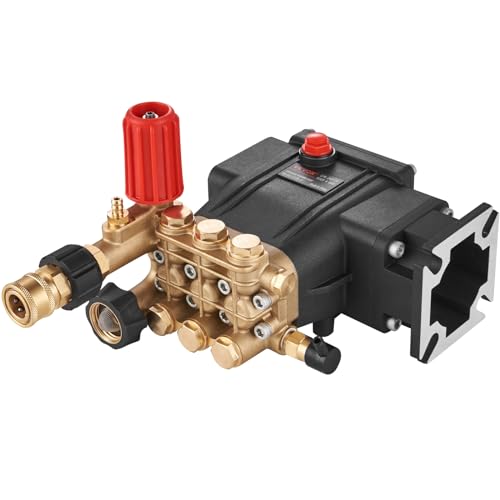
Best for upgrading from a sealed axial cam pump to a rebuildable one
- Triplex plunger design rather than axial cam
- 3300 PSI at 3.0 GPM
- Serviceable — seals, valves and plungers are replaceable
- Runs cooler and tolerates long continuous sessions
Why buy it: a triplex pump is the genuine upgrade in this category: it runs cooler, lasts several times longer, and can be rebuilt instead of thrown away when the seals go.

Best for a straightforward like-for-like replacement on a budget
- Horizontal 3/4-inch shaft
- 2600–3300 PSI at 2.5 GPM
- Supplied with unloader, thermal valve and quick-connect outlet
- Common bolt pattern for gas frames
Why buy it: the cheapest pump here that owners consistently report fitting without modification, which is the only specification that really matters in a replacement.

Best for commercial-frame machines with 389cc–420cc engines
- 1-inch horizontal shaft for large engines
- 4400 PSI at 4.2 GPM
- Adjustable unloader supplied
- Sized for contractor-frame washers
Why buy it: the right class of pump for a big-engine frame — fit a 2.5 GPM pump to a 390cc engine and you waste most of what you paid for the engine.
Quick Comparison
| Product | Best for | Rating | Price | Buy |
|---|---|---|---|---|
| YAMATIC 3000 PSI 2.5 GPM Pressure Washer Pump, Vertical 7/8" Shaft | Best Overall Vertical | — | Check (paid link) | |
| YAMATIC Horizontal 3/4" Shaft Pressure Washer Pump, 3400 PSI 2.5 GPM | Best Horizontal | — | Check (paid link) | |
| OEM Technologies 3400 PSI 2.5 GPM Horizontal Pressure Washer Pump Kit 90029 | Best OEM Replacement | — | Check (paid link) | |
| VEVOR Horizontal Triplex Pressure Washer Pump, 3/4" Shaft, 3300 PSI, 3.0 GPM | Best Premium Triplex | — | Check (paid link) | |
| TOOLCY 3/4" Shaft Horizontal Pressure Washer Pump, 2600–3300 PSI at 2.5 GPM | Best Value | — | Check (paid link) | |
| TOOLCY 1" Shaft Pressure Washer Pump, 4400 PSI, 4.2 GPM, with Adjustable Unloader | Best for Large Gas Machines | — | Check (paid link) |
Why Pumps Fail — and How to Stop It Happening Again
Freezing. The largest single cause. Water left in a pump through a hard freeze expands and cracks the head or distorts the valves, and a cracked head cannot be sealed. Prevention takes ninety seconds: disconnect the water, run the machine briefly to expel what is inside, then feed pump antifreeze into the inlet until it comes out of the outlet.
Running dry. Water lubricates and cools the seals. Starting a machine before the pump is purged of air, or letting the supply hose kink, scores the seals in seconds. Always turn the water fully on and squeeze the trigger with no nozzle fitted until the flow is steady before you start the motor — the full sequence is in how to start a pressure washer.
Running in bypass. When the engine is running and the trigger is released, the unloader recirculates water inside the pump. That water heats quickly, and after a few minutes it is hot enough to cook the seals. Do not leave a gas machine idling while you move a ladder — shut it off.
Starved supply. A 1/2-inch garden hose, a long coil, or a partly-open tap can fail to deliver what a 2.5 GPM pump demands. The pump cavitates, which sounds like pulsing and destroys valves. Use a 5/8-inch hose, uncoiled, with the tap fully open.
A blocked inlet screen. Two minutes of maintenance that prevents the same cavitation. Rinse the screen every few uses.

Fitting It Safely
Pump replacement is a genuinely accessible job — usually four bolts, a shaft coupling and three hose connections — but two safety points apply. Disconnect the spark plug lead before you go near the shaft on a gas machine, because a pull on the recoil with your fingers in the coupling will hurt. And when you first pressurise the new pump, treat the machine as live: a high-pressure stream can penetrate skin and inject water and debris into the tissue underneath through a puncture that looks trivial, and the clinical literature on high-pressure injection injuries treats these as surgical emergencies precisely because the visible wound understates the damage. Never check a fitting for leaks with a hand, never aim the wand at anyone, and treat the red 0° nozzle as one you essentially never fit. Full detail in pressure washer safety tips.
How We Rank
We do not buy or fit these pumps. Rankings are drawn from aggregated owner ratings across the most-bought replacement pumps, weighted heavily toward what reviews say about fitment — because that is where this category actually fails — and cross-checked against published shaft, flow and pressure specifications. Four things carry the weight: fitment reliability on the machines each pump claims to suit; completeness, meaning whether the unloader, thermal valve and injector are included; design, with triplex construction weighted above axial cam; and durability as reported after a season or more. Prices were checked at the time of writing. Full method: how we rank.
The Verdict
Measure first, buy second. For the vertical-shaft residential machines most people own, the YAMATIC 3000 PSI vertical 7/8-inch pump has the deepest record of bolting straight on. For horizontal-shaft frames — the Honda GC-engined machines especially — the YAMATIC horizontal 3/4-inch is the equivalent. If the machine earns its keep and you have already replaced one axial pump, spend the extra on the VEVOR triplex and rebuild it rather than replacing it next time. And if the pump on your electric machine has failed, do not chase a part number that probably does not exist — buy a better machine.
More from this hub: leaf blowers & yard cleanup · pressure washer leaking water · how to start a pressure washer · best pressure washer brands · how we rank.