 Garden


Affiliate Disclosure
Some links on this page are affiliate links. As an Amazon Associate, we earn from qualifying purchases — at no extra cost to you. We do not buy, test, or physically handle the products we cover; our rankings come from aggregated owner reviews, ratings and expert consensus. Commissions never change our verdicts. How we rank · full disclosure.
Work downwind, in one direction, toward one collection point, building long windrows instead of chasing scattered leaves. Do lawn and beds first, hard surfaces last, because everything crosses them. Use two tarps rather than bags. Hold the nozzle six to twelve inches off the ground, not waist high. And wait for dry leaves if you possibly can — a day of drying beats any equipment upgrade.
Plan the Yard Before You Start the Blower
The single biggest time sink in leaf cleanup is moving the same leaves twice. Two minutes of planning eliminates most of it.
Check the wind and pick your direction. Wind that helps is worth more than 200 CFM. Stand outside, note which way the leaves are already drifting, and set your collection point downwind. Then work the entire yard in that direction. Fighting a breeze the whole session is the most common self-inflicted problem in fall cleanup.
Pick one destination. A tarp staging area, the compost heap, the curb pile, the bed you are mulching — one, not three. Every additional collection point multiplies the crossing paths and the leaves you handle twice.
Set the order: lawn, beds, then hard surfaces. Driveways, walks and patios come last because every leaf you push off the grass has to cross them. Clearing the driveway first guarantees you will clear it again.
Clear the obstacles. Toys, hoses, planters, furniture, extension cords. Ten seconds each now, versus stopping mid-pass to move them later.
Windrows: Why Pushing a Mass Beats Chasing Leaves
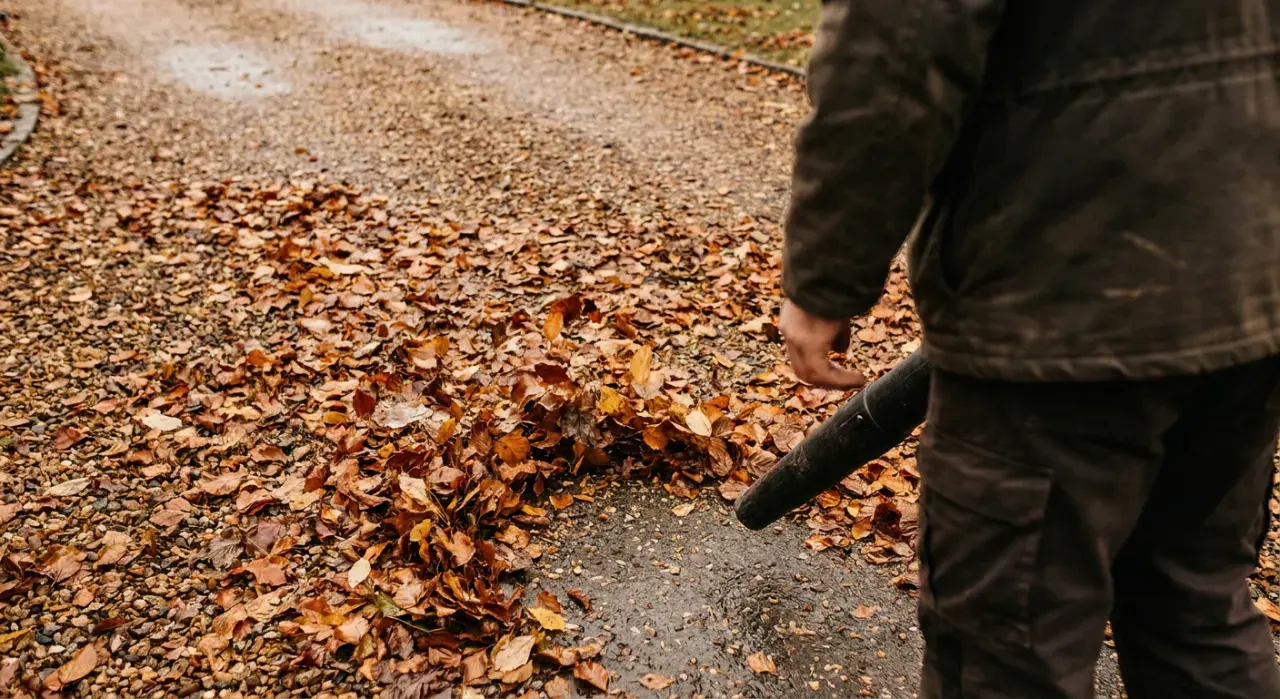
This is the technique that separates people who finish in forty minutes from people who spend an afternoon. Do not blow individual leaves toward a pile. Build a moving line of leaves — a windrow — perpendicular to your direction of travel, and push the whole line forward.
A windrow works because leaves in bulk carry each other. Air hitting the back of a substantial line of leaves moves the entire mass forward, while the same air aimed at scattered leaves flicks a few of them randomly. Once a windrow has real bulk, each pass advances it several feet and the leaves at the front are being pushed by the leaves behind them rather than by your blower.
Practically: start at the far upwind edge and walk parallel to that edge, sweeping the nozzle in a steady arc to gather leaves into a line ahead of you. When you reach the end, step forward into fresh ground and come back the other way, adding to the same line. The windrow grows and advances with you. Do not stop to tidy stragglers — you will collect them on the return pass.
On large open areas, work in strips 15 to 20 feet wide rather than trying to move the entire lawn as one front. On a slope, work downhill; gravity is free CFM.
Nozzle, Height and Angle
Three adjustments most owners never make, each worth real time.
Height. Six to twelve inches off the ground. Most people hold a blower around waist height, which sends the majority of the air stream over the leaves instead of under them. Get the nozzle down and the swath widens immediately.
Angle. Point slightly forward and down, roughly 30 to 45 degrees, so the air gets underneath the leaves and lifts as well as pushes. Straight down scatters them; straight ahead skims over the top.
Nozzle choice. The wide flat nozzle maximizes swath and is right for open lawn and general sweeping. The round tapered nozzle concentrates the same air into a faster jet and is right for wet clumps, corners, fence lines, gutters and prying leaves out of ground cover. Switch deliberately rather than using whichever came fitted. The reason the two nozzles behave so differently — and why the MPH figure on the box comes from the narrow one — is explained in CFM vs MPH explained.
Throttle. Variable speed exists for a reason. Full power near a mulch bed redistributes your bark chips across the driveway and blasts gravel at the siding. Drop to a third near beds, gravel and delicate plantings, and save turbo for wet clumps.

Two Tarps Beat a Stack of Bags
A 10 by 10 foot tarp costs around fifteen dollars and moves in one trip what takes six or eight bag-fillings. Blow or rake the pile onto the tarp, gather two adjacent corners, and drag. On grass it slides easily; on pavement it slides even better.
Two tarps roughly double the throughput. Either stage them at opposite ends of a large yard so you always have one near the work, or fill one while the other is being emptied. If you are moving leaves to beds or a compost heap, the tarp is also the delivery vehicle — no transfer step at all.
Other things that speed the collection end: a leaf scoop pair, which are effectively giant plastic hands and grab several times what your arms do; bag holders that keep a paper yard-waste bag open so you are not fighting it; and a mulching pass first, which shrinks the volume you have to move by a large factor. Vacuum-mulcher machines reduce leaves at roughly 10:1 to 16:1, and the picks are in best leaf vacuum and mulcher.
Timing: The Free Speed Increase
| Condition | Effect on cleanup | What to do |
|---|---|---|
| Dry leaves | Travel several times further per pass | Wait a day after rain if you can |
| Wet or matted leaves | Stick to turf and pavement; clog vacuums | Short close passes, round nozzle, full throttle |
| Morning dew | Same as wet | Start mid-morning once it has burned off |
| Steady light wind | Free assistance | Set the collection point downwind and commit |
| Gusty wind | Undoes windrows | Work in smaller sections, or postpone |
| Frost on the lawn | Leaves freeze down; turf is brittle | Wait for it to thaw |
The other timing decision is how often. Two or three moderate sessions through the fall are considerably less work in total than one enormous one, because a thin layer moves easily while a deep wet mat has to be broken up first. It also protects the lawn, since a thick layer left through several weeks of rain blocks light and traps moisture against the crowns.

The Fastest Cleanup Is the One You Skip
A substantial share of leaf cleanup does not need to happen. If you can still see grass through the leaves, a pass with a mulching mower shreds them into the turf where they break down over winter and feed the soil. That is faster than blowing, bagging and hauling, and it improves the lawn rather than just clearing it.
The limit is real: a thick wet layer that blocks light will smother turf over winter, so heavy fall under a mature oak or maple still needs removing. Where the line sits, and what the shredded leaves do for the soil, is set out in mulching leaves vs bagging. Leaves you do collect are the best free mulch and the classic brown ingredient for a compost pile, so the collection point is often better placed at a bed or a heap than at the curb.
Mistakes That Cost the Most Time
Working upwind. Everything you move comes back. Check before you start.
Clearing the driveway first. You will clear it twice.
Blowing at full throttle everywhere. It scatters more than it collects on light dry leaves, redistributes mulch, and drains a battery in fifteen minutes.
Chasing stragglers. Leave them. They get collected on the next pass, and stopping breaks your rhythm and your windrow.
Blowing into a fence or hedge. Leaves pack into the base and have to be pulled out by hand. Work parallel to a fence line, not into it.
Ignoring the neighbors. Do not blow leaves onto adjacent property, and check your local hours — many US municipalities restrict blower use to set windows and some cap decibel levels or restrict gas machines entirely. What the common ordinances look like is in leaf blower noise rules.
Skipping eye and ear protection. A blower fires grit and small stones at speed, and gas machines sit in the range where hearing protection stops being optional.
Where to Go Next
If the machine is the bottleneck rather than the method, size it properly — the numbers that predict how fast a yard clears are in CFM vs MPH explained, and the ranked field is in best leaf blower. Deciding between power sources? See gas vs battery leaf blowers. Keeping whatever you own working is covered in leaf blower maintenance. Everything sits under the leaf blowers and yard cleanup hub.
We do not buy or physically handle the products we rank — recommendations come from aggregated owner reviews, ratings and expert consensus, and the method is on how we rank.