 Garden

Affiliate Disclosure
Some links on this page are affiliate links. As an Amazon Associate, we earn from qualifying purchases — at no extra cost to you. We do not buy, test, or physically handle the products we cover; our rankings come from aggregated owner reviews, ratings and expert consensus. Commissions never change our verdicts. How we rank · full disclosure.
There is no federal leaf blower rule — restrictions are local, and they vary hugely. The most common municipal decibel cap is 65 dB at 50 feet, typical use windows are around 8am to 6pm on weekdays with tighter weekend hours, and a growing number of US cities restrict or ban gas models specifically. California prohibited the sale of new gas-powered small off-road engines, leaf blowers included, effective 2024. Check your own city before you buy.
Why This Tool in Particular
Leaf blowers attract more regulation than any other piece of yard equipment, and it is not arbitrary. A gas handheld typically measures around 70 to 80 dB at 50 feet, and the sound is dominated by low-frequency energy from a two-stroke engine — the part of the spectrum that travels furthest, penetrates walls best and is hardest to block. A mower is louder at the operator but the noise falls off faster and the machine is used for a shorter, more predictable period.
Two-stroke engines are also disproportionate emitters for their displacement, since a portion of the fuel-air charge passes through the engine unburned. That is the second strand of the regulation, and it is the one driving the California rule rather than the noise complaints that drive most city ordinances.
The Four Forms Restrictions Take
| Type of rule | Typical form | Who it affects |
|---|---|---|
| Decibel cap | 65 dB at 50 ft is most common; 70 dB widespread; some cities measure at the property line | Effectively excludes most gas handhelds; most battery models pass |
| Time-of-day window | Roughly 8–9am to 6–7pm weekdays; later start and earlier end Saturdays; Sundays and holidays restricted or banned | Everyone, including battery users |
| Seasonal restriction | Gas blowers permitted only during spring and fall cleanup months, banned in summer | Gas owners |
| Outright gas ban | Gas blowers prohibited entirely; battery and corded permitted | Gas owners; a growing list of cities |
Additional provisions appear frequently: limits on the number of blowers operating simultaneously on one property, requirements that commercial operators register equipment or post decibel ratings, prohibitions on blowing debris onto a neighboring property or into a public street, and narrower windows near hospitals, schools and designated quiet zones.
The California Rule
California is the piece of this that has national significance, because it operates on sales rather than on use. Under state legislation directing the Air Resources Board to regulate small off-road engines — the category covering leaf blowers, string trimmers, chainsaws, pressure washers and walk-behind mowers — the sale of new gas-powered equipment in that class was prohibited from 2024.
Three practical points. It targets new sales, not possession or use, so existing machines are not confiscated and can generally still be operated subject to local rules. It applies to equipment sold in California, which is why manufacturers have accelerated battery development for the whole US market rather than maintaining separate lines. And it sits on top of local ordinances rather than replacing them — plenty of California cities already banned gas blower use outright, and those rules still apply.
Other states have watched this closely and various proposals have surfaced elsewhere. Nothing comparable is in force nationally, and it would be wrong to imply otherwise, but it is a reasonable factor to weigh when buying a machine you expect to keep for a decade.
Reading a Decibel Limit Correctly
Decibel caps trip people up because the measurement conditions matter as much as the number.
Distance is part of the specification. A limit of 65 dB at 50 feet and a limit of 65 dB at the property line are very different rules — the second is stricter, since sound drops roughly 6 dB with every doubling of distance. Read which one your ordinance uses.
The scale is logarithmic. An increase of 10 dB is perceived as roughly twice as loud and represents ten times the sound energy. The gap between a 62 dB battery blower and a 76 dB gas one is therefore much larger in practice than the numbers suggest.
Manufacturer figures are measured under standard conditions that a real yard does not replicate. Hard surfaces reflect sound, buildings channel it, and the operator hears considerably more than a meter at 50 feet does. Treat published ratings as comparative rather than as a guarantee of compliance.
Typical published figures, for orientation: battery handheld blowers commonly sit around 59 to 68 dB at 50 feet, gas handhelds around 70 to 80 dB, and gas backpacks at the upper end of that range. This is the practical reason so many decibel-based ordinances function as gas restrictions without ever using the word.
Finding the Rules That Apply to You
Search the municipal code, not the news. Your city or county name plus "leaf blower ordinance" or "noise ordinance" will usually reach the code directly. Look for the section on noise or on landscaping and maintenance equipment. News coverage tends to report proposals that were never adopted.
Check the county too. Unincorporated areas fall under county rules, which are often looser than the nearby city but rarely absent.
Check your HOA separately. Homeowner association covenants are private agreements that operate independently of city law and are frequently stricter — tighter hours, gas prohibitions, or contractor-only provisions. Enforcement is through the association rather than the city, but it is enforcement all the same.
Check rental and condo rules if that applies, since building rules commonly restrict powered equipment further.
If nothing turns up, call the city clerk or code enforcement. Five minutes on the phone gives you a definitive answer, and it is worth doing before spending several hundred dollars on a gas machine.
Being a Reasonable Neighbor
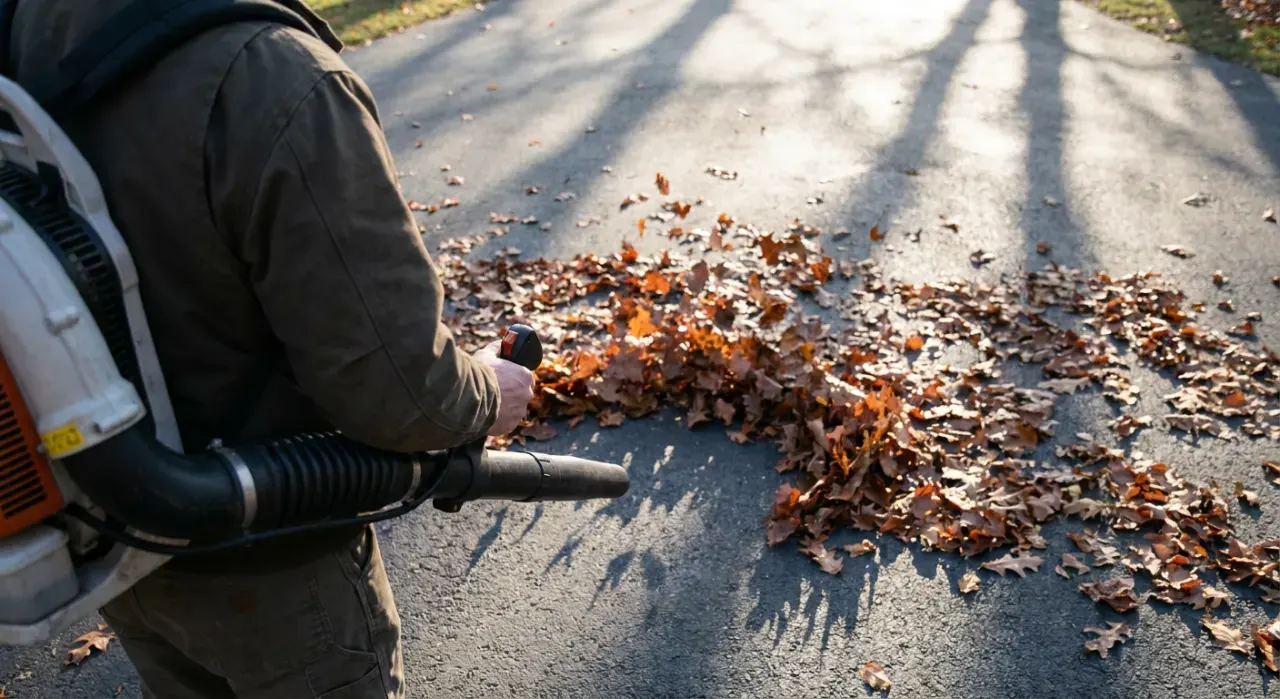
Most enforcement in this area begins with a complaint, so the practical rule is simple: do not be the reason someone calls. Stay well inside the permitted hours rather than at the edge of them. Avoid early mornings on weekends even where they are technically allowed. Never blow debris onto adjacent property or into the street, which is separately prohibited in many codes. Use the lowest throttle setting that does the job — full power is rarely necessary on dry leaves and is dramatically louder. And keep sessions short and predictable rather than running for two hours on a Sunday afternoon.
Wearing hearing protection is worth its own line. At 70 to 80 dB at 50 feet, the level at the operator is considerably higher, and blower operation is one of the more common sources of avoidable occupational and hobby noise exposure. Eye protection matters more than people expect too, since a blower fires grit and small stones at real speed.
What This Means When You Buy
If you live somewhere with an active ordinance, or you expect to move within the life of the machine, battery is the lower-risk purchase — most cordless models fall under the common decibel caps, and gas-specific bans do not touch them. If you have a large property, live rurally, and no ordinance applies, gas remains the strongest tool at the top of the power range and the regulatory picture is not a factor.
The full trade-off on power, runtime, weight and cost per season is in gas vs battery leaf blowers. The quietest capable machines are covered in best cordless leaf blower, and if a gas backpack is genuinely the right answer for your acreage, the field is ranked in best backpack blower.
Where to Go Next
Sizing the machine matters more than almost anything else, and the numbers on the box are explained in CFM vs MPH explained. Working quickly means fewer minutes of noise, and the pattern that halves most cleanup times is in how to clear leaves fast. Everything sits under the leaf blowers and yard cleanup hub.
This page is general information, not legal advice — ordinances change and only your own municipality can tell you what applies. We do not buy or physically handle the products we rank; recommendations come from aggregated owner reviews and expert consensus, and the method is on how we rank.