 Garden

Affiliate Disclosure
Some links on this page are affiliate links. As an Amazon Associate, we earn from qualifying purchases — at no extra cost to you. We do not buy, test, or physically handle the products we cover; our rankings come from aggregated owner reviews, ratings and expert consensus. Commissions never change our verdicts. How we rank · full disclosure.
Clear at 2 to 4 inch intervals during a big storm, rather than once at the end. Snow that has just fallen is loose and light; the same snow after six hours of accumulation has compacted under its own weight and can weigh two or three times as much per shovelful. Three short clearings during a storm is less total work than one long one, and it is far safer — because the real hazard in snow clearing is not the tool you use, it is the combination of cold air and sudden heavy exertion.
Why the Timing Question Is Really a Health Question
Snow shoveling is a documented cardiac trigger, and it is worth understanding the mechanism rather than treating it as a vague caution. The American Heart Association describes several stressors arriving at once:
- Cold constricts blood vessels. Breathing cold air narrows the coronary arteries and raises blood pressure before you have lifted anything.
- The effort is largely isometric. You strain against a load without much joint movement, which spikes blood pressure far more sharply than steady aerobic work.
- It is arm work. Upper-body exertion is more demanding on the heart than the equivalent leg work.
- People hold their breath. Straining to lift a heavy shovelful with a closed airway produces a sudden jump in heart rate and pressure.
- You stand still. Blood pools in the legs rather than being pumped back by walking.
Add that most people shovel first thing in the morning, when blood pressure is naturally at its daily peak, having done nothing strenuous for months, and the picture is clear. The AHA advises that people with known heart disease, prior heart attack, high blood pressure or diabetes, and people who are generally sedentary, should not shovel snow at all. Emergency departments across the snow belt report a rise in cardiac presentations after heavy snowfalls.
If you are in one of those groups, that is not a reason to leave the driveway — it is a reason to buy a machine, hire a service, or ask a neighbor. A snow blower is cheap next to an ambulance.

The Interval Rule
| Forecast total | Clear when | Why |
|---|---|---|
| Under 4 in | Once, after it stops | Light enough to move in a single pass |
| 4–8 in | Once mid-storm, once after | Halves the depth per pass |
| 8–14 in | Every 3–4 in | Keeps every load inside a safe weight |
| Over 14 in | Every 2–3 in | Below this, the pile becomes unliftable and refreezes |
| Wet snow at any depth | Every 2–3 in | Wet snow can weigh over 20 lbs per cubic foot |
| Blowing and drifting | After it stops | Early clearing gives wind fresh ground to fill |
Weight is the argument. Light dry powder runs about 7 pounds per cubic foot; heavy wet snow can exceed 20. A standard shovel blade holds a few cubic feet of snow over the course of a driveway, and a 12-inch fall on a two-car drive means moving somewhere between one and three tons of material. Splitting that across three sessions is the difference between an exertion and an event.
Push, Do Not Lift
The single change that reduces both back and cardiac risk is to stop lifting. Snow that is pushed off a surface never has to be raised, twisted or thrown.
- Use a pusher for the open runs. A wide curved-blade pusher rolls snow off to the side in a continuous walking motion, with no lifting at all.
- Plan the route so you push to the nearest edge. Long pushes into a growing pile are where people revert to lifting.
- Where you must lift, take half loads. A half-full blade twice is easier on the heart and the lumbar spine than a full one once.
- Bend at the knees and hips, keep the load close, and do not twist. Turn your feet to face where the snow is going.
- Never throw over your shoulder. The combined twist and lift is the classic mechanism for a back injury.
- Warm up for a few minutes and take breaks every 10 to 15 minutes. Treat it as exercise, because it is.
- Stop immediately at chest discomfort or pressure, pain in the arm, jaw or back, unusual shortness of breath, lightheadedness or nausea, and call emergency services. Do not drive yourself.
Two more practical points: do not eat a heavy meal or drink alcohol before clearing, as both divert circulation and impair judgment of exertion; and dress in layers you can open, because overheating inside a heavy coat adds cardiovascular load of its own.
The Two Tools Worth Owning
Shovel choice matters far less than timing and technique — a good pusher used at the wrong time is harder work than a cheap shovel used at the right one. But if you are buying, buy for the motion rather than the blade size.

Best for pushing rather than lifting on a long paved driveway or walk
- 30-inch curved blade designed to push, not scoop
- UHMW polyethylene wear strip on the leading edge
- Rolls the snow off to the side in one continuous pass
- No lifting motion at all when used correctly
Why buy it: the whole cardiac risk in snow clearing comes from lifting and throwing, and a pusher removes that motion entirely — you walk the snow off the surface instead of picking it up.
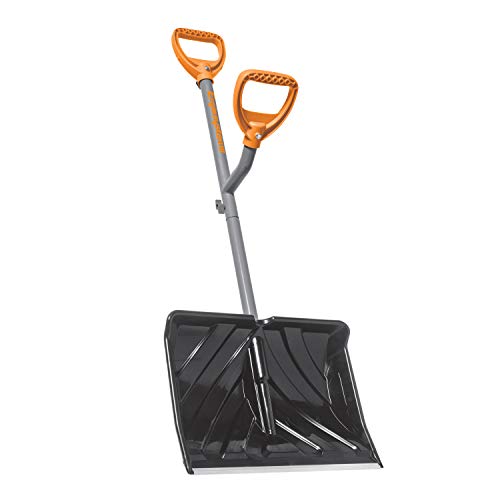
Best for steps, edges and the places a pusher cannot reach
- 18-inch push scoop blade
- Second handle mounted on the shaft
- Bent-shaft geometry to reduce back flexion
- About 4 pounds
Why buy it: the second handle is what changes the movement — it lets you lift from a more upright posture rather than bending and twisting, which is where most shoveling back injuries come from.
For a longer look at the field, including bent-shaft designs and metal versus poly blades, see our full guidance in this hub. If clearing has become genuinely hard work, an electric snow shovel for steps and walks or a snow blower for the driveway is the right next step — and for anyone in a cardiac risk group, it is the recommended one.

When to Salt Around the Clearing
A light pre-treatment before snow starts prevents the first layer bonding to the concrete, which makes every subsequent clearing easier. Keep it light — heavy snow buries and dilutes it. The main application belongs after you have cleared, on the thin remaining film where it can actually work, and it should be spread thinly rather than poured.
Temperature decides the product. Rock salt (sodium chloride) stops working effectively somewhere around 15 to 20°F; calcium chloride keeps melting far colder, down toward -25°F according to extension guidance such as Iowa State University Extension. Whatever you use, keep it off new concrete — anything less than a year old is vulnerable, and heavy repeated application on spalling or unsealed concrete accelerates surface damage.
If you have dogs, read our page on ice melt and dogs before you buy anything labeled pet safe — the term is not regulated.
The Short Version
Clear early and often — every 2 to 4 inches in a serious storm — because the snow only gets heavier and the pile only gets harder to move. Push rather than lift, take small loads, warm up, and take breaks. And if you are older, sedentary, or have any heart condition, do not shovel heavy wet snow at all: that is the plain advice of the American Heart Association, not an abundance of caution.
More from this hub: leaf blowers & yard cleanup · best snow blower · how to use a snow blower · best electric snow shovel · how we rank.
This page is general information, not medical advice. If you have a heart condition or any doubt about your fitness for heavy exertion, ask your doctor before clearing snow. Links to products are affiliate links; we do not test products first-hand — how we rank.