 Garden

Affiliate Disclosure
Some links on this page are affiliate links. As an Amazon Associate, we earn from qualifying purchases — at no extra cost to you. We do not buy, test, or physically handle the products we cover; our rankings come from aggregated owner reviews, ratings and expert consensus. Commissions never change our verdicts. How we rank · full disclosure.
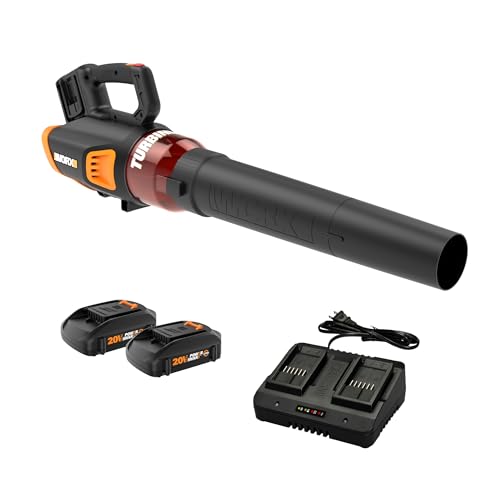
The verdict: the WORX WG584 is the blower to buy for a quarter-acre suburban lot where the job is driveways, decks and a moderate fall leaf drop. It earns 4.4 stars for pairing a brushless motor and roughly 480 CFM with two batteries and a charger in the box, at a price where many rivals sell the tool alone. Skip it if your property runs to half an acre or more, if you deal with wet matted leaves regularly, or if you need to work for an hour without stopping.
Best for quarter-acre suburban lots, driveways, decks and dry fall leaves
- 40V from two 20V Power Share batteries, brushless motor
- Turbine fan design moving roughly 480 CFM on high
- Two batteries and a dual-port charger included
- Two-speed control with a hyper-stream nozzle
Why buy it: starts with a trigger, needs no gas or mixing, and includes the batteries — which is usually where the real cost hides.
What owners consistently praise
It starts, every time, instantly. The most common positive in the record is not about power at all — it is about never again pulling a starter cord on a machine that has sat in a shed since last November. No fuel mixing, no stale gas, no carburetor cleaning, no spark plug. Owners switching from a two-stroke describe this as the reason they use the blower more often, and a tool you actually use beats a more powerful tool you avoid.
Power is adequate for the job it is sold for. Around 480 CFM on high, driven by a brushless motor and a turbine-style fan, moves dry leaves off a lawn, clears a driveway and blows out a garage without difficulty. Owners on quarter-acre lots consistently report finishing the whole property on one charge. The two-speed control matters more than it sounds: low is enough for a deck or a flowerbed edge without scattering mulch, and it roughly doubles the runtime.
Both batteries and the charger are included. On battery yard tools this is frequently where the real cost hides — a bare-tool listing looks cheap until you add two batteries and a charger. Here they are in the box, and if you already own WORX 20V tools the packs interchange across the whole Power Share range.
It is much quieter than gas. Roughly 60 to 70 decibels at operator distance against 90-plus for a two-stroke, which is the difference between needing hearing protection and merely preferring it — and, in a growing number of cities, the difference between legal and not.

What owners actually complain about
Runtime is the ceiling, and it is a hard one. Twelve to twenty minutes on high. In cold weather, less. For a small lot that is enough; for anything approaching half an acre it means stopping to charge partway through, which turns a 40-minute job into an afternoon. This is the single most-repeated complaint and it is inherent to the format rather than to this model. A second pair of batteries is the fix, and it should be budgeted for at purchase rather than discovered in November.
Wet leaves defeat it. A matted wet layer on a lawn does not lift in a single pass. Short close-range bursts at a shallow angle will break it up, but it is slow work, and owners in the Pacific Northwest and the Northeast say so plainly. Every handheld blower struggles here; the honest answer for routinely wet cleanup is a backpack unit — see best backpack blower for wet leaves.
Battery charge time and degradation. An hour to bring both packs back up, and — as with every lithium tool — capacity falls over several seasons, so the runtime you get in year four is not the runtime you got in year one. Storing batteries at partial charge in a cool place rather than fully charged in a hot garage measurably slows that.
Weight and ergonomics. Around seven and a half pounds with both packs fitted, carried at arm's length. It is manageable for a driveway and tiring across a whole yard, and owners with wrist or shoulder problems mention it. The two-speed switch is also less useful than a variable trigger — you get two settings rather than modulated control, which matters when working near mulch beds.
It is a proprietary platform. The 20V Power Share packs work only in WORX tools. Buying this is a commitment to one manufacturer for whatever yard tool you buy next.

Who should buy something else
If your property is half an acre or more, or if you clear leaves for hours rather than minutes, buy a backpack blower. The harness moves the weight off your arm, the airflow is in a different class, and gas models have no runtime limit at all. Our best backpack blower roundup covers both gas and battery options, and handheld vs backpack leaf blower sets out where the line falls.
If you only clear a driveway and a small deck, this is more blower than you need — a corded electric or a lighter battery unit will do it for far less. See best budget leaf blower.
Before you buy anything, two pages are worth the five minutes: CFM vs MPH explained, because the specification that sells blowers is not the one that clears leaves, and gas vs battery leaf blower. If you are in California or another jurisdiction phasing out small gas engines, are gas leaf blowers banned in California may make the decision for you. The full ranked field is in our best cordless leaf blower roundup.

Specifications
| Model | WORX WG584 |
| Voltage | 40V (two 20V Power Share batteries) |
| Motor | Brushless |
| Airflow | Approx. 480 CFM on high |
| Speeds | Two, plus hyper-stream nozzle |
| Runtime | Approx. 12 to 20 min high, 30 to 45 min low |
| Weight | Approx. 7.5 lbs with batteries |
| In the box | Two 2.5 Ah batteries and a dual-port charger |
| Owner rating | 4.4 stars (verified, see card above) |
How we reached this verdict
We do not buy or operate this equipment. This review is built from the aggregated owner-review record, weighted toward reviews written after a full fall season or more, where battery degradation, wet-leaf performance and real runtime actually surface. The star rating and review count on the card above are pulled from licensed Amazon listing data and refresh automatically, so nothing here is a hand-typed statistic. Full method: how we rank.
Check price on Amazon → (paid link)
More from this hub: leaf blowers and yard cleanup · best leaf blower · how to clear leaves fast · how many decibels is a leaf blower · how we rank.