 Garden

Affiliate Disclosure
Some links on this page are affiliate links. As an Amazon Associate, we earn from qualifying purchases — at no extra cost to you. We do not buy, test, or physically handle the products we cover; our rankings come from aggregated owner reviews, ratings and expert consensus. Commissions never change our verdicts. How we rank · full disclosure.
Winterize an above ground pool once water temperature holds below 60°F. The sequence is: deep clean, balance the chemistry to pH 7.2 to 7.6 and alkalinity 80 to 120 ppm, add winterizing shock and algaecide, remove ladders and returns, lower the water 4 to 6 inches below the skimmer for a solid cover, disconnect and fully drain the pump, filter and hoses, plug the skimmer and return, float an air pillow, and fit and secure the cover. Never drain the pool completely. The water is what holds the wall round through the winter.
When should I close the pool?
Water temperature decides, not the calendar. At 60°F and below, algae growth effectively stops and chlorine demand drops to near zero, so the winterizing chemicals you add will still be doing their job in April. Close a pool at 75°F and those chemicals are consumed within weeks, which is the single most common reason people open a green pool in spring after doing everything else right. Buy a $10 floating thermometer and wait for three consecutive days under 60°F. In the Upper Midwest and Northeast that is typically late September to mid October, in the mid-Atlantic mid to late October, and in the Southeast often November.
What chemistry do I need before closing?
Balance the water 24 to 48 hours before you cover it, with the pump running so everything mixes. Balanced water protects the liner through five months of no circulation; unbalanced water etches, stains or wrinkles it. Test and correct in this order, because each reading affects the next.
| Reading | Closing target | Why it matters over winter |
|---|---|---|
| Total alkalinity | 80 - 120 ppm | Buffers pH so it does not drift acidic and etch the liner |
| pH | 7.2 - 7.6 | Low pH attacks vinyl and metal; high pH scales |
| Calcium hardness | 175 - 275 ppm (vinyl) | Low calcium makes water aggressive to metal parts |
| Free chlorine | Shock to 10 - 12 ppm, let fall to 3 - 5 | Kills what is in the water before it goes dormant |
| Cyanuric acid | 30 - 50 ppm | Protects the residual on sunny winter days |
| Algaecide | Polyquat 60, per label | Copper-free, will not stain a vinyl liner |
Use a polyquaternary algaecide rather than a copper-based one. Copper algaecides sitting in still water for months are a common cause of the blue-green liner staining owners discover at opening. Add shock first and algaecide 24 hours later, since high chlorine destroys algaecide on contact.
What is the full closing sequence?
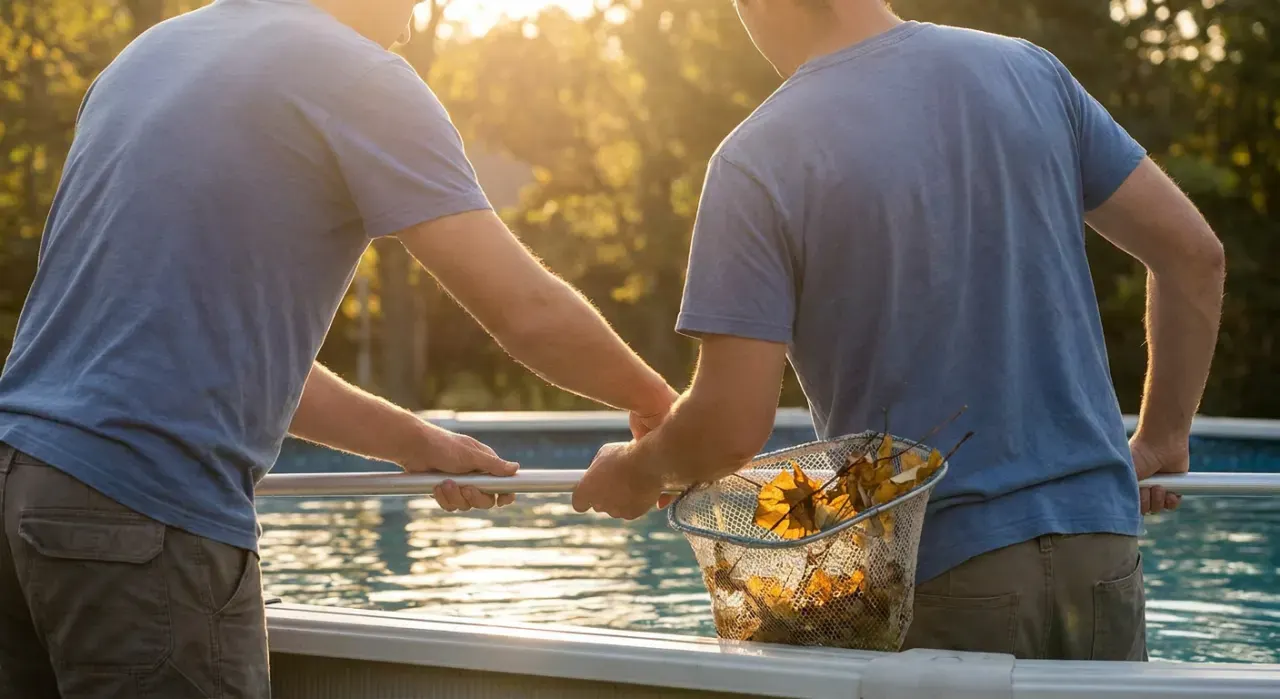
- Clean thoroughly. Brush walls and floor, vacuum to waste, net everything out. Organic debris left on the floor consumes chlorine all winter and stains vinyl.
- Balance and shock per the table above, running the pump 24 hours to circulate.
- Clean the filter. Backwash a sand filter, or hose and soak a cartridge — see how often to clean a pool filter cartridge. Store cartridges dry indoors.
- Remove everything removable. Ladder, steps, solar cover, skimmer basket, return eyeball fittings, floats, thermometer. Store dry and out of the sun.
- Lower the water. 4 to 6 inches below the skimmer opening for a solid cover, 1 to 3 inches below the return for a mesh cover, which admits precipitation and will refill through the winter.
- Disconnect and drain the equipment. Pull every drain plug on the pump and filter, tip both to empty, disconnect the hoses and drain them, and store the pump indoors. Water left in a pump volute cracks the housing at the first hard freeze.
- Plug the openings. A winter skimmer plug or an expansion plug in the return, plus a skimmer gizmo if your skimmer will still hold water. The gizmo compresses instead of the skimmer wall.
- Float the air pillow. Inflate to 60 to 80 percent, center it, and tie it to opposite sides so it cannot drift to the edge.
- Fit and secure the cover. Cable and winch through the grommets, then wall clips or cover seal to stop wind lifting it. A cover that gets under the wind is a cover that ends up in the pool.
- Check monthly. Pump standing water off the cover, clear heavy snow at the edges, and confirm the cover is still sealed.
What goes wrong most often?
Four failures account for most winter damage. Draining the pool completely, which lets the wall lose its bracing and the liner shrink beyond recovery. Leaving water in the pump or filter, which splits the housing and turns a $0 job into a $300 replacement. Closing too warm, which spends the winterizing chemicals early and delivers a green pool at opening. And letting water accumulate on the cover, which drags the cover in, contaminates the water and can collapse a wall section under the weight. A cover holding four inches of water over an 18-foot round pool is carrying more than 5,000 pounds.
Cold water is also hard on liners. Freeze-thaw cycling and UV are the two things that age vinyl fastest, which is why closing properly extends liner life materially — see how long an above ground pool liner lasts.
Does this change by climate?
Yes. In the Sun Belt where the water never approaches freezing, many owners do not close at all. They keep the cover on, run the pump a few hours a day, and maintain a low chlorine residual through the winter — which is often less work than a full close and open. In the freeze belt the full sequence above is not optional. In transitional zones such as the Carolinas, north Texas and the Pacific Northwest, the practical approach is to close the plumbing and equipment as if it will freeze, because it occasionally does, while treating the water as a mild-climate pool.
Local ordinances on pool barriers, fencing and covers still apply through the off-season, and several states require a compliant barrier year round regardless of whether the pool is in use. Check your municipal code.
We never buy, test or physically handle the products we rank. Recommendations come from aggregated owner reviews, star ratings, review volume and expert consensus — see how we rank.
More from this hub: Pools & Spas · Best above ground pools · Best pool pumps · Pool pH and chlorine levels · How we rank