 Garden


Affiliate Disclosure
Some links on this page are affiliate links. As an Amazon Associate, we earn from qualifying purchases — at no extra cost to you. We do not buy, test, or physically handle the products we cover; our rankings come from aggregated owner reviews, ratings and expert consensus. Commissions never change our verdicts. How we rank · full disclosure.
Run a single-speed pool pump 8 to 12 hours a day during swim season, and a variable-speed pump 12 to 24 hours a day at low RPM. The real target is not hours, it is turnover: one to two complete circulations of the pool volume every 24 hours. Divide your pool volume in gallons by the pump flow in gallons per minute, then divide by 60, and you have the hours needed for one turnover. Increase run time in hot weather, after storms and after heavy bather loads. Below 65°F water temperature, roughly halve it.
How do I calculate turnover for my pool?
Turnover is the number of hours it takes to pass the whole pool volume through the filter once. The formula is straightforward.
Hours per turnover = pool gallons ÷ (flow rate in GPM × 60)
Flow rate comes from the pump curve for your model at your system's resistance, usually 40 to 80 GPM for a residential single-speed pump and 20 to 45 GPM for a variable-speed pump at moderate RPM. If you have a flow meter, read it. If not, the pump's rated flow at 40 feet of head is a workable estimate.
| Pool volume | Flow 40 GPM | Flow 60 GPM | Flow 25 GPM (VS, low) |
|---|---|---|---|
| 10,000 gal | 4.2 hr | 2.8 hr | 6.7 hr |
| 15,000 gal | 6.3 hr | 4.2 hr | 10.0 hr |
| 20,000 gal | 8.3 hr | 5.6 hr | 13.3 hr |
| 25,000 gal | 10.4 hr | 6.9 hr | 16.7 hr |
| 30,000 gal | 12.5 hr | 8.3 hr | 20.0 hr |
One turnover a day is the minimum for a lightly used residential pool with a good sanitizer residual. Two turnovers is the target in hot weather, heavy use or when recovering from algae. Not sure of your volume? Work it out in how many gallons a 24 foot round pool holds.
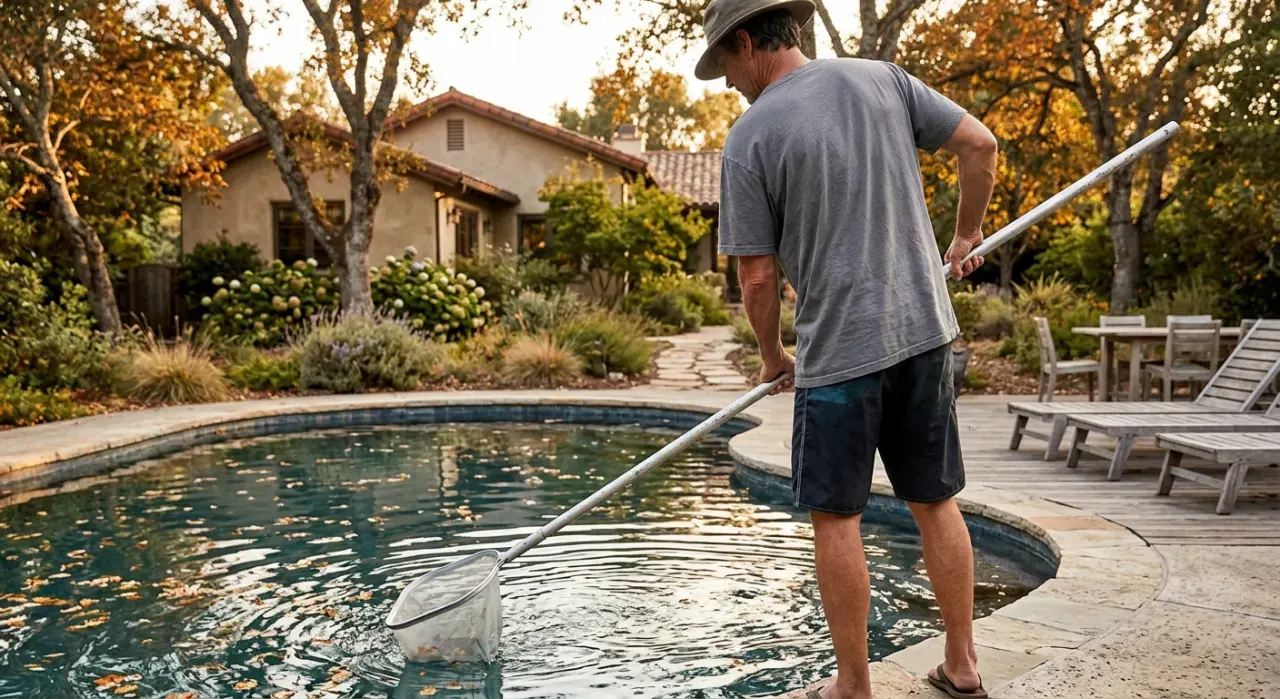
Why is slow and long cheaper than fast and short?
This is the part that changes the answer completely, and it comes from the pump affinity laws. Flow falls in direct proportion to motor speed, but power consumption falls with the cube of speed. Halve the RPM and you get half the flow for one-eighth the power. To move the same number of gallons you run twice as long, which means the same turnover costs one-quarter of the energy.
| Speed | Approx. flow | Approx. draw | Hours for 20,000 gal turnover | Energy per turnover |
|---|---|---|---|---|
| 3,450 RPM (full) | 60 GPM | ~1,800 W | 5.6 | ~10.1 kWh |
| 2,600 RPM | 45 GPM | ~800 W | 7.4 | ~5.9 kWh |
| 1,700 RPM | 30 GPM | ~230 W | 11.1 | ~2.6 kWh |
| 1,200 RPM | 21 GPM | ~90 W | 15.9 | ~1.4 kWh |
Figures are typical for a residential variable-speed pump and will differ with plumbing size and filter condition, but the shape of the curve is fixed physics. It is why the Department of Energy's efficiency standard for dedicated-purpose pool pumps pushed almost all replacement pumps to variable speed, and why ENERGY STAR certified pool pumps are rated on energy factor rather than horsepower. Our picks are in best pool pumps.

What schedule should I actually set?
| Situation | Single speed | Variable speed |
|---|---|---|
| Peak summer, water above 85°F | 10 - 12 hr | 18 - 24 hr at low RPM |
| Normal season, 75 - 85°F | 8 - 10 hr | 12 - 18 hr at low RPM |
| Shoulder season, 65 - 75°F | 6 - 8 hr | 8 - 12 hr |
| Below 65°F, pool open | 4 - 6 hr | 6 - 8 hr |
| Freeze protection only | Run on freeze sensor | Run on freeze sensor |
| Saltwater chlorine generator | Match cell output hours | Long low-speed block plus a high block |
| Suction or pressure cleaner attached | Add 2 - 3 hr at full speed | Dedicated 2 - 3 hr high-RPM block |
| Recovering from algae | 24 hr until clear | 24 hr at high RPM until clear |
Two operational notes. A saltwater pool has to run long enough for the cell to produce the day's chlorine, so cell sizing and pump schedule are linked; undersized cells force long run times. And if you have a heater, run the pump whenever the heater runs, plus a short period afterward to clear residual heat from the exchanger.
Should I split the run time into blocks?
For a single-speed pump, yes. Two blocks — for example six hours in the morning and four in the late afternoon — hold sanitizer more evenly through the day than one continuous run, and they let you dodge a time-of-use peak rate window. For a variable-speed pump, a single long low-speed block with a short high-speed period for skimming and cleaner operation is usually better, because constant slow circulation never lets the water stratify in the first place.
Whatever the schedule, filter condition changes everything. A clogged filter raises head pressure, cuts flow and lengthens the real turnover time even though the timer says the same hours. Watch the pressure gauge, not the clock — details in how often to clean a pool filter cartridge. If chlorine keeps disappearing regardless of run time, the cause is usually chemistry rather than circulation; see why your pool keeps losing chlorine.
We never buy, test or physically handle the products we rank. Recommendations come from aggregated owner reviews, star ratings, review volume and expert consensus — see how we rank.
More from this hub: Pools & Spas · Best pool pumps · Weekly pool service cost · How we rank