 Garden

Affiliate Disclosure
Some links on this page are affiliate links. As an Amazon Associate, we earn from qualifying purchases — at no extra cost to you. We do not buy, test, or physically handle the products we cover; our rankings come from aggregated owner reviews, ratings and expert consensus. Commissions never change our verdicts. How we rank · full disclosure.
Vacuum a pool once a week during swim season, twice a week if it sits under trees or takes heavy use, and daily while recovering from an algae bloom. Off-season and covered pools need it roughly every two to four weeks. The interval is driven by debris load rather than the calendar: anything organic sitting on the floor consumes chlorine as it decays, which is why a dirty pool eats sanitizer and clouds up even when the chemistry looks right on a test strip.
What schedule suits your pool?
Debris load varies more between two pools on the same street than most owners expect. Use the table as a starting frequency and adjust from what you actually see on the floor after three days.
| Situation | Vacuum | Brush |
|---|---|---|
| Normal residential pool, in season | Weekly | Weekly |
| Under trees or heavy pollen | Twice weekly | Twice weekly |
| Screened or covered pool | Every 2 weeks | Weekly |
| After a storm | As soon as debris settles | Same day |
| After heavy bather load | Next day | Waterline |
| Algae recovery | Daily, to waste | Daily, aggressively |
| Off-season, pool open | Every 2 - 4 weeks | Every 2 weeks |
| New plaster or fresh fill | Twice weekly for a month | Daily for the first week |
Brushing deserves as much attention as vacuuming and takes a quarter of the time. It lifts the biofilm and fine grit that the vacuum head glides straight over, and it is the step that actually prevents algae from establishing in the shaded end and around steps.
Why does debris on the floor matter so much?
Because organic matter is chlorine demand. Leaves, pollen, insects and lawn clippings decay in warm water, and every bit of that decay consumes free chlorine that would otherwise be available to sanitize. A pool with a layer of settled debris will show a falling chlorine reading no matter how much you add, which is the most common reason owners conclude their chlorine is somehow disappearing — the wider set of causes is in why a pool keeps losing chlorine.
Debris also stains. Leaves left on a vinyl liner or plaster for a few days leave tannin marks that can take an ascorbic acid treatment to remove, and metal objects left on the floor rust. And settled organic material is where algae takes hold first, because it shelters spores from circulating sanitizer. The CDC guidance for public pools treats visible debris and turbidity as a reason to close a pool, which is a reasonable signal for how much it matters in a backyard too.

What is the right way to vacuum?
- Brush first. Walls, steps, and the floor toward the main drain. Let the silt settle for 20 to 30 minutes.
- Prime the hose. Hold the open end over a return jet until all the air is out, or the pump will lose prime when you connect it.
- Connect to the skimmer through a vacuum plate, with the main drain valve partly closed for stronger suction at the head.
- Move slowly in overlapping straight passes, like mowing. Fast passes kick silt back into suspension and you end up doing it twice.
- Watch the pump basket. Stop and empty it when it fills, and watch the filter gauge — a rise of eight to ten psi means it is time to clean the filter.
- Use waste mode for fine silt or dead algae, keeping the water above the skimmer mouth as you go.
- Finish with the steps and behind the ladder by hand, since these are where automatic cleaners consistently miss.
If suction fades partway through, the cause is usually a clogged basket, a hose air leak or a blocked head — the diagnosis order is in why a pool vacuum loses suction. If the head keeps jamming or stopping, see why a pool vacuum keeps getting stuck.

How do you vacuum less often?
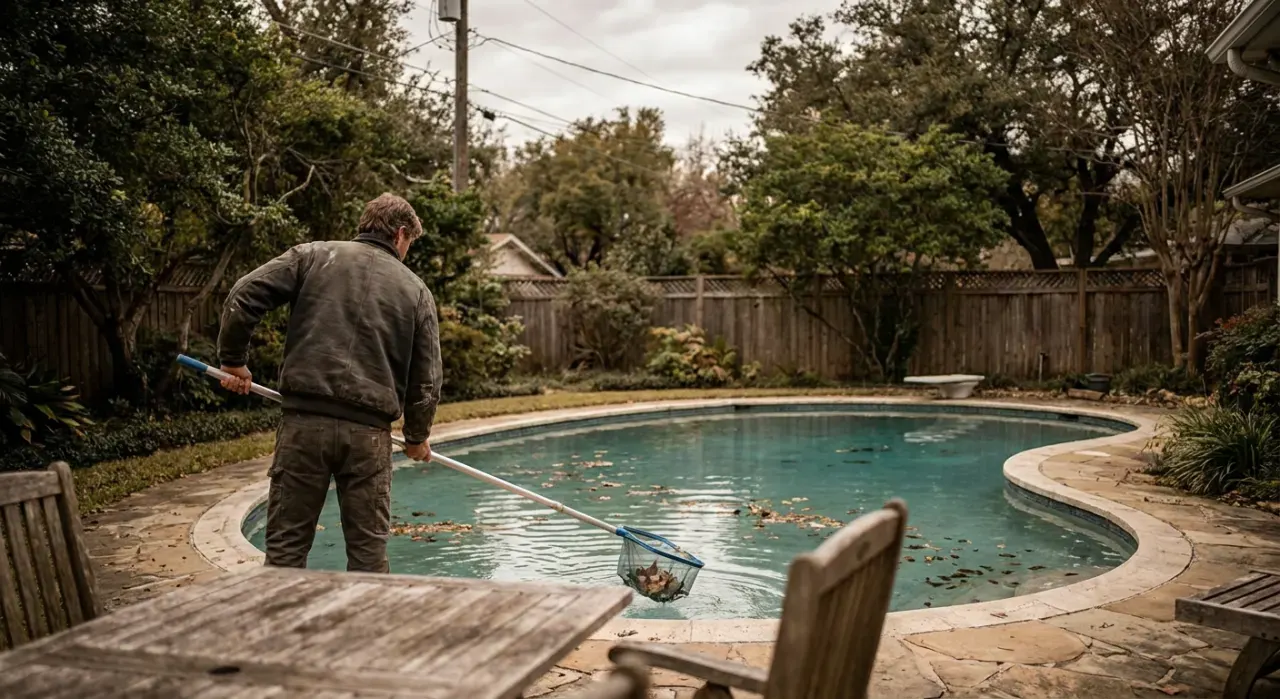
Three changes cut the frequency meaningfully. Improve circulation so debris reaches the skimmer instead of settling: aim return jets slightly downward and in the same rotational direction so the whole pool turns over, and run the pump long enough for one to two full turnovers a day, as set out in how long a pool pump should run per day. Keep the filter clean, because a loaded filter returns fine particulate to the pool. And intercept debris before it sinks — skimmer socks, a leaf net used daily during fall, and a cover during storms or the worst of the pollen drop.
Beyond that, automation is the honest answer for a high-debris yard. A robotic cleaner run every second day keeps the floor clear without touching your pump schedule, and the economics are laid out in are robotic pool cleaners worth it. Current model rankings, based on aggregated owner ratings and review volume, are in best pool vacuums.
We never buy, test or physically handle the products we rank. Recommendations come from aggregated owner reviews, star ratings, review volume and expert consensus — see how we rank.
More from this hub: Pools & Spas · Best pool vacuums · Cloudy water after shocking · How we rank