 Garden

Affiliate Disclosure
Some links on this page are affiliate links. As an Amazon Associate, we earn from qualifying purchases — at no extra cost to you. We do not buy, test, or physically handle the products we cover; our rankings come from aggregated owner reviews, ratings and expert consensus. Commissions never change our verdicts. How we rank · full disclosure.
The short answer: the highest-value step by a wide margin is a solar cover, bubbles down, on the water whenever nobody is swimming. Evaporation accounts for most of a pool's heat loss, and stopping it typically adds 5 to 10°F and holds overnight temperature within 1 to 3°F instead of 5 to 8°F. Beyond that, in order of cost-effectiveness: a windbreak, solar rings or liquid solar blanket, a DIY or panel solar heater (3 to 8°F), an electric heat pump ($2 to $6 a day), then gas or propane (fastest, most expensive).
Above-ground pools warm quickly because they hold less water than in-ground pools, and they lose heat just as quickly because the walls sit in open air. That works in your favor if you manage the surface. We do not physically handle the products we rank; our picks come from aggregated owner reviews and expert consensus, described in how we rank, with the ranked field in best above-ground pools.
The options, ranked by value
| Method | Typical gain | 2026 cost | Running cost |
|---|---|---|---|
| Solar cover (bubble blanket) | +5 to 10°F | $40 – $120 | none |
| Solar rings or liquid blanket | +2 to 5°F | $30 – $70 | liquid: $15 – $30/mo |
| Windbreak (fence, hedge, screen) | +1 to 4°F held | $0 – $400 | none |
| DIY black hose / coil heater | +3 to 8°F | $60 – $200 | pump only |
| Solar panel kit on roof or rack | +8 to 15°F | $200 – $700 | pump only |
| Electric heat pump | Sets any temperature, slow (0.5 to 1.5°F/hr) | $1,800 – $3,500 | $2 – $6/day |
| Natural gas heater | Fast (2 to 4°F/hr) | $1,600 – $3,000 | $3 – $8/day |
| Propane heater | Fast | $1,600 – $3,000 | $6 – $15/day |
| Electric resistance heater (small pools) | Slow | $300 – $900 | $8 – $25/day |
Prices are 2026 US retail and running costs assume a 15 to 18 ft above-ground pool of 5,000 to 8,000 gallons. Heat pump running cost climbs sharply once night temperatures fall below about 50°F, because a heat pump extracts heat from ambient air and there is progressively less of it to extract.
Get the cover right
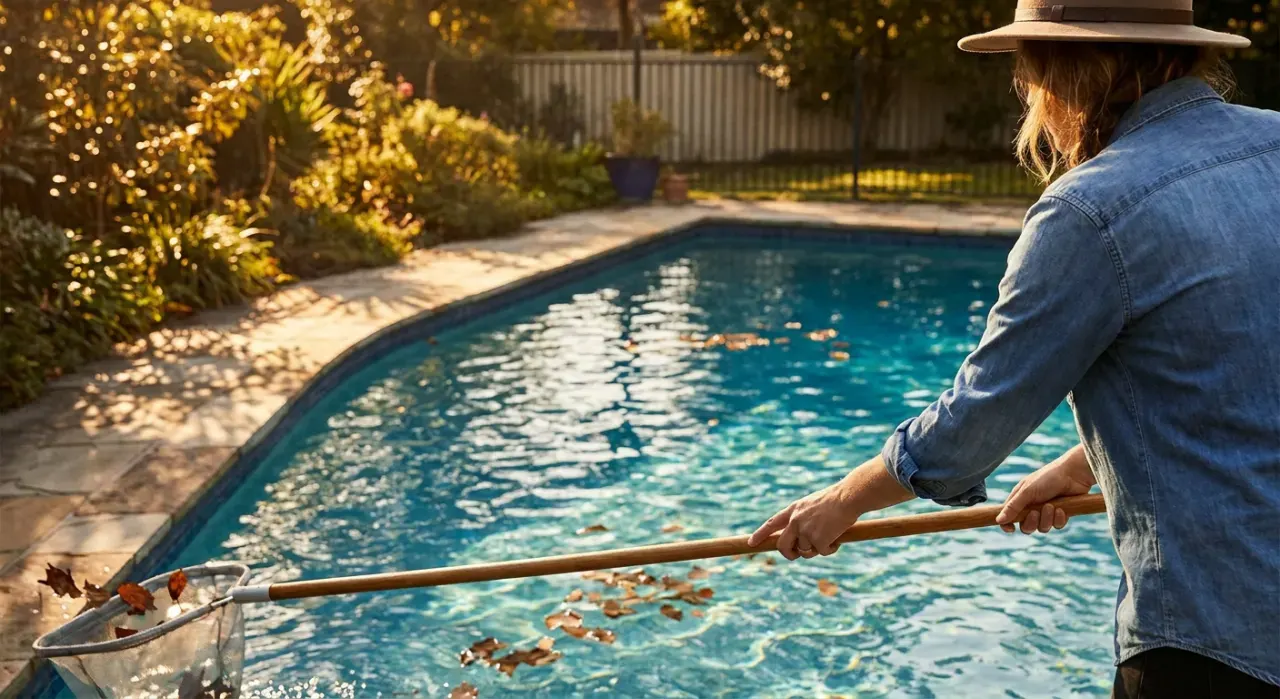
- Bubbles face down, in contact with the water. This is not a preference. The bubbles trap the insulating air and hold the cover flat.
- Cut it to the pool shape with scissors, leaving it slightly oversized so it rests on the water rather than being stretched across it.
- Use it every night and any time nobody is swimming. The overnight hours are when the temperature you gained during the day disappears.
- Thickness matters modestly. 12 mil is the budget option, 14 to 16 mil lasts longer and insulates slightly better. Expect two to four seasons before UV degrades it.
- A reel is the difference between using it and not. A $70 to $180 reel turns a two-person five-minute wrestle into a one-person 30-second job, and reviewers repeatedly mention it as the reason they kept using the cover.
- Never leave a cover on a pool being chlorinated at shock level — high chlorine attacks the plastic and voids most warranties.
A safety note that matters more on above-ground pools than people expect: floating solar covers are not safety covers. They will not support weight, and a child or pet that gets under one cannot easily get out. Remove and store the cover during swimming, and keep the ladder removed or locked when the pool is unattended.
Free and cheap gains
- Block the wind. Wind across an open water surface accelerates evaporation dramatically. A solid fence panel, hedge or even a temporary screen on the prevailing wind side holds several degrees.
- Site or angle for sun. Above-ground pools are movable at setup time. Six-plus hours of direct sun makes a large difference over a season; heavy afternoon shade from a single tree can cost 4 to 6°F.
- Run the pump during the day, not at night. Circulating water during peak sun distributes surface heat downward; circulating overnight moves warm water to the surface where it is lost.
- Consider a dark liner. A darker liner absorbs noticeably more solar energy than a pale one. Worth knowing at replacement time — see how long an above-ground pool liner lasts.
- Do not over-aerate. Fountains, aerators and jets aimed upward cool the water fast. That is useful in Phoenix in July and counterproductive in May in Ohio.
Where the heat actually goes
Understanding the loss pathways explains why the cheap fixes outperform the expensive ones so often. For an outdoor pool, the approximate split is:
| Loss pathway | Share of total | What reduces it |
|---|---|---|
| Evaporation from the surface | roughly 70% | A cover. Nothing else comes close |
| Radiation to the night sky | roughly 20% | A cover, again — it also blocks radiative loss |
| Conduction through walls and floor | roughly 5 to 10% | Insulating wall wrap or foam floor pad at setup |
| Convection from wind across the surface | varies, accelerates evaporation | A windbreak on the prevailing side |
Two practical consequences follow. First, almost everything a solar cover does is worth more than anything a heater does, because a heater without a cover is pouring energy into an open surface. Second, an above-ground pool loses proportionally more through its walls than an in-ground pool does, because the walls sit in moving air rather than in ground that is holding yesterday's warmth. A closed-cell foam pad under the pool and a reflective wrap around the outside of the wall are cheap additions at setup time and are impossible to retrofit later.
Expect a realistic ceiling on what passive measures achieve. A cover plus a windbreak plus good siting typically holds an above-ground pool 8 to 12°F above where it would otherwise sit through late spring and early fall, which in most of the US is the difference between a pool that is usable from late May to mid-September and one that is usable from late June to late August. Pushing beyond that means a heater.
If you go with a heater
Size it to the volume and the temperature rise you want. A rough guide for above-ground pools: 5,000 to 10,000 gallons is well served by a 50,000 to 100,000 BTU gas heater or a 50,000 to 75,000 BTU heat pump. Undersizing means the heater runs constantly and never catches up; oversizing on gas costs more up front but reaches temperature faster and cycles less.
Safety and code. Gas and propane heaters involve fuel lines, combustion and venting clearances, and electric heaters and heat pumps require dedicated, GFCI-protected circuits sized to the load. Gas connections and any new electrical circuit are licensed work in most jurisdictions and frequently require a permit and inspection. Codes and permit requirements are jurisdiction-specific — check with your local building department, and hire a licensed plumber, gas fitter or electrician for the connection. Pool equipment bonding requirements under the National Electrical Code are not optional and are one of the most commonly failed inspection items on above-ground installations.
For how long any of this takes to show up in the water, see how long it takes to heat a pool 10 degrees. If you are weighing whether to leave the pool up through the cold months, can you leave an above-ground pool up all year and how to winterize an above-ground pool cover it, and the running-cost picture is in how much it costs to maintain an above-ground pool. Everything else is at the pools and spas hub.