 Garden

Affiliate Disclosure
Some links on this page are affiliate links. As an Amazon Associate, we earn from qualifying purchases — at no extra cost to you. We do not buy, test, or physically handle the products we cover; our rankings come from aggregated owner reviews, ratings and expert consensus. Commissions never change our verdicts. How we rank · full disclosure.
A saltwater pool is a chlorine pool. The salt chlorine generator makes chlorine continuously from dissolved salt rather than you adding it from a bucket, and the sanitizing chemistry in the water is identical. What genuinely changes: you stop hauling chlorine, the water feels softer, pH drifts upward and needs more attention, salt is corrosive to some metals and stone, and you take on a cell that wears out every three to seven years. The target ranges you test against do not change at all.
Almost every argument about these two systems dissolves once that first sentence sinks in. The choice is not chlorine versus no chlorine. It is a monthly chore and a monthly cost versus a periodic equipment cost and a slightly different maintenance rhythm.
How a salt system actually works
You dissolve salt into the pool to roughly 3,000 ppm — for scale, seawater is around 35,000 ppm, so this is about a tenth as salty, and most people can barely taste it. Pool water then passes through a cell containing electrically charged titanium plates. Electrolysis splits the dissolved sodium chloride and produces chlorine, which sanitizes the water exactly as chlorine from any other source does. Once it has done its work, it reverts to salt and goes around again.
Salt is therefore not consumed. You lose it only through splash-out, backwashing, leaks and rain overflow, so a pool typically needs a modest top-up once or twice a season rather than continuous dosing. That closed loop is the whole appeal.
Side by side
| Salt chlorine generator | Manual chlorine | |
|---|---|---|
| What sanitizes the water | Chlorine, generated on site | Chlorine, added by hand |
| Upfront cost | $1,000 to $2,500 installed | Effectively none |
| Ongoing chemical cost | Low — salt top-ups plus balancers | Higher — continuous chlorine purchase |
| Wear item | Salt cell, $400 to $900 every 3 to 7 years | None |
| Routine chore | Check cell, brush off scale, watch pH | Refill tablets, dose liquid, watch chlorine |
| Chlorine stability | Very steady — generated continuously | Peaks and troughs between doses |
| pH behavior | Drifts upward; needs acid regularly | Depends on the chlorine type used |
| Cyanuric acid | Added deliberately, stays put | Climbs on its own if you use tablets |
| Water feel | Softer, less chemical smell | Familiar; smell means chloramines |
| Corrosion risk | Higher for bare metal and some stone | Lower |
| Chemical handling | Much less hazardous product on site | Concentrated chlorine stored at home |
The water genuinely does feel different
This is the reason most owners give for switching, and it is not imagined. Two things are happening. First, salt at 3,000 ppm makes the water feel silkier on skin. Second, and more significant, a salt pool holds a steady low chlorine level around the clock rather than the sawtooth of a pool dosed every few days, and steady low chlorine produces fewer chloramines.
Chloramines are the compounds that cause the sharp pool smell, stinging eyes and dry skin — and the counterintuitive fact worth knowing is that the smell means too little free chlorine, not too much. A pool that smells strongly of chlorine has a chloramine problem. Salt systems reduce that simply by never letting the sanitizer level crash between doses. A conventional pool dosed carefully and tested twice a week gets most of the same benefit.
What maintenance actually looks like
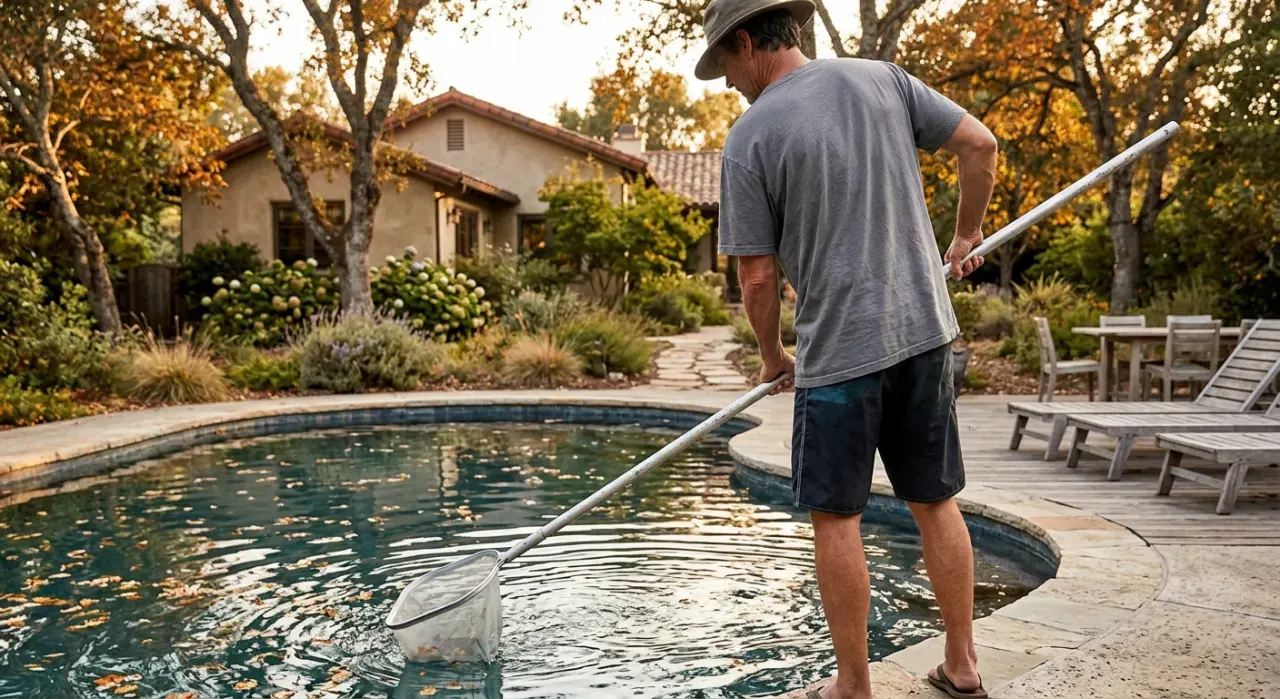
Salt systems reduce work; they do not remove it, and the work shifts rather than disappearing.
- pH needs more attention, not less. Chlorine generation is inherently a pH-raising process, so a salt pool drifts upward and needs acid on a regular schedule. Let it climb past 7.8 and much of the chlorine you are generating becomes chemically inactive, which is the classic salt-pool complaint of algae in a pool that shows plenty of chlorine.
- The cell needs inspecting and sometimes cleaning. Calcium scale builds on the plates, particularly in hard water, and a scaled cell produces less chlorine. Many modern cells self-clean by reversing polarity, but check yours a few times a season and clean it per the manufacturer's instructions.
- Stabilizer still matters. Generated chlorine is destroyed by sunlight exactly as any other chlorine is, so a salt pool still wants cyanuric acid at 30 to 50 ppm. The advantage is that it stays where you put it rather than climbing every week the way it does on a trichlor tablet diet.
- Salt gets tested and topped up, usually once or twice a season, to 2,700 to 3,400 ppm or the generator's stated range. Too low and output falls; too high and some units shut down.
- You still shock. Most generators have a boost or superchlorinate mode, but a genuine bloom or a heavy bather load still calls for a shock dose, and the chemical-handling rules are unchanged: never mix pool chemicals with each other, never combine chlorine with acid, and always add product to water rather than water to product.
Corrosion: the real drawback
Salt at 3,000 ppm is mild compared with the ocean but it is not inert, and this is where the honest owner-review record is least flattering. Reviewers of salt systems repeatedly mention faster wear than they expected on:
- Ladders, handrails and light rings — stainless is not immune, and lower grades pit noticeably.
- Heater heat exchangers, unless specified as salt-compatible.
- Natural stone coping and travertine, where salt crystallizes in the pores and spalls the surface over years.
- Nearby concrete and any untreated metal reached by splash-out.
The mitigations are straightforward and worth doing from day one: specify salt-rated hardware and heater components, fit a sacrificial zinc anode so it corrodes instead of your fittings, rinse stone coping and decking regularly, and keep the water properly balanced — badly balanced water is corrosive whether or not there is salt in it. Vinyl liners and modern fiberglass shells are generally unaffected.
The ten-year cost picture
Consider a 20,000-gallon pool over a decade. A salt system costs $1,000 to $2,500 to install, then two cell replacements at $400 to $900 each, plus salt top-ups and balancers — call it $2,500 to $5,000 all in. A conventional pool spends nothing upfront but buys chlorine every month, which on that size pool commonly runs $200 to $400 a season, so $2,000 to $4,000 over the same decade.
They land close enough that cost should not be the deciding factor. What should decide it is which pattern of ownership you prefer: a chore you do every week and a bill you pay every month, or a system that mostly runs itself and hands you a several-hundred-dollar bill every few years. Both add the same balancer costs and the same pump electricity, which is worked out line by line in pool running costs.
Which should you choose?
Choose salt if you swim often and value steady water quality, dislike storing and handling concentrated chlorine, are bothered by chloramine smell and skin irritation, and are building or renovating so that salt-rated hardware can be specified from the start.
Stay with manual chlorine if you have natural stone coping or older metal fittings you do not want to replace, if your pool is small or seasonal so the upfront cost never amortizes, if you would rather avoid a several-hundred-dollar equipment bill arriving unannounced, or if you already have a testing routine that keeps the water excellent — because a well-managed conventional pool is genuinely as pleasant to swim in.
Either way the numbers you test against are identical, and getting them right matters more than the delivery method. We do not buy or physically handle the equipment we rank; verdicts come from aggregated owner ratings and expert consensus, as described on how we rank.
Where to go next
Pool water chemistry covers every target range and the order to adjust them, which applies to both systems. Pool running costs shows the arithmetic for the pump, chemicals, water and heating. If your pool is losing sanitizer faster than it should, why my pool keeps losing chlorine. And for the equipment that matters most to either setup, the best pool pumps. Everything else sits under the pools and spas hub.