 Garden

Affiliate Disclosure
Some links on this page are affiliate links. As an Amazon Associate, we earn from qualifying purchases — at no extra cost to you. We do not buy, test, or physically handle the products we cover; our rankings come from aggregated owner reviews, ratings and expert consensus. Commissions never change our verdicts. How we rank · full disclosure.
The short version: after weighing six of the most-reviewed impact drivers on the US market against owner ratings, review volume, published torque and head-length figures and the complaints that recur year after year, the DEWALT DCF885C1 is the one we would hand to almost any homeowner. It has the torque to sink 3-inch deck screws all afternoon, it comes with a battery and charger, and the aggregated owner consensus has barely moved in a decade of selling. Below is the full ranked field, the consensus score behind each placement, and the gripes owners actually file.
An impact driver is not a second drill — it is a different tool that happens to share a battery. If you are still deciding which to buy first, read drill vs impact driver, and if the answer turns out to be a drill, our ranked field is in best cordless drills. The battery platform you pick here is the decision you live with for a decade, so it is worth reading cordless battery platforms compared before you commit.
Top Picks at a Glance

Our #1 Pick: DEWALT DCF885C1 20V MAX
The DCF885 is the impact driver equivalent of a Toyota Corolla, and that is the compliment. It produces 1,400 in-lbs of torque and spins to 2,800 RPM with 3,200 impacts per minute — enough to bury a 3-inch structural screw in pressure-treated pine without a pilot hole and without twisting your wrist. The one-handed hex collet accepts a bit with a push rather than a sleeve pull, which matters more than it sounds when you are on a ladder. Three LEDs ring the chuck, so the bit is lit rather than shadowed.
The aggregated picture behind it is unusually stable. Owner ratings sit at the top of the category, and the written reviews are dominated by people describing years of ownership rather than first impressions — the strongest signal available when nobody is testing the tool on your behalf. The people who move on from it almost always move to another 20V MAX tool, which tells you the platform rather than the driver was the reason.
Consensus Score ██████████░░ 9.2 — from the aggregated owner-review consensus
Check price on Amazon → (paid link)
The Ranked Field

Best for the homeowner who has a drill and keeps stalling it on long screws
- 1,400 in-lbs max torque, 0–2,800 RPM
- One-handed 1/4-inch hex chuck
- 5.55 in. front-to-back, 2.8 lb bare
- Battery, charger and contractor bag included
Why buy it: the impact driver the largest number of American garages already contains, and the ratings have held steady through a decade of sales.

Best for weekly users who want brushless runtime and the least wrist punishment here
- 1,500 in-lbs max torque, 0–3,400 RPM
- Brushless motor, 5.0 in. long
- 3.3 lb with battery — lightest full-size pick
- 3.0Ah battery + 30-minute rapid charger
Why buy it: the shortest, lightest full-size driver in the ranking, and the one owners describe as comfortable rather than merely powerful.

Best for decking, ledger boards and anyone already invested in M18
- 2,000 in-lbs max torque — highest here
- Four-mode DRIVE CONTROL with self-tapping screw mode
- 4.6 in. head length, 2.3 lb bare
- Two 5.0Ah XC batteries, charger and case
Why buy it: the most torque and the most control settings in the field, which is why it turns up on framing crews rather than in junk drawers.

Best for a first impact driver without buying into a jobsite platform
- 1,460 in-lbs max torque, 0–2,800 RPM
- 3,100 impacts per minute
- LED work light with 20-second delay
- 1.3Ah V20 battery and charger included
Why buy it: a genuine full-size impact driver at a bare-tool price, on a battery platform that keeps expanding at Lowe’s and on Amazon.

Best for cabinet work, ladders and anyone who found the DCF885 nose-heavy
- 1,825 in-lbs max torque
- Brushless motor, 4.98 in. front-to-back
- 2.5 lb bare — pocketable for a 20V tool
- Three LEDs for shadow-free light
Why buy it: more torque than the DCF885 in a shorter body, which is the upgrade most DEWALT owners actually want.
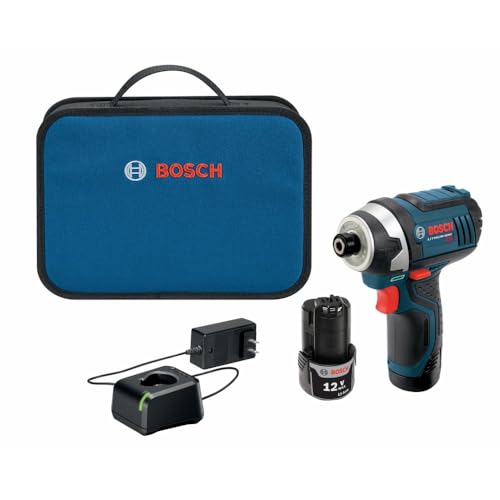
Best for overhead work, tight cabinets and long one-handed sessions
- 930 in-lbs max torque, 0–3,100 BPM
- 5.4 in. head length, about 2 lb with battery
- Three-LED ring light around the chuck
- Two 12V Max batteries, charger and case
Why buy it: small enough to hold above your head all afternoon while still driving 3-inch screws without complaint.
Quick Comparison
| Product | Best for | Rating | Price | Buy |
|---|---|---|---|---|
| DEWALT DCF885C1 20V MAX 1/4-inch Impact Driver Kit | Best Overall | — | Check (paid link) | |
| Makita XDT131 18V LXT Brushless Impact Driver Kit | Best Premium | — | Check (paid link) | |
| Milwaukee 2853-22 M18 FUEL Impact Driver XC Kit | Best for Pros | — | Check (paid link) | |
| CRAFTSMAN CMCF800C1 V20 Impact Driver Kit | Best Value | — | Check (paid link) | |
| DEWALT DCF787C1 20V MAX Brushless Impact Driver Kit | Best Compact Brushless | — | Check (paid link) | |
| Bosch PS41-2A 12V Max Impact Driver Kit | Best 12V Pick | — | Check (paid link) |

How We Rank
We never buy, test or physically handle the products we rank. Instead we aggregate what the owner base already knows: star ratings weighted by review volume, the shape of the one- and two-star distribution, published manufacturer specifications, and the consensus of trade and DIY publications that do put tools through their paces. For impact drivers specifically we weight four things — torque against real fastener jobs rather than headline numbers, head length and weight, because a driver that fits between joists gets used and one that does not gets left in the case, battery and charger value in the box, and durability signals from long-tenure reviews, especially anvil play, collet springs that stop retaining bits, and LED failures. Prices move constantly and were accurate at the time of writing. The full method is on our how we rank page.
What an Impact Driver Actually Does
Inside the housing sits a spring-loaded hammer that spins with the motor and strikes an anvil connected to the chuck — up to about 3,500 times a minute. Each strike is a short, violent burst of rotation. Because those bursts happen along the axis of the screw rather than as sustained resistance in your hand, almost none of the reaction torque reaches your wrist. That is why a small 2.5-pound tool can drive a fastener that would twist a much larger drill out of your grip.
Three consequences follow. First, cam-out mostly disappears: the bit stays seated in the screw head because it is being hammered forward as it turns. Second, screws go in far faster, which is the difference between a deck taking a weekend and taking three. Third, an impact driver is loud — genuinely loud, in the range where hearing protection is a sensible habit rather than an over-caution — NIOSH calls noise hazardous from 85 dBA up, and sets its recommended exposure limit there, which is covered in power tool safety basics.
The trade-off is precision. There is no clutch, so an impact driver will happily snap a brass screw, strip a soft screw head or sink a fastener straight through 1/2-inch drywall. Modern drivers add multi-speed modes to soften the first few seconds — Milwaukee’s four-mode DRIVE CONTROL is the most developed version — but nothing replaces feathering the trigger.
The Drivers, Reviewed
1. DEWALT DCF885C1 20V MAX — Best Overall
Covered above. Consensus Score ██████████░░ 9.2. What owners like: the torque-to-price ratio, the one-handed collet, and the fact that the battery fits the rest of a very large tool range. What owners complain about: the kit ships with a single small 1.3Ah battery in most configurations, so runtime is the first thing people upgrade; the brushed motor runs hot on sustained driving; and it is longer front-to-back than the newer brushless DEWALT models, which shows up in cabinet work. It is also — like every driver here — loud enough to annoy the rest of the house. Check price (paid link).
2. Makita XDT131 18V LXT Brushless — Best Premium
At 5 inches front-to-back and 3.3 pounds with a 3.0Ah battery attached, this is the driver owners describe as pleasant, which is not a word that gets used about power tools often. The brushless motor produces 1,500 in-lbs and noticeably more work per charge, and Makita’s rapid charger refills the pack in around half an hour. Grip shape and balance draw more unprompted praise in the reviews than any other brand here. Consensus Score █████████░░░ 9.1. Complaints: the price is well above the DEWALT kit; it ships with one battery rather than two; and LXT bare tools are rarely discounted as hard as DEWALT or Ryobi, so expanding the platform stays expensive. Check price (paid link).
3. Milwaukee 2853-22 M18 FUEL — Best for Pros
Two thousand inch-pounds of torque and a 4.6-inch head make this the most capable driver in the ranking and, in the two-battery XC kit, the most expensive. The four DRIVE CONTROL modes are the real feature: mode one crawls for small fasteners, mode four is full power, and the self-tapping screw mode drops the speed the moment the fastener seats so you stop shearing metal screws. Two 5.0Ah packs and a hard case mean it is the best-equipped kit here. Consensus Score █████████░░░ 9.0. Complaints: the price is roughly double the DEWALT kit; M18 is the costliest platform to expand into; and the sheer torque means it strips soft fasteners more easily than gentler drivers if you leave it in mode four. If you are not already on M18, the Makita is the better spend. Check price (paid link).
4. CRAFTSMAN CMCF800C1 V20 — Best Value
Around 1,460 in-lbs, 2,800 RPM and 3,100 impacts per minute, with a battery and charger in the box for roughly a hundred dollars. That combination is why it keeps outranking cheaper drivers: it is not a cut-down tool, it is a full-size driver on a cheaper platform. The delayed LED that stays lit for twenty seconds after the trigger releases is a small thing owners mention constantly. Consensus Score ████████░░░░ 8.7. Complaints: the included 1.3Ah battery is small and the charger is slow — a second pack is the most common first purchase; the brushed motor heats up on long runs; and while the V20 range keeps growing, it is thinner than DEWALT or Ryobi if you plan to build out a full garage. Check price (paid link).
5. DEWALT DCF787C1 20V MAX Brushless — Best Compact Brushless
This is the answer to the most common DCF885 complaint. It is roughly half an inch shorter, a few ounces lighter, brushless, and it makes more torque — around 1,825 in-lbs. If you already own 20V MAX batteries, the bare-tool version is one of the better upgrades in the whole platform. Three LEDs light the bit properly rather than casting a shadow of the chuck onto the work. Consensus Score █████████░░░ 9.0. Complaints: the kit battery is again small; the tool costs meaningfully more than the DCF885 for a difference most casual users will not feel; and there is no multi-mode speed control, so soft fasteners still need a careful trigger finger. Check price (paid link).
6. Bosch PS41-2A 12V Max — Best 12V Pick
Two pounds, a 5.4-inch head and 930 in-lbs of torque, with two batteries and a charger in a case. It drives 3-inch screws into softwood without drama and it is the tool people reach for inside a sink cabinet, above their head, or on a step ladder where a full-size 20V driver becomes a chore. The LED ring around the collet lights the fastener from all sides rather than from below. Consensus Score ████████░░░░ 8.6. Complaints: it slows noticeably in hardwood and on lag screws; the price is high for a 12V kit once the DEWALT and CRAFTSMAN 20V kits are on sale; and for most people it is a second driver rather than a first. Buyers who expect it to replace a full-size tool are the ones who leave the low ratings. Check price (paid link).

What Owners Actually Complain About
Read enough negative reviews across all six and four themes recur regardless of brand.
Noise. This is the single most common surprise in first-time-buyer reviews. An impact driver at full chat sits in the same range as a lawn mower, and it is a sharp, metallic rattle rather than a hum. Nobody returns a driver over it, but plenty of owners say they wish someone had mentioned ear protection first. OSHA requires engineering or administrative controls above a 90 dBA eight-hour average at work, and the same physics applies in a garage.
Small batteries in the kit. Almost every entry-level kit ships with the manufacturer’s smallest pack. On an impact driver that matters less than on a saw, but owners who take on a deck describe running out of charge halfway through the first afternoon. Budget an extra $40 to $60 for a 2.0Ah or 4.0Ah pack if you have a real project lined up.
Stripped and snapped fasteners. With no clutch, an impact driver punishes cheap screws and soft materials. The recurring beginner complaint is sinking screws straight through trim or shearing the heads off deck screws. The fix is technique — start slow, back off as the head approaches flush — plus impact-rated bits, which cost more and last much longer than the ones in a bargain set.
Collet and anvil wear. The durability complaint that shows up on drivers three or four years old is a collet spring that stops retaining bits, so they fall out under vibration, or visible play in the anvil. It appears across every brand and correlates with heavy use and cheap bits. None of it is a reason to avoid a particular model; it is the predictable cost of the category, and knowing it in advance is most of the value.
How to Choose Between Them
Work backwards from the hardest fastener you actually drive. If it is furniture, hinges and shelf brackets, you probably do not need an impact driver at all — a decent drill with a clutch is safer for soft materials, and the money is better spent on good bits. If it is a deck, a fence, a shed or a pergola, buy the DEWALT DCF885C1 and stop thinking about it. If you use tools weekly, go brushless: the Makita XDT131 for comfort and runtime, or the DEWALT DCF787C1 if you already own 20V MAX batteries. If you are framing, hanging ledger boards or driving structural timber screws, the Milwaukee 2853-22 is the only one here with real torque headroom and mode control. If you already own a full-size driver and keep banging your knuckles in cabinets, the Bosch 12V is the second tool that earns its space.
Whatever you choose, buy impact-rated bits. The single most common self-inflicted problem in this category is a standard screwdriver bit shattering under impact loads, and owners routinely blame the tool for it. And choose the battery platform on purpose rather than by accident — that decision outlives every tool in this list, and it is laid out in the battery platform guide.
The Verdict
The DEWALT DCF885C1 wins because it fits the most households at the lowest risk: enough torque for any deck a homeowner will build, a battery and charger in the box, a one-handed collet, and an owner consensus that has not wavered in years. Spend more only if you use tools weekly, in which case the Makita XDT131 is the driver owners are consistently happiest holding, or the Milwaukee 2853-22 if the fasteners are structural. Spend less and the CRAFTSMAN CMCF800C1 gives you a full-size driver for around a hundred dollars. If you own neither tool yet, read best cordless drills first — for most people the drill is still the tool to buy first — and browse the rest of the hub at power tools and workshop. Check price on Amazon → (paid link)