 Garden


Affiliate Disclosure
Some links on this page are affiliate links. As an Amazon Associate, we earn from qualifying purchases — at no extra cost to you. We do not buy, test, or physically handle the products we cover; our rankings come from aggregated owner reviews, ratings and expert consensus. Commissions never change our verdicts. How we rank · full disclosure.
The five rules, in order.
- Outdoors only. Never in a garage, basement, crawlspace, shed, carport, porch, or under a deck — an open door does not make an enclosed space safe.
- At least 20 feet from the house, and from any neighboring building.
- Exhaust pointed away from every door, window, vent, soffit, dryer outlet and air conditioning intake.
- CO alarms on every level of the home and outside each sleeping area, battery-powered or battery-backed.
- Never plug a generator into a wall outlet. Backfeeding can electrocute utility line workers. Use a transfer switch installed by a licensed electrician.
A single portable generator can emit as much carbon monoxide as hundreds of cars, and more than 100 people a year die in the United States from generator carbon monoxide. Those figures come from the US Consumer Product Safety Commission. Carbon monoxide is colorless, odorless and tasteless — there is no warning of any kind, which is what makes it so consistently lethal. People do not smell it, do not see it, and frequently lose consciousness before they understand that anything is wrong. The rules above are not cautious advice; they are what separates a working generator from a fatal one.
Why carbon monoxide kills so efficiently
Carbon monoxide binds to hemoglobin in the blood far more readily than oxygen does, forming carboxyhemoglobin and displacing the oxygen your tissues need. The heart and brain — the organs with the highest oxygen demand — fail first. That is why the early symptoms are headache, dizziness and confusion: they are symptoms of oxygen starvation, not of a poison you can feel.
The CDC describes CO poisoning symptoms as flu-like: headache, dizziness, weakness, nausea, vomiting, shortness of breath and confusion. During a storm and a power outage, that pattern is easy to attribute to stress, poor sleep or a virus. The distinguishing signs are the absence of fever, symptoms that improve outdoors and return indoors, and — the strongest signal of all — several people or pets in the same building feeling unwell at the same time.

Where a generator may and may not go
| Location | Safe? | Why |
|---|---|---|
| Attached garage, door fully open | No | Walls and ceiling hold exhaust; CO enters the house through the connecting door |
| Detached garage or shed | No | Same enclosure problem, plus stored fuel and fire risk |
| Carport or covered porch | No | A roof alone is enough to trap exhaust against the building |
| Under a deck or exterior stairs | No | Traps exhaust and heat directly under living space |
| Basement or crawlspace | No | Lethal within minutes |
| Inside an RV, van or vehicle | No | A leading cause of generator CO deaths, especially overnight |
| Against an exterior wall | No | Exhaust washes along the wall and finds openings |
| Under a tarp or in a tent | No | Any full enclosure traps exhaust; also a fire risk |
| Open yard, 20+ ft, exhaust pointed away | Yes | The only correct placement |
| Open yard under an open-sided running canopy | Yes | A roof with all four sides clear is rain protection, not an enclosure |
Two placement details do most of the remaining work. Exhaust direction matters as much as distance — a generator 20 feet away aimed at an open window is worse than one 20 feet away aimed at the yard. And wind on the day can undo a good placement, so check it and move the machine rather than accepting a bad orientation. Full detail: how far a generator should be from the house.
CO shutdown sensors: useful, not a permission slip
After sustained pressure from the CPSC on generator carbon monoxide deaths, manufacturers began fitting automatic shutdown sensors — marketed as CO Sensor, CO Watchdog, CO Detect and similar. These detect rising carbon monoxide around the machine and switch the engine off before concentrations become lethal. The industry voluntary standard behind this work is ANSI/PGMA G300, developed by the Portable Generator Manufacturers Association, and units built to it carry the certification on the box.
They are genuinely worth having, and if you are buying a generator today we would treat a CO shutdown sensor as a requirement rather than an upgrade. But understand precisely what they are: a backstop for a placement mistake, not a substitute for correct placement. A sensor can fail. It can respond slowly in a large partially enclosed space. And it cannot remove the carbon monoxide already produced before it triggered. Every rule above still applies to a generator that has one.
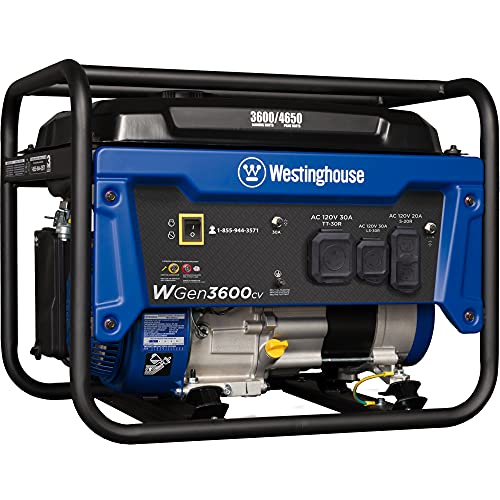
Best for a first generator, bought with the safety feature that matters most
- 4,650 peak / 3,600 running watts, gasoline
- CO sensor shuts the engine down automatically as CO accumulates
- RV Ready 30A TT-30R outlet
- Low-oil shutdown fitted
Why buy it: a shutdown sensor is the only feature on any generator that protects a person rather than the machine, and it is still rare at this price.

Best for home backup with automatic shutdown and dual fuel storage
- 6,800 surge watts, dual fuel, inverter output
- CO Watchdog automatic shutdown sensor
- Electric start with a fuel shut-off valve
- RV Ready 30A outlet
Why buy it: combines the two features that actually keep a backup generator both safe and startable — a CO shutdown sensor and propane storage capability.

Carbon monoxide alarms
Alarms are the layer that catches what placement misses — a wind shift, a vent you did not know about, a neighbor's generator, or a family member who moved the machine closer because of rain.
- Install on every level of the home and outside each separate sleeping area.
- Use battery-operated or battery-backed units. A mains-only alarm is dead during the outage when you need it most.
- Follow the manufacturer's mounting height. Guidance varies by sensor type; do not guess.
- Keep them out of garages and bathrooms and roughly 15 feet away from fuel-burning appliances, where false alarms are likely.
- Check the expiry date. Sensors have a service life, typically five to ten years, printed on the housing. An expired alarm is a decoration.
- Test before storm season, along with the batteries.
If an alarm sounds
- Get everyone and every pet outside into fresh air immediately. Do not stop to open windows or find the source.
- Call 911 from outside. Say a carbon monoxide alarm has activated and that a generator is running — it changes how responders approach.
- Count heads. Anyone unaccounted for is a job for the fire service, not for you.
- Do not re-enter until emergency services or the utility confirms it is safe.
- Get medical assessment for anyone with symptoms. Carboxyhemoglobin levels can be measured and treated, and delayed neurological effects are documented after significant exposure.

The other way generators kill
Carbon monoxide is the hazard that kills the generator's owner. Backfeeding is the hazard that kills someone else. Never plug a generator into a wall outlet to power your house. Doing so energizes your home wiring and pushes power back through the utility transformer onto the neighborhood distribution lines — where the transformer steps it back up to thousands of volts and a line worker who has tested that circuit dead can be electrocuted by it. It can also destroy your generator and start a fire when grid power returns out of phase.
The only correct method is a manual transfer switch or an approved interlock kit, installed at the service panel by a licensed electrician, with a permit and an inspection. Both work by making it physically impossible for utility power and generator power to reach your wiring at the same time. Until that is installed, run appliances directly from the generator using outdoor-rated extension cords with intact ground pins. Options and realistic costs are in our transfer switch guide.
Fuel and fire, briefly
Two more rules that belong on the same card. Never refuel a running or hot generator — gasoline vapor on a hot muffler ignites. Shut down and wait 10 to 15 minutes. And never operate a generator in standing water or with wet hands; raise it on blocks or a pallet if the ground is flooding, and keep it dry with an open-sided running canopy rather than anything that encloses it. Store fuel cans away from the generator and away from the house, never in a basement or beside a pilot flame.
Where to go next
Placement specifics are in how far a generator should be from the house, and safe cover choices — the difference between a rain canopy and a CO trap — are in best generator covers. Our ranked best portable generators flags which models ship with automatic CO shutdown. For silent, exhaust-free backup that can legally run indoors, see best portable power stations. Everything sits under the power tools and workshop hub.
Sources: US Consumer Product Safety Commission Carbon Monoxide Information Center; CDC, carbon monoxide poisoning basics; Electrical Safety Foundation International, portable generator safety; Portable Generator Manufacturers Association, which publishes the ANSI/PGMA G300 safety standard; Ready.gov, power outages.
We never buy or physically handle the equipment we rank — our recommendations come from aggregated owner reviews and expert consensus, and the method is on how we rank. Check CO-sensor generator prices on Amazon → (paid link)