 Garden


Affiliate Disclosure
Some links on this page are affiliate links. As an Amazon Associate, we earn from qualifying purchases — at no extra cost to you. We do not buy, test, or physically handle the products we cover; our rankings come from aggregated owner reviews, ratings and expert consensus. Commissions never change our verdicts. How we rank · full disclosure.
Change the oil in a new generator after the first 20 to 25 hours, then every 50 to 100 hours of running, or once a year, whichever comes first. Check the manual for your engine — some manufacturers specify the first change as early as 8 hours and routine changes at 50, while permanently installed standby units generally run 100 to 200 hours between services. The number that catches people out is what a real outage represents: a generator run continuously for three days has accumulated over 70 hours, which is an entire service interval in one event.
The intervals, by machine type
| Machine | First change | Then | Also |
|---|---|---|---|
| Portable generator, gasoline | 20–25 hours | Every 50–100 hours | At least annually |
| Inverter generator | 20 hours or 1 month | Every 100 hours or 6 months | At least annually |
| Large open-frame, heavy use | 20–25 hours | Every 50 hours | Sooner in dusty conditions |
| Air-cooled standby generator | Per commissioning schedule | Every 100–200 hours | Annual dealer service |
| Liquid-cooled standby | Per commissioning schedule | Every 250–500 hours | Annual dealer service |
Break-in matters more than owners expect. A new small engine sheds metal particles as the rings seat and the bearings bed in, and that debris ends up suspended in the oil. There is no oil filter on most portable generators to catch it, so the only way it leaves the engine is in the first oil change. Skipping it means circulating fine metal through the bearings for the next fifty hours.
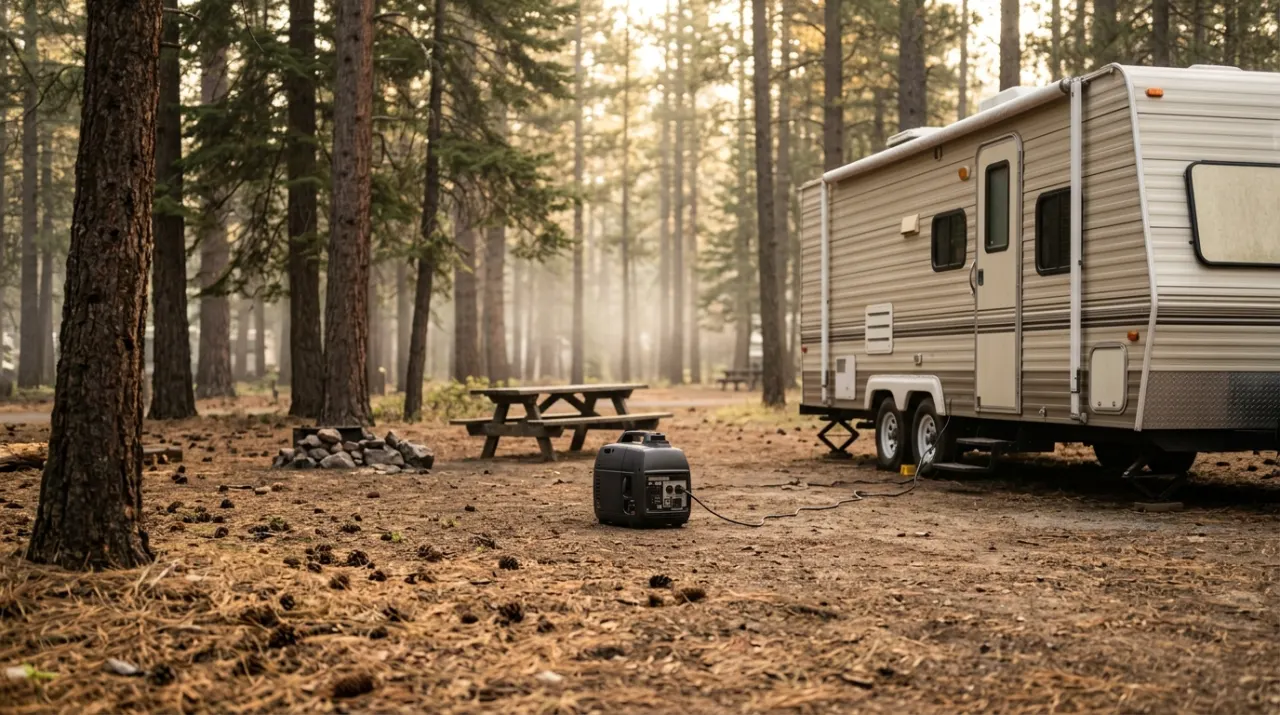
Why are the intervals so much shorter than a car's?
Three reasons, and together they explain the whole difference.
There is almost no oil. A portable generator holds 0.6 to 1.2 quarts against five or six in a car. The same amount of contamination is far more concentrated, and the same heat load has far less oil to absorb it.
There is usually no oil filter. Most small air-cooled engines rely on a splash lubrication system with no filtration at all. Everything the engine produces stays in the oil until you drain it.
They run hot and at constant speed. A conventional generator holds 3,600 rpm continuously to produce 60 Hz power, air-cooled, often under sustained load — conditions that oxidize oil far faster than a car engine's varying load and liquid cooling. Inverter generators throttle down at light load, which is one of several reasons their intervals are longer.
Counting outage hours honestly
This is where most generator maintenance goes wrong. Owners think of an outage as an event rather than as running hours, and the arithmetic is unforgiving.
| Situation | Hours accumulated | Action |
|---|---|---|
| Overnight outage, 12 hours | 12 | Log it; no change needed |
| Two-day outage, running days only | ~24 | Change if the machine is new |
| Three-day outage, continuous | ~72 | Change the oil immediately after |
| Week-long hurricane outage | ~120–160 | Change mid-outage and again after |
| Quarterly 30-minute exercise runs | 2 per year | Annual change regardless |
For long outages, the practical approach is to keep two quarts of the correct oil and a drain pan with the generator, and change it during the outage at the interval rather than waiting until power returns. Twenty minutes with a warm engine is a much better outcome than a scored cylinder on day five.

How to do it
- Warm the engine for two or three minutes, then shut it down. Warm oil carries the suspended contamination out with it; cold oil leaves a lot of it behind.
- Disconnect the spark plug lead. Non-negotiable — an accidental start with your hand near the recoil or the engine is how injuries happen.
- Position a drain pan and remove the drain plug. It is usually low on one side of the crankcase, occasionally behind a small access panel. Tilt the frame slightly at the end to clear the last of it.
- Refit the plug, snug but not overtightened — these threads are in soft aluminum and they strip easily.
- Refill on level ground. Most portables take 0.6 to 1.2 quarts. Where there is no dipstick, the correct level is the bottom of the fill port threads — fill until oil is just visible there.
- Reconnect the lead, run for a minute, shut down and recheck. The level always drops slightly as oil fills the passages.
- Recycle the old oil. Nearly every auto parts store and municipal recycling center takes used oil free. Never pour it down a drain or onto the ground.
Overfilling is a genuine and common mistake, not a harmless one. Too much oil in a small air-cooled engine gets whipped into foam by the crankshaft, which does not lubricate, and it can push oil past the rings into the combustion chamber — producing white smoke and a fouled plug that owners then diagnose as a failing engine.
Which oil, and does synthetic help?
| Conditions | Typical specification |
|---|---|
| Above 50°F | SAE 30, API SJ or higher |
| Varying, 0°F to 100°F | 10W-30 |
| Cold weather, below 40°F | 5W-30, synthetic preferred |
| Very cold, below 0°F | Full synthetic 5W-30 |
Synthetic oil is worth using in a generator, particularly in a cold climate, because it flows faster on a cold start and that is when most engine wear happens. What it does not do is extend the change interval, because the interval is set by contamination and moisture rather than by the oil breaking down. Follow the hour figure regardless of what you put in.

The rest of the annual service
Tie these to the oil change and you have covered nearly everything that ends a generator early:
- Air filter. Clean or replace annually, sooner in dusty conditions. A restricted filter richens the mixture and accelerates cylinder wear.
- Spark plug. Inspect annually, replace every 100 to 200 hours or every couple of years. They cost a few dollars.
- Fuel. Stabilize it or store the machine dry. Stale gasoline is the number one cause of a generator that will not start — see the troubleshooting sequence.
- Starter battery. Keep a tender on electric-start units, or expect to pull-start a heavy machine in a storm.
- Exercise run. Twenty to thirty minutes under a real load every three months.
Two safety notes
When you run the machine to warm the oil or to exercise it, do it outdoors only, at least 20 feet from the house, with the exhaust pointed away from doors, windows and vents — never in a garage, a shed or under a carport, even with the door open. The US Consumer Product Safety Commission states that a single portable generator can emit as much carbon monoxide as hundreds of cars, and links more than 100 US deaths a year to generator carbon monoxide. It is colorless and odorless, so there is no warning. Fit CO alarms on every level of the home. And never plug a generator into a wall outlet to power the house — backfeeding energizes the utility line and can electrocute the crews restoring your power. A transfer switch or interlock kit installed by a licensed electrician is the only correct method.
Where to go next
For expected service life and what actually ends a generator, see how long generators last. For run limits during a long outage, how long a generator can run continuously. Our ranked best portable generators notes which models make oil access easy, which matters more than it sounds when you are doing it in the dark. Everything sits under the power tools and workshop hub.
Source: US Consumer Product Safety Commission Carbon Monoxide Information Center.
We never buy or physically handle the equipment we rank — our recommendations come from aggregated owner reviews and expert consensus, and the method is on how we rank.