 Garden

Affiliate Disclosure
Some links on this page are affiliate links. As an Amazon Associate, we earn from qualifying purchases — at no extra cost to you. We do not buy, test, or physically handle the products we cover; our rankings come from aggregated owner reviews, ratings and expert consensus. Commissions never change our verdicts. How we rank · full disclosure.
The short version: the best chainsaw chaps for regular use are the Husqvarna Technical Apron Wrap — five protective layers, apron wrap coverage that carries around the inside of the leg, and a gear pocket. If cost is the obstacle, the Forester apron chaps are certified protection at a price nobody can argue with after buying a saw. For felling and bucking, where the saw moves around your body, the Oregon full-wrap is the right shape.
This page exists because of a specific number: CPSC injury data consistently shows the legs taking a large share of the tens of thousands of chainsaw injuries treated in US emergency rooms each year. A chain running at operating speed opens a thigh to the bone faster than a person can flinch. OSHA lists cut-resistant chaps alongside a hard hat, safety glasses, hearing protection, heavy gloves and ankle-covering boots as the standard chainsaw kit — equipment, not accessories.
If you are still choosing a saw, that is at best chainsaw. Everything else is at the pruning, trimming and hedges hub.
How chaps actually stop a chainsaw
This is worth understanding, because it explains every buying decision below. Chaps are not armor and they do not resist the chain by being tough. The outer shell is cut through almost instantly. Underneath sit multiple layers of long, loose ballistic fibers — commonly a warp knit of ballistic nylon or similar — and when the chain reaches them it grabs the fibers and drags them into the drive sprocket, where they wad up and jam the chain to a stop. The whole event takes a fraction of a second.
Three consequences follow. Layer count matters, because more layers means more fiber to jam the sprocket before the chain reaches skin. Coverage matters, because fibers only work where they are — a bar that lands on an unprotected calf meets nothing. And chaps are single-use: after any contact the protective layers are destroyed and the pair must be replaced, even if the outer shell looks lightly marked.
One important limitation to state plainly: chaps are designed and tested against saw chain, not against a spinning brush cutter blade or a circular saw, and their effectiveness against very high chain speeds on large professional saws is lower than against homeowner saws. They dramatically reduce injury severity. They do not make you invulnerable.
Top Picks at a Glance
Our #1 Pick: Husqvarna Technical Apron Wrap
The reason these sit at the top is coverage geometry rather than layer count. Plain apron chaps protect the front of the leg. The apron wrap design carries the protective material around the inside of the leg as well, and the inside of the thigh and knee is exactly where a bar goes when a cut finishes faster than expected and the saw swings across your body — the single most common way homeowners cut themselves.
Consensus Score █████████░ 9.1 — among the highest-rated protective equipment in the category
Five layers of protective material sit under a durable shell, with quick-release buckles that let you get out of them fast, an adjustable belt across a wide waist range, and a pocket for a scrench or felling wedges. They are built to the recognized protective standards for the category — ASTM F1897 and ANSI Z133 — which is the specification to look for on any chaps you buy.
The recurring criticisms are honest. They are hot: multiple protective layers do not breathe, and owners in southern summers consistently mention it. They are heavy compared with lightweight designs, and the weight is noticeable walking uphill. Sizing runs long for shorter users, and several owners report needing a shorter length than their waist size suggested. The buckles draw occasional complaints about durability. And they are expensive relative to basic apron chaps, though cheap relative to a leg injury.
Check price on Amazon → (paid link)
Best Chainsaw Chaps 2026: The Ranked Field

Best for regular chainsaw use where coverage and durability both matter
- Five layers of protective material with an apron wrap front
- Adjustable belt and quick-release buckles
- Gear pocket for a scrench or wedges
- Built to ASTM F1897 and ANSI Z133 protective standards
Why buy it: the apron wrap extends protection around the inside of the leg, which is where a slipped bar actually lands on most cuts.

Best for the homeowner who needs proper protection without a professional budget
- Apron-style front coverage with ballistic protective layers
- Adjustable waist across a wide size range
- Available in several lengths so the hem sits at the boot
- Meets the ASTM F1897 chainsaw protective standard
Why buy it: it removes the excuse — proper certified leg protection at a price no one can reasonably argue with after buying a saw.

Best for felling, bucking and any work where the saw moves around the leg
- Full wrap-around coverage front and back of the lower leg
- Eight layers of protective warp knit under a 600 denier shell
- Adjustable waist and leg straps
- Professional-grade construction for daily use
Why buy it: full wrap protects the back of the calf, which apron chaps leave exposed and which is where a saw ends up when you turn with it running.
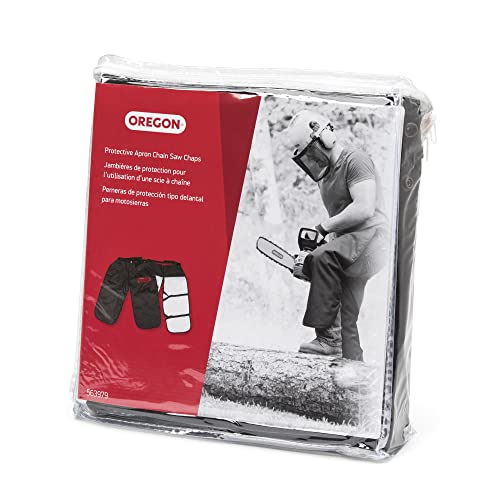
Best for hot-weather cutting where heavy chaps get abandoned
- Eight protective layers in a lighter, more breathable construction
- One-size design with an adjustable waist
- Apron-style front coverage
- Lower bulk for extended wear in heat
Why buy it: chaps only protect you when you are wearing them, and the lightweight pair is the pair that still goes on in August.

Best for occasional cutting where simple, proven apron coverage is enough
- Straightforward apron-style front protection
- Adjustable waist and leg straps
- Durable outer shell over ballistic protective layers
- A long-established design with a deep review history
Why buy it: a simple, well-proven design with nothing to fail — the pair to buy if you want protection without fittings and pockets.

Best for a first chainsaw purchase, buying all the protection at once
- Apron chaps plus a forestry helmet in one purchase
- Helmet combines hard hat, mesh face screen and ear muffs
- Adjustable waist and helmet harness
- Covers the head, face, hearing and legs together
Why buy it: it gets the whole protective set into one order, which is the realistic way people actually end up owning all of it.
Quick Comparison
| Product | Best for | Rating | Price | Buy |
|---|---|---|---|---|
| Husqvarna Technical Apron Wrap Chainsaw Chaps 40 to 42 Inch with 5 Layers Adjustable Belt and Gear Pocket | Best Overall | — | Check (paid link) | |
| FORESTER Chainsaw Apron Chaps for Men and Women with Pocket and Adjustable Waist Orange 37 Inch | Best Value | — | Check (paid link) | |
| Oregon Professional Full-Wrap Chainsaw Chaps 36 Inch with 8 Layer Warp Knit Protection 564134 | Best Full Wrap | — | Check (paid link) | |
| Oregon Protective Chainsaw Chaps 8 Layers Lightweight Breathable One Size Fits All 563979 | Best Lightweight | — | Check (paid link) | |
| Husqvarna Protective Apron Chainsaw Chaps Classic 531309503 | Best Classic Apron | — | Check (paid link) | |
| FORESTER Chainsaw Safety Kit Apron Style Chaps and Forestry Helmet with Face Shield and Ear Protection | Best Starter Kit | — | Check (paid link) |
How We Rank
We do not buy or physically handle this equipment, and we do not conduct cut testing — that is exactly what the ASTM F1897 standard and the certification bodies exist for, and it is not something a publisher should improvise. Rankings come from aggregating star ratings and review volume across large owner-review sets, checking stated layer counts, coverage type, lengths and certification claims against manufacturer documentation, and reading negative reviews closely.
Four factors set the order. Coverage geometry — apron, apron wrap or full wrap — weighted first, because unprotected area is unprotected regardless of layer count. Stated protective construction and certification. Whether owners actually wear them, taken from heat and bulk complaints, since chaps left in the shed protect nobody. And owner satisfaction weighted by review volume, with attention to fit and sizing reports. Prices were checked at the time of writing. Full method: how we rank.
The Chaps, Reviewed
1. Husqvarna Technical Apron Wrap — Best Overall
Covered above. Consensus Score █████████░ 9.1. Strengths: apron wrap coverage protecting the inside of the leg; five protective layers; quick-release buckles; a gear pocket; and construction to the recognized protective standards. Recurring complaints: hot in summer; heavy; sizing runs long for shorter users; occasional buckle durability reports; and a premium price.
2. Forester Apron Chaps — Best Value
The pair that removes the last excuse. Certified apron-style protection with ballistic layers, an adjustable waist across a wide range, and — importantly — a choice of lengths so the hem can be set to sit at the top of your boot rather than swinging around your shin. At this price there is no defensible reason to cut wood without leg protection.
Consensus Score ████████░░ 8.8 — very strong ratings, consistently praised on value
Recurring complaints: the shell material is described as less durable than the premium brands and shows wear faster in brush. Apron-only coverage leaves the back of the calf unprotected. Owners report the straps as basic and occasionally fiddly. Several describe stitching quality as inconsistent between units. And, like all chaps, they are hot.
3. Oregon Professional Full-Wrap 564134 — Best Full Wrap
The right shape for real felling work. Full wrap means the protective layers continue around the back of the lower leg, and the reason that matters is specific: when you turn while carrying a running saw, or when a saw kicks and swings, the bar can end up behind your calf where apron chaps offer nothing. Eight layers of warp knit under a 600 denier shell, in a construction built for daily professional use.
Consensus Score █████████░ 8.9 — excellent ratings from a professional user base
Recurring complaints: the hottest pair here by a clear margin, and owners in warm climates describe genuinely uncomfortable wear. Heavy and bulky enough to slow you down walking through brush. More straps to fasten, which owners report skipping when in a hurry. Sizing is reported as running large. And they are expensive.
4. Oregon Protective Chaps 563979 — Best Lightweight
The pair that solves the real-world problem: chaps you do not wear protect nothing, and heat is the single biggest reason people leave them hanging up. Eight protective layers in a lighter, more breathable construction with a one-size adjustable waist, keeping the protection while cutting the bulk that gets them abandoned in August.
Consensus Score ████████░░ 8.6 — strong ratings, particularly from warm-climate owners
Recurring complaints: apron-only coverage, so the calf is unprotected. The one-size approach fits some builds better than others and taller owners report the hem sitting high. The lighter shell shows abrasion faster. Several owners describe the leg straps as slipping during long sessions. And thinner construction makes them feel less reassuring even where the layer count is comparable.
5. Husqvarna Classic Protective Apron Chaps — Best Classic Apron
The plain version, with a deep review history behind it. Apron-style front coverage, an adjustable waist and leg straps, a durable outer shell over the protective layers, and nothing else to go wrong. For occasional cutting — a few afternoons a year of limbing and cleanup — this level of protection is proportionate and the simplicity is a genuine advantage.
Consensus Score ████████░░ 8.7 — long-established design with consistently good ratings
Recurring complaints: apron-only coverage with the calf exposed. Fewer layers than the technical models, which owners doing heavy work note. No pockets or extras. Sizing reports are mixed on length. And, in common with the whole category, they are hot to wear.
6. Forester Chainsaw Safety Kit — Best Starter Kit
Included because of how people actually behave. The single biggest gap in homeowner chainsaw safety is not chaps versus no chaps — it is that people buy chaps and never get around to head, face and hearing protection. This pairs apron chaps with a forestry helmet combining a hard hat, a mesh face screen and ear muffs, in one order, at one price.
Consensus Score ████████░░ 8.5 — good ratings, with the helmet the weaker half
Recurring complaints: the helmet is the compromise — owners describe the harness as basic and the ear muff attenuation as adequate rather than good. The mesh screen fogs and collects sawdust. The chaps are the standard Forester apron design, so the calf is unprotected. Sizing on the helmet suits medium heads best. And buying the two separately gets you better versions of each.
How to Choose Chainsaw Chaps
Decide apron or wrap by what you cut. Apron chaps cover the front and inside of the leg and are the sensible homeowner default — lighter, cooler, and covering the zone where a slipped bar lands on most cuts. Full wrap adds the back of the calf and is the right answer for felling and bucking, where you turn with the saw running and where the bar can end up behind your leg. Wrap costs you heat and weight, and heat is the reason chaps get left behind.
Get the length right before anything else. Measure from where the belt will sit to the top of your boot and buy that length. Chaps ending mid-shin leave the ankle exposed, and the ankle and lower leg is a common cut zone. Chaps that are too long catch on brush and trip you.
Look for the standard, not the layer count alone. ASTM F1897 is the US chainsaw protective clothing standard, and ANSI Z133 is the arboricultural operations safety standard that requires leg protection. Reputable chaps state one or both. Layer counts vary between designs and are not directly comparable across constructions.
Buy for the climate you actually cut in. The best chaps are the ones on your legs. If you cut in July in Georgia, the lightweight pair you will wear beats the eight-layer wrap pair hanging in the garage.
Care, storage and when to replace
- Replace after any chain contact, without exception. The protective fibers work by being destroyed, and a used pair cannot stop a second cut even if the shell looks fine.
- Follow the manufacturer's washing instructions exactly. Most permit cold gentle machine washing with mild detergent and require line drying. No bleach, no fabric softener, no tumble dryer, never dry-clean — heat and solvents degrade the fibers.
- Replace fuel- or oil-soaked chaps. Contamination reduces the fibers' ability to bind in the sprocket.
- Hang them, do not fold them under weight. Store dry and out of direct sunlight; UV degrades the shell over time.
- Inspect before each use — shell tears, failed stitching, missing straps, or fiber visible through the outer layer all mean replace.
The rest of the kit, and the injury you are protecting against
Chaps address one part of the problem. The mechanism behind most severe chainsaw injuries is kickback: when the upper quadrant of the bar nose contacts wood or any solid object, the chain cannot pull through and instead drives the bar backward and upward toward the operator's head, face and shoulder in a fraction of a second, far faster than a human reaction. That trajectory is above the chaps. It is why a helmet with a face screen, and eye protection under it, belong in the same purchase.
The mitigations for kickback itself are specific: never cut with the nose of the bar; keep the tip in view and clear of hidden branches and the ground; wrap the thumb of your leading hand fully under the front handle so the bar cannot be thrown clear; stand slightly to the side of the cutting line rather than directly behind the bar; keep the chain sharp and correctly tensioned, because a dull or slack chain grabs; and verify the chain brake stops the chain before every session. See what causes chainsaw kickback and how tight should a chainsaw chain be.
Never operate a chainsaw from a ladder, and never cut above shoulder height. Both put the bar tip out of sight and your body out of brace, and a kickback from a ladder adds a fall to a laceration. And hand any tree that leans, is split, hollow or storm-loaded — or that stands within 10 feet of a power line, where OSHA bars unqualified people entirely — to a certified arborist. The CDC sets out the same protective equipment and safe practice for post-storm cutting, which is when most homeowner chainsaw injuries occur.
The Verdict
Buy the Husqvarna Technical Apron Wrap if you cut regularly — the wrap around the inside of the leg covers the zone that actually gets hit. Buy the Forester apron chaps if price is what has been stopping you, because at that price nothing is stopping you. Take the Oregon full-wrap if you fell and buck and move around with the saw running, and the Oregon lightweight if you cut in real heat and know yourself well enough to admit the heavy pair would stay on its hook. The Forester safety kit is the sensible first purchase alongside a first saw, because it gets head, face, hearing and legs covered in one go.
Whatever you choose: chaps are not optional equipment, and they are not the place to save money after spending several hundred dollars on a saw.
Check price on Amazon → (paid link)
Next: choose the saw at best chainsaw, learn the mechanism at what causes chainsaw kickback, work safely on the ground with how to fell a small tree, or browse more gear at tools.