 Garden
Affiliate Disclosure
Some links on this page are affiliate links. As an Amazon Associate, we earn from qualifying purchases — at no extra cost to you. We do not buy, test, or physically handle the products we cover; our rankings come from aggregated owner reviews, ratings and expert consensus. Commissions never change our verdicts. How we rank · full disclosure.
Dry-clean first, then damp-clean with a microfiber flat mop wrung out until it is barely moist and a pH-neutral cleaner made for laminate — no steam, no wet mopping, no vinegar. That is the entire method, and the order matters: removing grit is what protects the finish, and mopping a gritty floor just drags abrasive around. Everything below explains why each rule exists, and what happens when you break it.
Why Laminate Is Fussy About Water
Laminate looks like a sealed, wipe-clean surface, and its top layer genuinely is. The problem is what is underneath. The North American Laminate Flooring Association describes laminate's core as wood fibers compressed under intense heat and pressure — a fiberboard panel (NALFA). Water that gets past the surface at a plank joint, or reaches the perimeter expansion gap hidden behind your baseboard, is absorbed by that fiberboard, which swells and stays swollen. The symptom is a ridge along a seam where two plank edges have peaked up, with the wear layer chipping off the high edge. It is not repairable — those planks come out.
That is why manufacturer guidance on laminate is stricter than for almost any other hard floor. Shaw's own care instructions say to "not wash or wet mop the floor with soap, water, oil-soap detergent or any other liquid," and ask owners to vacuum with a hard surface attachment rather than a beater bar and to hold indoor humidity between 35 and 65 percent year round to limit expansion and contraction (Shaw Floors, laminate care and maintenance).
The Routine, Step by Step
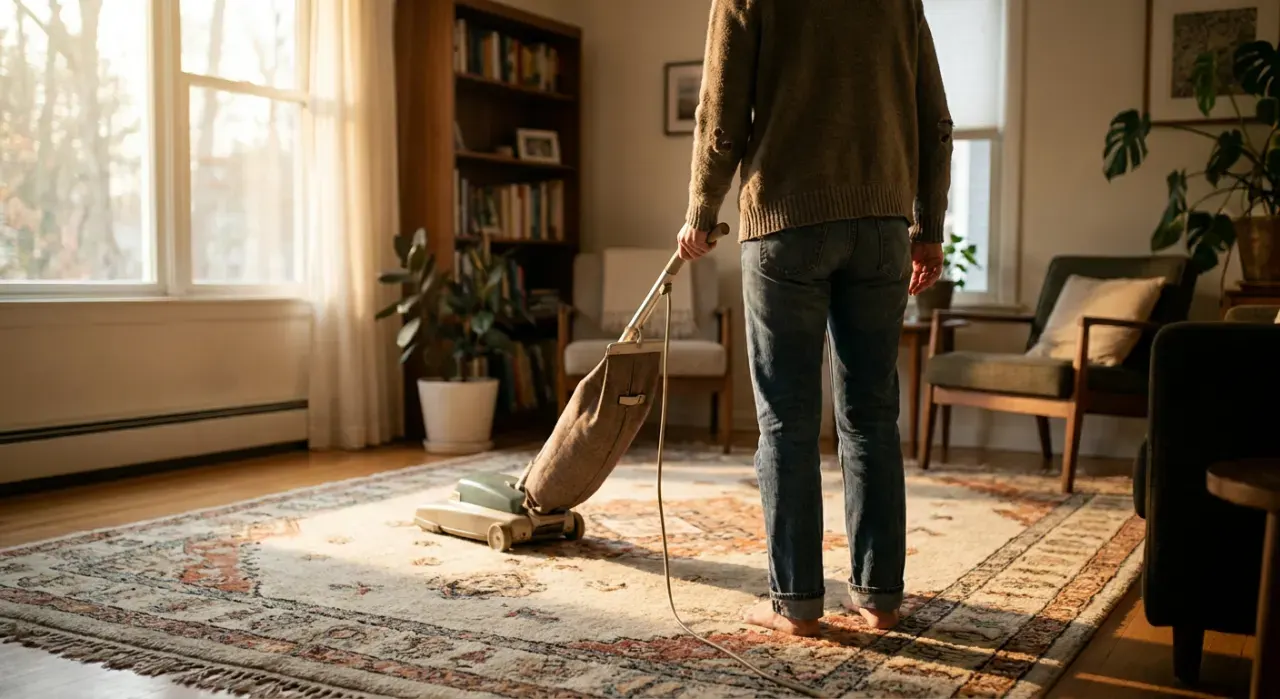
- Dry-clean the whole floor first. Vacuum on a hard-floor setting with the brush roll off, or use a microfiber dust mop. This step does more for the floor's appearance in ten years than anything else, because tracked sand and grit are abrasive and every footstep grinds them into the wear layer.
- Spot-lift anything sticky before you mop. Dried food, tree sap, a sticker. Soften with a damp cloth, then lift with a plastic scraper or an old credit card. For candle wax or chewing gum, harden it with an ice pack first and scrape gently — Shaw recommends exactly this and warns to avoid scratching the surface.
- Mix or spray a pH-neutral laminate cleaner. Either a dedicated laminate cleaner in a spray bottle, or a very dilute solution in a bucket. If in doubt, use less.
- Wring the pad until it is barely damp. The test: press the pad against a dry paper towel. If the towel wets through, wring more. It should feel cool, not wet.
- Work in three-to-four-foot sections, along the plank direction. Mopping along the boards keeps liquid moving over the joints rather than across and into them.
- Dry immediately behind yourself. A second dry microfiber pad, or a dry towel underfoot. Nothing should stay wet on the surface for more than a few seconds.
- Change pads when they stop looking clean. A loaded pad is just moving film around, and that is where streaks come from.
Frequency: dry-clean high-traffic paths every couple of days and the whole floor weekly; damp-clean the whole floor every one to two weeks in a normal household, weekly with pets or kids.
Steam: The One That Voids Warranties
Steam mops are the most destructive thing sold as a floor-cleaning product for laminate, and the reason is mechanical rather than mysterious. Steam is hot water vapor under pressure. Pressure drives it into the hairline gap of a click joint far more effectively than a damp mop ever could, and heat then makes the fiberboard core take it up faster. The damage is cumulative and invisible for months.
The genuinely useful nuance is that manufacturer positions are per product, not per category. Mannington, for instance, approves residential steam-based cleaners for one specific laminate collection while not extending that approval across its laminate range, and separately approves steam-based cleaners for its ADURA luxury vinyl products with the caveat "Never flood the floor with water" (Mannington ADURA care). So the correct action is not to argue about steam in general — it is to find your floor's care sheet or warranty document and read what it says about heat and moisture. If you cannot find it, assume steam is not permitted, because that is the safer error.
What to Use, and What Never to Use
| Use | Avoid | Why it matters |
|---|---|---|
| pH-neutral laminate cleaner | Vinegar and other acids | Acid gradually dulls and etches the wear layer, and laminate cannot be refinished |
| Microfiber flat mop, barely damp | String mop, sponge mop, bucket-wet mopping | Standing water reaches the fiberboard core through seams |
| Vacuum with brush roll off | Beater-bar upright | Shaw specifically directs owners to a hard surface attachment, not the beater bar |
| Plastic scraper for stuck-on spots | Steel wool, scouring pads, abrasive powders | They scratch the finish permanently |
| Nothing else on the surface | Wax, polish, oil soap | Laminate needs no coating; these build a haze you cannot strip |
| Plain water for a final pass | Bleach, ammonia, all-purpose degreaser | Harsh chemistry attacks the melamine surface and its seam treatment |
Spills, Pet Accidents and the 60-Second Rule
Speed is the whole game with laminate. A cup of water wiped up in under a minute is a non-event; the same cup left across a seam for an hour is a maybe. Blot rather than spread, work from the outside of the spill inward so you are not pushing liquid across more joints, and pay particular attention to the perimeter — water that runs to the wall drops straight into the expansion gap where you cannot reach it.
Pet accidents deserve extra care because urine is both liquid and mildly acidic, and it wicks along seams. Blot dry, clean with a pH-neutral cleaner, then dry again. If a smell persists after the surface is clean, liquid has reached the core or the underlayment, and no amount of surface cleaning fixes that.
Prevention Does More Than Cleaning
- Mats at every exterior door, one outside and one inside. This is the highest-value thing on the list, because it stops the abrasive grit at the source.
- Felt pads under every furniture leg, checked twice a year — pads collect grit and then act like sandpaper.
- A hard-floor mat under any caster chair. Casters roll grit and concentrate load.
- Humidity between 35 and 65 percent, per Shaw's guidance, to limit seasonal expansion and the gapping that follows it.
- Avoid rubber-backed and latex-backed rugs. They trap moisture underneath and can discolor the finish; woven or natural-backed rugs are safer.
- Trim pet nails. The most common source of visible surface scratching in a family home.
Tools Worth Owning
You need remarkably little: a microfiber flat mop with several washable pads, a spray bottle of pH-neutral laminate cleaner, and a vacuum that will not scuff the floor. That last one is the only real purchase decision — a vacuum whose brush roll cannot be switched off will scuff a laminate finish over time, which is precisely why Shaw directs owners to a hard surface attachment. Our picks for hard-floor vacuums and stick vacuums for hard floors cover models owners rate for exactly this, and a good broom is still the fastest tool for a daily pass in a kitchen. If a robot handles your floors between deep cleans, robot mop combos use a damp pad rather than steam, which is the right approach here.
If the Damage Is Already Done
Swollen, peaked plank edges cannot be sanded, filled or dried back flat. On a floating floor, individual planks can be replaced — which is one of laminate's genuine advantages — but it means working back from the nearest wall or using a specialty plank-replacement cut. Surface scratches in the wear layer can sometimes be disguised with a color-matched repair marker or wax filler pencil, though this is cosmetic, not structural. Gaps that have opened between planks are usually a seating or humidity problem rather than a defect, and a gap-repair tool closes them without dismantling the floor — see the accessory picks in our laminate spec guide.
We never buy, install or physically handle the products and materials we write about. Guidance here comes from manufacturer care documentation, published standards and aggregated owner reviews — see how we rank.
More from this hub: Vacuums & Floor Care · cleaning vinyl plank floors · laminate vs vinyl plank · vacuuming hard floors without scratching · how we rank.