 Garden

Affiliate Disclosure
Some links on this page are affiliate links. As an Amazon Associate, we earn from qualifying purchases — at no extra cost to you. We do not buy, test, or physically handle the products we cover; our rankings come from aggregated owner reviews, ratings and expert consensus. Commissions never change our verdicts. How we rank · full disclosure.
Sweep or vacuum with the brush roll off, then damp-mop with a microfiber flat mop and a pH-neutral cleaner made for luxury vinyl — and never flood the floor. Vinyl plank is far more forgiving of water than laminate, because the plank is solid polymer and cannot swell. The catch is that the floor is an assembly of planks with seams, so standing water does not hurt the vinyl — it runs through the joints and sits on the subfloor underneath, where it does real damage. Everything below follows from that one distinction.
Why the Rules Differ From Laminate
Laminate's core is compressed wood fiber and water reaching it is terminal. Vinyl plank has no wood fiber in it at all — SPC is limestone powder in PVC, WPC is a foamed polymer core — so an individual plank could sit in a bucket for a month unchanged. That is a genuine advantage and it earns vinyl a real difference in cleaning routine: you can use a properly damp mop, you can clean up a spill at your leisure, and a bathroom or laundry install is not a gamble.
What has not changed is the subfloor. Click joints are tight, not sealed, and every floating floor has a deliberate expansion gap at the perimeter behind the baseboard. Water on the surface finds both. Underneath, plywood swells and grows mold, and a concrete slab holds the moisture in a sealed cavity with no airflow. Manufacturers state the rule directly rather than explaining it — Mannington's ADURA care instructions say "Never flood the floor with water" and add "Do not use abrasive cleaners, steel wool or scouring powder, as these may scratch your floor" (Mannington, ADURA care and maintenance).
The Routine
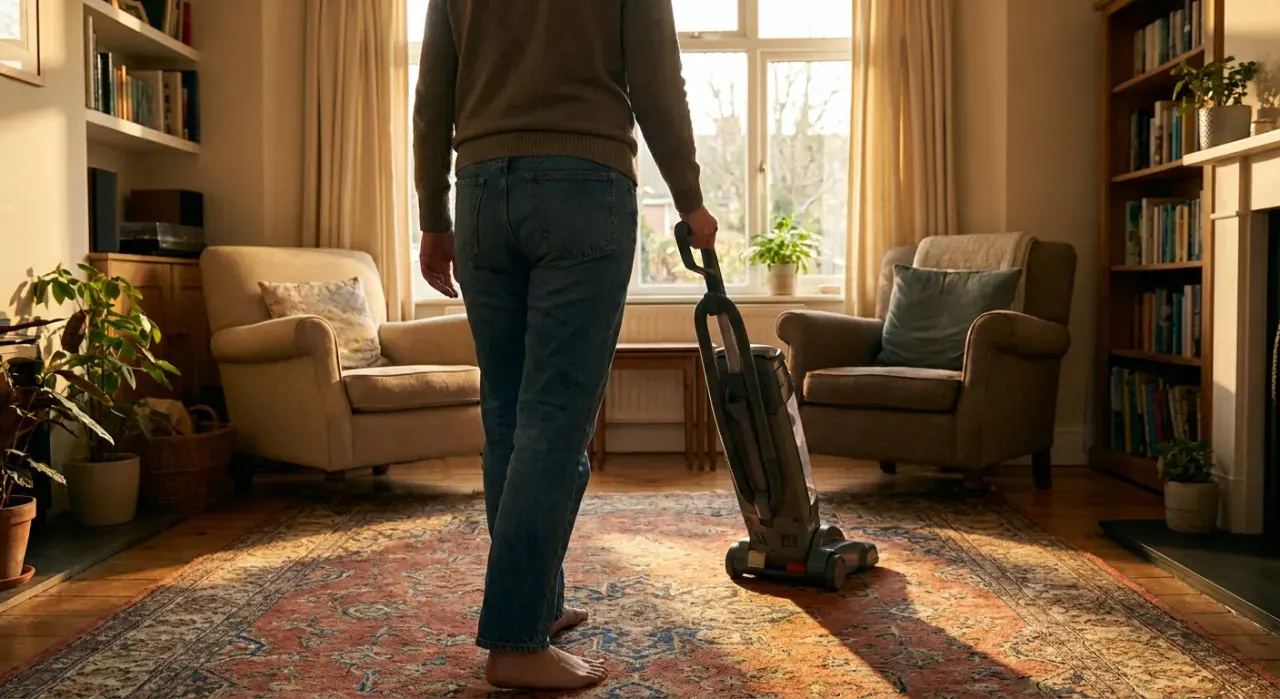
- Dry-clean first, and do it often. Sweep with a soft broom or vacuum on a hard-floor setting with the brush roll switched off. Grit is abrasive and every step grinds it into the wear layer — this is what actually determines whether the floor still looks new in year ten.
- Damp-mop with a microfiber flat mop. Wring it out well. Damp is right; wet is not. A pH-neutral luxury vinyl cleaner, or a very dilute non-sudsy cleaner in warm water, is all you need.
- Work in sections along the plank direction. Following the boards keeps water moving over the joints rather than across them.
- Do not let liquid stand. If a section still looks wet after you pass, you used too much. Follow with a dry pad in high-risk areas — bathrooms, in front of a dishwasher, around a fridge water line.
- Change the pad when it stops looking clean. Streaks on vinyl are nearly always a loaded pad or too much product, not the floor.
- Spot-treat scuffs separately. Black rubber sole marks lift with a melamine foam sponge used lightly and with almost no pressure, or with the manufacturer's recommended spot cleaner. Do not scrub — the wear layer is what you are polishing away.
Frequency: sweep or vacuum traffic paths every day or two, damp-mop the whole floor weekly in a busy house or every couple of weeks otherwise. Kitchens and entries want more; bedrooms want much less.
Use and Avoid
| Use | Avoid | Why |
|---|---|---|
| pH-neutral luxury vinyl cleaner | Vinegar and acidic cleaners | Acid gradually dulls the wear layer, and vinyl cannot be refinished |
| Microfiber flat mop, wrung out | String or sponge mop, bucket-wet mopping | Standing water routes to the subfloor through seams and the perimeter gap |
| Vacuum with brush roll off | Beater-bar upright | Stiff bristles scuff a soft vinyl surface |
| Melamine foam sponge, very lightly, for scuffs | Abrasive pads, scouring powder, steel wool | Explicitly warned against by manufacturers; they scratch permanently |
| Nothing on the surface | Wax, polish, acrylic “mop and shine” | Mannington says never wax, polish, sand or lacquer; polish builds a haze |
| Mats labeled safe for vinyl | Rubber-backed and latex-backed mats | Compounds in rubber migrate into vinyl and stain it permanently |
The Stain That Surprises Everyone: Rubber
If a yellow or brown patch appears under a door mat, under caster wheels, or under a rubber furniture foot, the floor is not dirty — it is stained from within. Antioxidant compounds used in rubber and latex backings migrate into vinyl over time and discolor it, which is why manufacturers of resilient flooring routinely warn against rubber-backed and latex-backed rugs. The mark is in the material, not on top of it, so no cleaner removes it and the only remedy is replacing the affected planks.
The practical consequences: buy mats specifically labeled as safe for vinyl or resilient floors, usually with a woven or colorfast backing; use felt or hard-plastic furniture pads rather than rubber ones; and if you park a bike or a car on vinyl, put a barrier under the tires.
Steam: A Per-Product Permission
Vinyl is the one hard-floor category where steam is sometimes genuinely approved. Mannington states that it "approves the use of residential steam based cleaners that are designed for use on hard surface floors" for its ADURA luxury vinyl products. Other manufacturers prohibit it and exclude steam damage from warranty coverage, and the reasons are specific: heat softens adhesive on glue-down and peel-and-stick installs, and it drives moisture into seams on floating installs.
So the correct action is not to take a position on steam in general. It is to find your product's care sheet or warranty document and read what it says about heat. If you cannot identify the product — a common situation in a house you bought — assume steam is not permitted. A barely damp microfiber pass cleans just as well, and a robot with a damp mopping pad handles maintenance cleaning between deep cleans without heat at all; our robot vacuum and mop combo picks cover that field.
Protecting a Soft Floor
Cleaning is only half of vinyl care, because the material's weakness is not dirt — it is dents. Vinyl is a thermoplastic that creeps under sustained point loads, so a refrigerator leveling foot, an office chair caster or a small-diameter furniture glide leaves a depression over weeks that does not recover.
- Wide furniture pads, not small felt dots — spread the load over as much area as possible.
- A hard-floor mat under caster chairs.
- Plywood or hardboard runway before you walk an appliance across the floor. This is the single most common cause of a brand-new vinyl floor arriving damaged.
- Blinds or UV film on strong south-facing glass. Vinyl expands with heat and prints fade; a sun-flooded strip in front of a patio door is the usual first place a vinyl floor shows its age.
- Trim pet nails, and keep an eye on grit tracked in from a gravel drive.
If Water Gets Under the Floor
Surface water is a non-event on vinyl. A real leak is not, and the reason has nothing to do with the plank. If a dishwasher hose, a supply line or an appliance lets go, the water is under the floor and out of reach of any mop. The EPA's guidance sets the clock: "It is important to dry water-damaged areas and items within 24-48 hours to prevent mold growth" (A Brief Guide to Mold, Moisture and Your Home).
Extract the surface water with a wet/dry vacuum, then get air moving. For anything more than a small volume, lifting planks at the perimeter to ventilate the cavity underneath is the right call even though it feels excessive — a floating floor seals the wet subfloor away from the air that would otherwise dry it. Our page on whether vinyl plank is actually waterproof works through this distinction properly.
We never buy, install or physically handle the products and materials we write about. Guidance here comes from manufacturer care documentation, published standards and aggregated owner reviews — see how we rank.
More from this hub: Vacuums & Floor Care · cleaning laminate floors · laminate vs vinyl plank · how long vinyl plank lasts · hard-floor vacuums · how we rank.