 Garden
Affiliate Disclosure
Some links on this page are affiliate links. As an Amazon Associate, we earn from qualifying purchases — at no extra cost to you. We do not buy, test, or physically handle the products we cover; our rankings come from aggregated owner reviews, ratings and expert consensus. Commissions never change our verdicts. How we rank · full disclosure.
The short answer: the best 100 ft garden hose is the Flexzilla 5/8 inch x 100 ft. It suits most long runs because of a property that matters far more at this length than at 50 feet: zero memory. Hybrid polymer does not try to spring back into a coil, so the hose lies flat where you drop it, sprinklers stay put instead of being dragged sideways, and you spend no time wrestling loops. It also stays flexible in cold weather, where vinyl stiffens into something unmanageable.
Before you choose, two things about 100-foot hoses that nobody mentions on the listing: diameter decides your flow, and weight decides whether you actually use the whole length. Both are below.
What 100 Feet Costs You in Flow
Static pressure at the spigot barely changes with hose length. Flow does, because friction inside the hose scales with length and falls sharply as diameter drops. Typical published figures at around 40 psi supply:
| Hose diameter | Flow at 50 ft | Flow at 100 ft | Verdict at 100 ft |
|---|---|---|---|
| 1/2 in | ~9 gpm | ~6 gpm | Avoid — sprinklers will struggle |
| 5/8 in | ~17 gpm | ~12 gpm | The right default for a home |
| 3/4 in | ~28 gpm | ~23 gpm | Overkill unless feeding several sprinklers |
Two practical consequences. If you run an oscillating sprinkler at the end of a 100-foot line, 5/8 inch is the minimum — a half-inch hose will leave it wilting. To find out what a sprinkler actually delivers, EPA WaterSense suggests setting empty tuna cans around the lawn and timing how long it takes to fill them with half an inch of water. And if you are joining two 50-foot hoses instead of buying one 100-foot hose, you add a coupling that is a further restriction and a further leak point; a single length is better on both counts.
And What It Costs You in Weight
| Type | Empty, 100 ft | Full of water |
|---|---|---|
| Rubber (Dramm) | ~20–25 lb | ~35–38 lb |
| Multi-layer vinyl (Gilmour) | ~15–18 lb | ~30 lb |
| Hybrid polymer (Flexzilla) | ~12–15 lb | ~27 lb |
| Stainless (Bionic Steel) | under 7 lb | ~20 lb |
| Expandable (TheFitLife) | ~5 lb | ~15 lb |
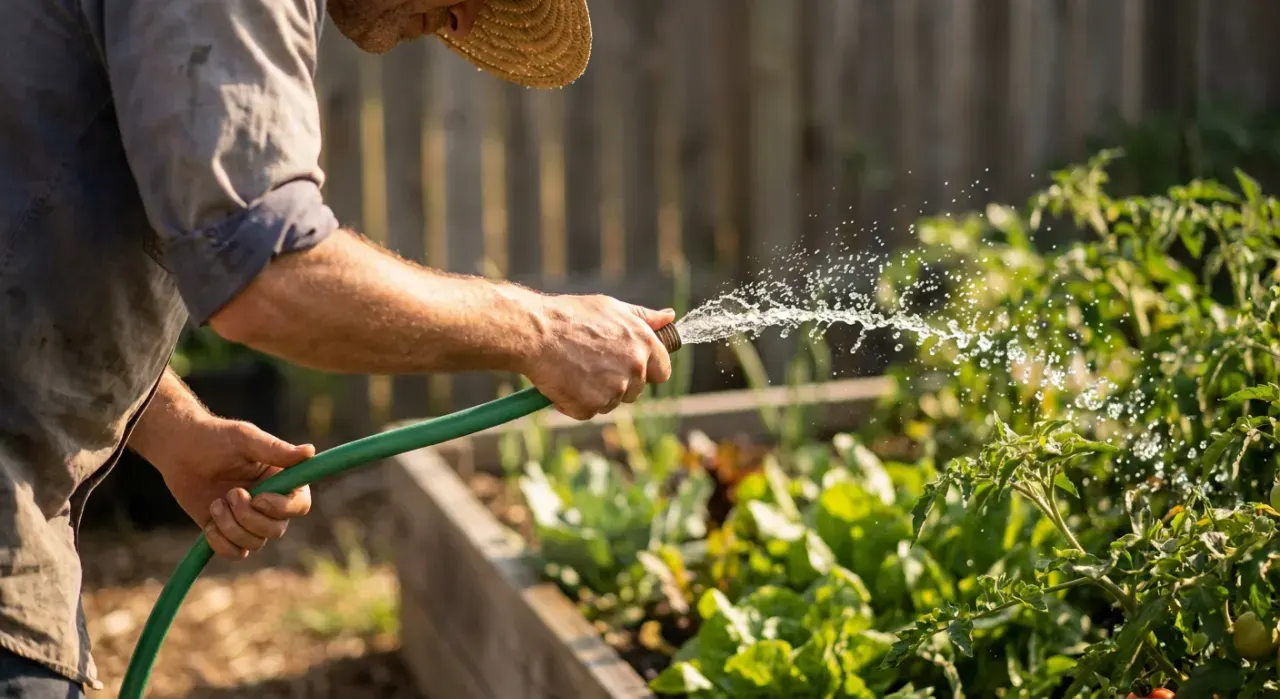
A hundred feet of 5/8 inch hose holds about 1.6 gallons, or roughly 13 pounds of water. That is why a rubber hose at this length is genuinely a two-hands job and why so many people who buy one end up using only the first 50 feet. Be honest about who will be dragging it.
Top Picks at a Glance
Our #1 Pick: Flexzilla Garden Hose 5/8 in x 100 ft
Flexzilla is a hybrid polymer hose, which is a genuinely different material from vinyl or rubber and behaves differently in the two ways that matter over 100 feet.
The first is zero memory. A vinyl hose remembers the coil it was shipped in and spends the rest of its life trying to return to it — which at 50 feet is mildly irritating and at 100 feet means a hose that loops, twists and drags your sprinkler out of position. Flexzilla lies where you put it. Owners describe it as the difference between placing a hose and fighting one, and it is the single most consistent theme in the review record.
The second is temperature range. It stays flexible from roughly 40°F below zero to 150°F. Vinyl at 35°F is stiff enough to be genuinely hard to coil, and vinyl on a July driveway goes soft and kinks. Neither happens here.
The fittings are crush-resistant aluminum with an oversized O-ring at the spigot end, which is where the majority of hose leaks originate. It is drinking-water safe, so it is fine for filling a dog bowl or a paddling pool.
Honest limitations, and they are real. The outer jacket is grippy, so it drags on rough concrete and picks up dirt more than a smooth vinyl hose. It is not immune to kinking — it kinks less, but a sharp bend under pressure will still fold. And aluminum fittings, while crush-resistant, are softer than brass and can deform if overtightened with pliers, so tighten by hand. At around $80 it is mid-priced for this length.
Check price on Amazon → (paid link)

The Ranked Field

Best for most long runs — light, flexible and it lies flat
- Hybrid polymer with zero memory — it lies where you drop it
- Stays flexible from about 40°F below to 150°F
- Crush-resistant aluminum fittings with a large O-ring
- Drinking-water safe
Why buy it: zero memory is the property that matters over 100 feet — the hose stops fighting you and sprinklers stay where you put them.

Best for yards with dogs, gravel, sharp corners or a lot of dragging
- 304 stainless steel outer construction
- Under about 7 pounds even at 100 ft
- Memoryless — lies flat and resists kinks
- Will not rot, crack or be chewed through
Why buy it: the only hose here a dog cannot chew and a lawnmower will not slice, which for some households settles the argument.
Best for a conventional hose that behaves like a good one used to
- Eight-layer construction rated to 500 psi
- Leak-proof brass couplings
- Kink-resistant across its length
- Made in the USA
Why buy it: eight layers and brass ends is the old-fashioned recipe, and it is still the one that survives being run over.

Best for hot water, commercial use and a decade of service
- Full rubber construction, not vinyl or hybrid
- Rated around 518 psi burst
- Nickel-plated brass couplings
- Hot and cold resistant, made in the USA
Why buy it: rubber is the only material that shrugs off hot sun, hot water and freezing, which is why nurseries buy it.

Best for anyone who cannot manage the weight of a full-size 100 ft hose
- Expands to 100 ft from roughly 33 ft at rest
- Latex core in a woven fabric jacket
- Solid brass fittings and nozzle
- Collapses to a coil carried one-handed
Why buy it: a 100 ft rubber hose full of water weighs over 30 pounds; this one you carry in one hand, which for some people is the deciding factor.

Best for a spare hose, or a first 100 ft run without much spend
- Rated 500 psi, crush-resistant metal fittings
- Notably light for its length
- Tear and puncture resistant jacket
- Kink-free, easy to coil
Why buy it: the cheapest 100 ft hose here that owners still rate well after a season, which is not true of most bargain hoses.
Quick Comparison
| Product | Best for | Rating | Price | Buy |
|---|---|---|---|---|
| Flexzilla Garden Hose 5/8 in. x 100 ft. | Best Overall | — | Check (paid link) | |
| BIONIC STEEL 100 Ft Metal Garden Hose with Sprayer Nozzle | Best Metal | — | Check (paid link) | |
| Gilmour Flexogen Heavy Duty Garden Hose 5/8 in x 100 ft | Best Traditional | — | Check (paid link) | |
| Dramm ColorStorm Premium Rubber Garden Hose 5/8 in x 100 ft | Best Rubber | — | Check (paid link) | |
| TheFitLife Flexible and Expandable Garden Hose 100ft | Best Lightweight | — | Check (paid link) | |
| Bionic Flex 100 ft Garden Hose Lightweight Weatherproof | Best Budget | — | Check (paid link) |
How We Rank
We do not buy or use garden hoses. We read the owner-review record at volume, weighting reviews written after a full season because hoses fail slowly. Four things carry the most weight at this length. Memory and kink behavior, which is a minor annoyance at 25 feet and the defining characteristic at 100. Coupling material and design, since the spigot-end fitting is where most leaks start and where most hoses are eventually crushed. Weight relative to construction, because a hose too heavy to move is a hose that does not get used to its full length. And UV and temperature durability, tracked through reviews written after a second summer, where stiffening and cracking appear. Prices were checked at time of writing. Full method on how we rank.
The Hoses, Reviewed
1. Flexzilla 5/8 in x 100 ft — Best Overall
Covered above. What owners consistently praise: that it lies flat and does not fight back, flexibility in cold weather, leak-free connections, and how much easier 100 feet is to handle than a comparable rubber hose. Recurring complaints: the textured jacket drags on rough surfaces and gets dirty; aluminum fittings deform if you attack them with pliers; and a minority report the outer layer separating at a fitting after a few years of hard use. It also still kinks if bent sharply under pressure. Check price (paid link).
2. BIONIC STEEL 100 Ft Metal Garden Hose — Best Metal
An interlocked 304 stainless outer over an inner tube. Two things follow. It is extraordinarily light for its length — under about 7 pounds empty, which is a third of a rubber hose — and it is effectively immune to the things that kill hoses in a real yard: dogs chewing, lawnmowers, gravel abrasion, sharp corners, being run over.
Recurring complaints: the metal jacket gets hot in direct sun and is unpleasant to handle; it will not lie perfectly flat and can spring slightly; the inner tube is the actual water path and if it fails the stainless outer does not help, which is the source of most one-star reviews; and it should not be dragged across delicate plants because the metal snags. Where it fits the situation, nothing else comes close. Check price (paid link).
3. Gilmour Flexogen Heavy Duty 5/8 in x 100 ft — Best Traditional
The conventional hose done properly. Eight layers of construction rated to 500 psi, leak-proof brass couplings, made in the USA. This is the hose a lot of people remember from before every hose became a hybrid or a metal novelty, and it still does what it did — resists kinking, survives being driven over, and seals reliably at the spigot.
Recurring complaints: it is heavy compared with the polymer and metal options and it retains some coil memory; it stiffens noticeably in cold weather; and the green vinyl finish shows dirt. Owners who wanted a straightforward, tough hose are broadly satisfied. Check price (paid link).
4. Dramm ColorStorm Premium Rubber 5/8 in x 100 ft — Best Rubber
The hose commercial nurseries buy, and the one to choose if you want a decade rather than a few seasons. Full rubber construction — not vinyl, not hybrid — rated around 518 psi burst, with nickel-plated brass couplings. Rubber handles hot water, hot sun and freezing better than any other material, and it is the least likely to kink permanently.
Recurring complaints: the weight, which at 100 feet is genuinely substantial and is the dominant complaint; the price at around $110; and the fact that rubber can leave marks on light-colored concrete. If you can manage the weight, it is the last 100-foot hose you will buy. Check price (paid link).
5. TheFitLife Expandable Garden Hose 100ft — Best Lightweight
Included for one specific group: people who cannot manage 30 pounds of hose. An expandable hose weighs around 5 pounds empty and collapses to roughly 33 feet at rest, so it can be carried one-handed and hung on a hook. For an older gardener or anyone with a shoulder or back problem, that is not a convenience — it is the difference between using the far end of the yard and not.
Recurring complaints: expandable hoses are a two-to-three-season product because the latex core eventually splits; the effective bore under pressure is closer to 1/2 inch, so flow at 100 feet is the lowest here; and it needs decent supply pressure to reach full length. Full detail in our expandable hose roundup. Check price (paid link).
6. Bionic Flex 100 ft Garden Hose — Best Budget
Around $45 for 100 feet, rated 500 psi, with crush-resistant metal fittings and a tear-resistant jacket over a flexible inner tube. Notably light, easy to coil, and it holds a solid rating across a large review base — which is genuinely unusual for a budget hose at this length, where most cheap options collapse in the reviews after one summer.
Recurring complaints: the jacket can wick water from a pinhole rather than spraying, which makes small leaks hard to locate; it is less abrasion resistant than Flexzilla on rough ground; and a subset of owners report fitting leaks out of the box, pointing to variable quality control. A good spare hose. Check price (paid link).
What Owners Actually Complain About
Kinking. The universal 100-foot complaint. Every hose kinks if bent sharply under pressure; low-memory hoses kink much less. Storing on a reel with a large drum diameter reduces it further.
Leaks at the spigot coupling. The most common failure point on every hose, and usually a missing or flattened rubber washer rather than the fitting — worth fixing promptly. EPA WaterSense puts outdoor water at more than 30 percent of average household use, and as much as 60 percent in arid regions. Keep a bag of washers; they cost pennies.
Crushed fittings. Caused by pliers, by car tires, or by dropping the coupling on concrete. Crush-resistant metal fittings resist it; brass takes it and can be reshaped.
Stiff in the cold. Vinyl and rubber both stiffen; hybrid polymer stays workable. If you water into November, that matters.
Too heavy to use. Rarely stated as a complaint, often visible in the reviews as owners describing using only part of the length. Weigh this before buying rubber.
Storing 100 Feet Properly
A hundred feet of hose left in a heap on a driveway is exposed to UV on top, grit underneath, and being run over from any direction. It will not last.
- Use a reel. A wall-mounted reel keeps the hose off the ground and coils it consistently around a large drum, which prevents the tight bends that cause permanent kinks. See our wall mounted hose reel picks.
- Coil loosely if by hand. Large loops, roughly 2 feet across. Tight coils set permanent bends into vinyl and rubber.
- Keep it out of direct sun where you can. UV is the main ageing mechanism for vinyl.
- Drain before winter. Disconnect at the spigot, then walk the hose from one end to the other holding it up so the water runs out. Store above freezing. Water left inside splits the inner tube when it freezes, and that failure is invisible until spring.
- Turn the spigot off, not just the nozzle. Leaving 100 feet of hose pressurised all summer stresses every fitting and every seam.
The Verdict
For a 100-foot hose that behaves itself, the Flexzilla 5/8 in x 100 ft is what the owner-review record supports most strongly — zero memory is the property that matters at this length, and nothing else here matches it. Yard full of hazards, or a dog that chews? The Bionic Steel. Want a traditional tough hose? The Gilmour Flexogen. Want a decade of service and can handle the weight? The Dramm ColorStorm. Cannot manage 30 pounds? The TheFitLife expandable, accepting the shorter life. On a tight budget? The Bionic Flex. Check price on Amazon → (paid link)
Next: the full watering and irrigation hub · the full best garden hoses roundup · garden hose sizes explained · what length garden hose do I need · how we rank.