 Garden


Affiliate Disclosure
Some links on this page are affiliate links. As an Amazon Associate, we earn from qualifying purchases — at no extra cost to you. We do not buy, test, or physically handle the products we cover; our rankings come from aggregated owner reviews, ratings and expert consensus. Commissions never change our verdicts. How we rank · full disclosure.
The short version: the best combination smoke and carbon monoxide alarm for most homes is the Kidde P3010CU — photoelectric smoke sensing, an electrochemical CO sensor, a sealed ten-year battery and a voice that tells you which hazard it found. That last feature is worth more than it sounds, because smoke and CO require opposite responses and a combination unit that only beeps leaves you guessing at 3am. On a hardwired circuit, the First Alert SC9120B is the straightforward swap.
Read the trade-off before you buy, though. Combining the sensors ties their replacement clocks together: NFPA guidance replaces smoke alarms at ten years, while most CO sensors are finished at five to seven, so a combination unit retires on the shorter clock. One device is simpler; two devices each run their full life. Both are defensible. Separate units are ranked in best smoke detector and best carbon monoxide detector. We do not test devices first-hand; see how we rank.
Top Picks at a Glance
Our #1 Pick: Kidde P3010CU
The P3010CU gets the two important choices right. Its smoke sensor is photoelectric, which responds faster to smoldering fires — the slow, smoke-heavy fires that start in upholstery or wiring and kill people while they sleep — and which produces far fewer cooking nuisance alarms than an ionization sensor. Its CO sensing is a standard electrochemical cell, listed to UL 2034. And the whole unit runs on a sealed ten-year lithium battery, so there is no annual ritual and nothing to pull out at 2am.
The voice is the feature that justifies the price over a plain beeper. A combination alarm that only sounds a pattern requires you to count beeps while half asleep to work out whether you should be running for the door or getting everyone outside into fresh air. This one says which hazard it detected. Owners consistently report that the announcement is the thing they did not know they wanted until they heard it during a test.
Consensus Score █████████░░ 8.9 — a strong owner consensus, with the voice feature the most-cited positive.
The honest weaknesses: it does not interconnect at all, so an alarm in the basement does nothing upstairs; the sealed battery means the whole unit is disposable at end of life; it is physically larger than a plain smoke alarm; and combining the sensors retires the smoke sensing early. For a hallway outside bedrooms in a home without alarm wiring, it is still the right buy.
Check price on Amazon → (paid link)
The Ranked Field
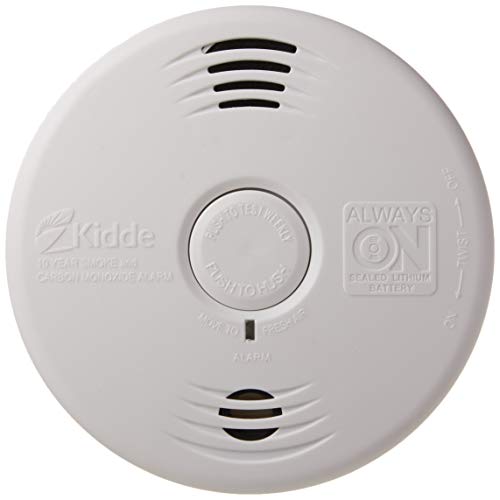
Best for a bedroom hallway where you want one device, no wiring and no battery changes
- Photoelectric smoke sensor plus electrochemical CO sensor
- Sealed 10-year lithium battery
- Voice announces which hazard was detected
- Test and hush button, UL 217 and UL 2034 listed
Why buy it: a spoken warning that says smoke or carbon monoxide removes the worst ambiguity of a combination alarm — knowing whether to run for the door or open the windows.

Best for covering several rooms cheaply with replaceable AA batteries
- Photoelectric smoke sensing, fewer cooking nuisance alarms
- Runs on two AA cells, batteries included
- Single test and silence button
- Mounts anywhere with two screws
Why buy it: the cheapest way from a mainstream brand to put both sensors in a room that currently has one alarm or none.

Best for replacing a hardwired alarm on a code-required interconnected circuit
- 120V hardwired with 9V battery backup
- Wire-interconnects with other BRK and First Alert units
- Ionization smoke sensing plus electrochemical CO
- End-of-life warning signal
Why buy it: the default contractor swap for a wired circuit, and the one most likely to drop straight onto the harness already in your ceiling.

Best for a wired house where you also want alarms in rooms with no wiring
- Hardwired with sealed 10-year backup battery
- Wire-free interconnect to units in unwired rooms
- Photoelectric smoke plus CO sensing
- Voice alerts naming hazard and location
Why buy it: it bridges a wired circuit to battery units elsewhere, which is how you extend coverage without opening finished walls.

Best for a household that wants phone alerts when nobody is home
- Phone alerts when the house is empty
- Speaks the hazard and the room aloud
- App silence and nightly self-test
- Interconnects wirelessly with other Protect units
Why buy it: the only alarm here that tells you what happened while you were out, which is the scenario where a slow CO event does the most damage.
Quick Comparison
| Product | Best for | Rating | Price | Buy |
|---|---|---|---|---|
| Kidde P3010CU Combination Smoke and Carbon Monoxide Detector with 10-Year Battery and Voice | Best Overall | — | Check (paid link) | |
| First Alert SCO5CN Combination Smoke and Carbon Monoxide Alarm, Battery Operated | Best Battery Value | — | Check (paid link) | |
| First Alert BRK SC9120B Hardwired Smoke and Carbon Monoxide Alarm with Battery Backup | Best Hardwired | — | Check (paid link) | |
| Kidde P4010ACSCO-W Hardwired Combination Alarm with Wireless Interconnect and Voice | Best Hardwired with Wireless Link | — | Check (paid link) | |
| Google Nest Protect Smoke and Carbon Monoxide Alarm, Battery Version | Best Smart Alarm | — | Check (paid link) |

How We Rank
We do not buy, test or physically handle these alarms. We rank them on evidence that scales: star ratings weighted by review volume, published UL 217 and UL 2034 listings and stated service life, the recurring failure modes in critical reviews, long-term owner reports written years after installation, and NFPA, CPSC and U.S. Fire Administration guidance as a cross-check. For combination alarms we weight three things hardest — smoke sensor type, whether the unit distinguishes the two hazards clearly, and reported nuisance-alarm rates — because an alarm that gets taken down after a month of false triggers protects nobody. Prices were current at the time of writing. Full method on how we rank.
The Combination Alarms, Reviewed
1. Kidde P3010CU — Best Overall
Covered above. What owners praise: the spoken hazard announcement, the sealed ten-year battery, photoelectric sensing that survives normal cooking, and a five-minute install. What owners complain about: no interconnect of any kind, a body large enough to look conspicuous on a hall ceiling, and end-of-life chirping that arrives without warning because there has never been a battery to change. The default pick for an unwired home.
2. First Alert SCO5CN — Best Battery Value
The long-running mainstream battery combination alarm, and the cheapest sensible way to put both sensors in a room. Photoelectric smoke sensing keeps cooking false alarms down, two AA cells are included, and a single button handles both test and silence. It is deliberately unsophisticated. What owners praise: price, the familiar First Alert name, simple mounting, and photoelectric sensing at this cost. What owners complain about: annual battery changes, no interconnect, no voice or display, and the same end-of-life chirp confusion the whole category shares. Buy two or three and cover the rooms that currently have nothing.
3. First Alert BRK SC9120B — Best Hardwired
If your ceiling already has a wired alarm on an interconnected circuit, this is the unit most likely to drop straight onto the existing harness. It is 120V hardwired with a 9V backup, wire-interconnects with other BRK and First Alert units, and carries both sensors in a standard-sized body. Note that its smoke sensing is ionization rather than photoelectric, which makes it faster on fast-flaming fires and more prone to cooking nuisance alarms — keep it well away from the kitchen. What owners praise: a genuinely quick swap, reliable wired interconnect, and a price close to a plain hardwired smoke alarm. What owners complain about: connector mismatches with older BRK generations that need an adapter plug, nuisance alarms when mounted too close to a stove, and a 9V backup that still needs changing every year. The contractor default for a wired house.
4. Kidde P4010ACSCO-W — Best Hardwired with Wireless Link
An unusual and genuinely useful combination: mains-powered and code-compliant on a wired circuit, with a sealed ten-year backup battery, plus wire-free interconnect to battery units in rooms that have no alarm wiring at all. That is how you extend coverage through an older house without pulling cable through finished walls. Photoelectric smoke sensing, CO sensing, and voice alerts naming hazard and location. What owners praise: the wired-to-wireless bridge, the sealed backup that ends the annual 9V change, and the voice announcements. What owners complain about: price, setup that is more involved than a plain swap, and occasional re-pairing needed after a power cut. The right unit for a whole-house upgrade done room by room.
5. Google Nest Protect — Best Smart Alarm
The Protect solves a problem none of the others touch: it tells you what happened while the house was empty. It announces the hazard and the room in speech, sends a phone alert, runs a nightly self-test, lets you silence a nuisance alarm from a phone instead of a stepladder, and interconnects wirelessly with other Protect units. For a slow carbon monoxide event with nobody home, that alert is the whole ballgame. What owners praise: remote alerts, spoken warnings, app silence, and whole-house interconnection. What owners complain about: a price three to four times the alternatives, sensors that expire on a fixed schedule regardless of use, Wi-Fi dropouts, and a combined unit that retires both sensors at once. Right for a connected household, expensive as plain coverage.
The Real Trade-Off: One Device or Two?
| Combination unit | Separate alarms | |
|---|---|---|
| Devices to test and maintain | One per location | Two per location |
| Replacement clock | Shorter of the two sensors | Each runs its own full life |
| Placement freedom | Must satisfy both rule sets at once | Each goes where it works best |
| Cost to cover a house | Lower | Higher |
| Hazard identification | Beep pattern, or voice on better models | Unambiguous by device |
| Best for | Hallways, most homes, simplicity | Kitchens, basements, tight layouts |
The placement row is the one people hit in practice. Smoke alarms want to be at least 10 feet from a cooking appliance; CO alarms want to be at least 15 feet from a furnace, water heater or gas range, and out of humid rooms. In a small apartment or a compact basement, one location may not satisfy both, and separate devices let you put each sensor where it belongs. In a normal hallway outside bedrooms, a combination unit satisfies both rules comfortably and is the simpler answer. Placement detail is in where to place a carbon monoxide detector and how many smoke detectors do I need.
Know Which Alarm Is Sounding
The responses are opposite, so the distinction is not academic.
| Pattern | Means | Do this |
|---|---|---|
| Three beeps, pause, repeat | Smoke | Get everyone out, close doors behind you, call 911 from outside |
| Four beeps, pause, repeat | Carbon monoxide | Get everyone outside into fresh air, call 911 from outside, do not stay to investigate |
| One chirp every 30–60 seconds | Low battery or end of life | New battery; if it continues, check the manufacture date |
| Five beeps or a spoken end-of-life message | Sensor expired | Replace the unit; a battery will not fix it |
If anyone has headache, nausea, dizziness or confusion when a CO alarm sounds, treat it as an emergency and call 911 from outside the building. This page describes devices and public-safety guidance; it is not medical advice.
What Owners Actually Complain About
Four themes repeat across the field. End-of-life chirping dominates, and most of it is confusion — a combination alarm reaches end of life earlier than people expect because the CO sensor sets the clock, and no battery will stop the signal. Nuisance alarms come second, concentrated on the ionization-sensor models mounted too close to a kitchen, and they are the single most common reason an alarm ends up in a drawer. Connector mismatches frustrate anyone replacing a hardwired unit from an older generation. And the both-sensors-retire-together problem shows up in long-term reviews from owners who did the math and concluded they would rather have run two devices. Owners consistently report that writing the install date on the housing in marker prevents most of the first and last of those.
How to Choose Between These Five
No alarm wiring, want one device? The Kidde P3010CU. Covering several rooms on a budget? The First Alert SCO5CN. Replacing a hardwired alarm? The First Alert SC9120B, kept well clear of the kitchen. Wired house, want to reach unwired rooms too? The Kidde P4010ACSCO-W. Want alerts when the house is empty? The Nest Protect. And if a compact layout makes it impossible to keep one device 10 feet from the stove and 15 feet from the furnace at the same time, buy separates instead — see best smoke detector and best carbon monoxide detector.
The Verdict
For most homes the Kidde P3010CU is the combination alarm we would recommend: photoelectric smoke sensing for the fires that start slowly at night, CO sensing in the same housing, a sealed ten-year battery, and a voice that tells you which hazard it found. Put one outside every sleeping area and one on every level, keep 10 feet from the stove and 15 from fuel-burning appliances, write the install date on the housing, and replace on the unit's stated service life rather than waiting for the chirp. Then check the rest: the coverage rules are in how many smoke detectors do I need, the expiry math in do carbon monoxide detectors expire, and everything else in the air quality hub. Check price on Amazon → (paid link)