 Garden

Affiliate Disclosure
Some links on this page are affiliate links. As an Amazon Associate, we earn from qualifying purchases — at no extra cost to you. We do not buy, test, or physically handle the products we cover; our rankings come from aggregated owner reviews, ratings and expert consensus. Commissions never change our verdicts. How we rank · full disclosure.
The short version: after weighing six of the most-owned comforters in the US on aggregated ratings, review volume, fill construction and what owners report a year or two in, our #1 pick is the Utopia Bedding down-alternative duvet insert. It is the default comforter in American bedrooms for a reason — box-stitched fill that stays put, corner tabs that work, and a price low enough that buying the wrong warmth costs you almost nothing. If you sleep hot, skip straight to the Bedsure cooling comforter. If you want real down and intend to keep it, the Globon 800 fill power is the one worth the money.
Before you pick a warmth level, settle the bigger question: down or down alternative. It decides price, care routine and how the comforter behaves in a warm room, and it is the choice people most often get backwards. The rest of the bed matters too — a hot comforter over the wrong sheets is a compounding problem, which is what best cooling sheets is for.
Top Picks at a Glance

Our #1 Pick: Utopia Bedding Down Alternative Duvet Insert
The Utopia wins on the sheer consistency of owner feedback rather than any single standout feature. Reviewers describe the same thing over and over: it arrives compressed, fluffs out within a few hours, feels substantially more expensive than it is, and survives the washing machine without collapsing into a flat sheet of batting. That last point is what separates it from the truly cheap inserts, where owners consistently report the loft never comes back after the first wash.
The construction is unglamorous and effective. Siliconized fiberfill in generous box stitching, so the fill has nowhere far to travel; a brushed microfiber shell that is soft rather than crisp; and corner tabs at all four corners. The limits are the honest ones for the price. It is a down-alternative comforter, so it is heavier on the body than down of the same warmth, and it holds more heat than a natural fill in a warm room. The shell is polyester, not cotton, so it breathes less well than the puredown or Globon options. And it is a duvet insert, not a finished bedspread — used bare it looks like exactly what it is.
Check price on Amazon → (paid link)
The Ranked Field
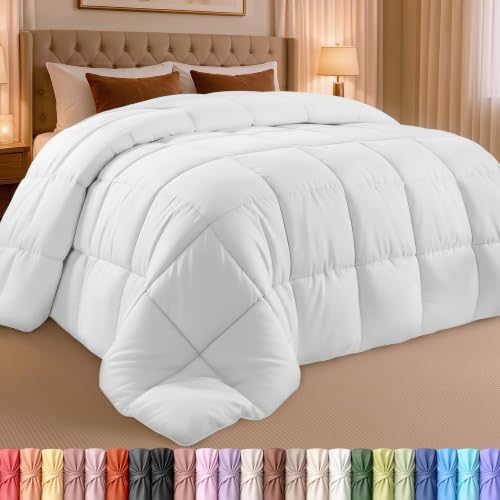
Best for the safest all-round comforter buy in any bedroom
- Box-stitched siliconized fiberfill, roughly 300 gsm
- Corner tabs for a duvet cover
- Machine washable in a home washer
- Queen measures 88 x 88 inches
Why buy it: the most-bought duvet insert in America, warm enough for three seasons and cheap enough to own two.
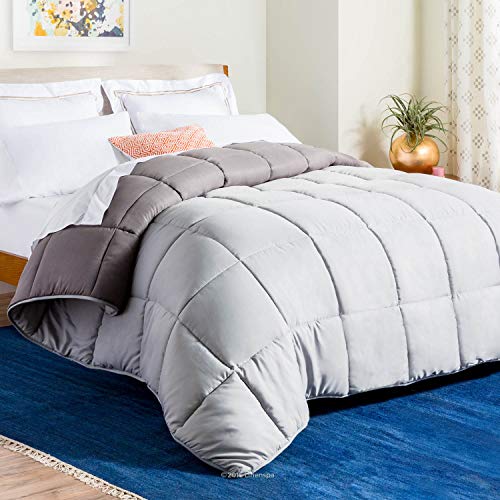
Best for shared beds and rooms that swing hot and cold
- Two-tone reversible shell, stone and charcoal
- 8 duvet loops rather than the usual 4
- 300 gsm all-season fill weight
- Three-year warranty
Why buy it: usable bare or inside a cover, with enough loops that it stops migrating into a lump at 3 a.m.

Best for buyers who want real down and expect to keep it a decade
- 800 fill power white goose down
- 420 thread count down-proof shell
- Baffle-free sewn-through box construction
- 8 corner tabs, RDS-tracked down
Why buy it: the warmth-to-weight ratio synthetic fill cannot reach — barely there on the body, genuinely warm.

Best for night sweats and bedrooms that never cool off
- Dual-sided cool-touch face over a soft reverse
- Lightweight summer-weight fill
- Corner rings to attach a duvet cover
- Machine washable, no dry cleaning
Why buy it: a comforter you can actually keep on in July, which is the only reason hot sleepers end up under a sheet alone.

Best for people who want natural fill without winter warmth
- 95% goose feather, 5% goose down fill
- 100% cotton shell, roughly 500 thread count
- Light warmth rating for warm rooms
- Responsible Down Standard sourced
Why buy it: natural fill breathability at a fraction of what real down costs, sized for a room that runs warm.

Best for guest rooms, dorms and first apartments
- All-season microfiber fill
- Corner tabs included
- Machine washable and dryer safe
- Sold in several fill weights
Why buy it: the cheapest comforter in this group that still holds loft after a wash, which is where budget inserts usually fail.
Quick Comparison
| Product | Best for | Rating | Price | Buy |
|---|---|---|---|---|
| Utopia Bedding Queen Comforter Duvet Insert, Down Alternative | Best Overall | — | Check (paid link) | |
| Linenspa Reversible Down Alternative Comforter, Queen | Best All-Season | — | Check (paid link) | |
| Globon Goose Down Comforter, 800 Fill Power All-Season Queen | Premium Pick | — | Check (paid link) | |
| Bedsure Cooling Comforter, Queen 88 x 88 | Best for Hot Sleepers | — | Check (paid link) | |
| puredown Lightweight Goose Feather Comforter, Full/Queen | Best Natural Summer Weight | — | Check (paid link) | |
| Amazon Basics Down Alternative Comforter, Full/Queen All-Season | Best Budget | — | Check (paid link) |

Specifications Side by Side
| Comforter | Fill | Shell | Warmth | Duvet tabs |
|---|---|---|---|---|
| Utopia Bedding Insert | Siliconized fiberfill | Brushed microfiber | All-season | 4 corner tabs |
| Linenspa Reversible | Down alternative, 300 gsm | Two-tone microfiber | All-season | 8 loops |
| Globon 800 FP | White goose down | 420 TC down-proof cotton blend | All-season | 8 corner tabs |
| Bedsure Cooling | Lightweight poly fill | Cool-touch dual face | Summer | 4 corner rings |
| puredown Feather | 95% feather / 5% down | 100% cotton | Light | Corner tabs |
| Amazon Basics | Microfiber fill | Microfiber | All-season | Corner tabs |
How We Rank
We never sleep under these comforters, and you deserve to be told that plainly rather than sold a story about a test lab. The ranking is built from aggregated owner ratings across the six models here, weighted toward reviews written after the first wash — because loft loss in the laundry is the single failure mode this category is known for, and it does not show up in week one. Four things carry the weight. Rating strength set against review volume, so a 4.8 from a few hundred buyers does not outrank a 4.5 from tens of thousands. Construction — box stitch spacing, shell thread count and whether the fill is contained or free to travel. Warmth honesty, meaning whether owners in warm and cold rooms both got what the label promised. And care realism: whether a normal household can wash it without a trip to a laundromat. Prices were checked at the time of writing. Full method: how we rank.
The Comforters, Reviewed
1. Utopia Bedding Down Alternative Insert — Best Overall
Covered above. Owners praise: loft that survives washing, genuine warmth for the price, corner tabs that hold, and a soft shell that does not crinkle. Owners gripe about: a polyester shell that sleeps warm in summer, occasional thin spots in the fill on arrival, and creases that take a day or two to hang out. Check price (paid link).
2. Linenspa Reversible Down Alternative — Best All-Season
The Linenspa solves two problems the Utopia does not. It has eight duvet loops instead of four, which is the difference between a comforter that stays square inside a cover and one that slides into a corner every night, and it is reversible in two colorways so it works as a finished bedspread without a cover at all. The fill is a genuine all-season 300 gsm, which owners in cold bedrooms describe as enough on its own and owners in warm bedrooms describe as slightly too much in August.
Owners praise: the eight loops, the reversible colors, good weight distribution and a three-year warranty. Owners gripe about: running warm for hot sleepers, a slightly crisper hand than the Utopia, and colors that read differently in person than on screen. Check price (paid link).
3. Globon 800 Fill Power Goose Down — Premium Pick
This is the one that explains why people pay for down. At 800 fill power the loft is enormous relative to the weight, and the down content behind that figure is a claim the FTC's advertising and labeling guidance for feather and down requires to be accurate, so the comforter feels like almost nothing on the body while trapping more air than a synthetic of twice the mass. The down-proof shell keeps the quills where they belong, and the eight corner tabs are placed properly rather than being a token pair. Owners consistently describe the first night as the moment they understood the price difference.
It is a real commitment, though. Down needs shaking out regularly to keep the loft even, it needs a duvet cover to stay clean, and washing it at home is a project rather than a chore. People with feather allergies should choose a down alternative instead; the sensitivity is usually to residual dust in the down, not the down itself, but the practical outcome is the same.
Owners praise: weightless warmth, excellent loft retention, a shell that does not leak quills, and a genuinely luxurious feel. Owners gripe about: the price, the need to fluff it regularly, occasional cold spots where sewn-through seams compress the down, and difficult home laundering. Check price (paid link).
4. Bedsure Cooling Comforter — Best for Hot Sleepers
A cooling comforter is not a gimmick, but it is narrower than the marketing suggests, and it cannot substitute for the room — the American Academy of Sleep Medicine's healthy sleep guidance is to keep the bedroom cool. The cool-touch face pulls heat away from skin on contact, which is genuinely noticeable when you first get in, and the low fill weight means less insulation trapping body heat through the night. What it does not do is refrigerate a hot room. Owners in genuinely warm bedrooms report it as the difference between using a comforter and abandoning it for a bare sheet, which is the honest claim.
Owners praise: the immediate cool-to-touch sensation, light weight, good drape and easy laundering. Owners gripe about: not being warm enough for winter, the cooling face feeling slick to some sleepers, and the effect fading as the fabric warms under a body. Check price (paid link).
5. puredown Lightweight Goose Feather — Best Natural Summer Weight
Feather-dominant fill is the value play in natural bedding. It is heavier and less lofty than down for the same warmth, but it costs a fraction as much, and inside a 100% cotton shell it breathes far better than any polyester insert. This is the comforter for someone who wants a natural-fiber bed in a warm climate and does not need winter warmth from the duvet.
Owners praise: breathability, the cotton shell, natural drape and a fair price for real fill. Owners gripe about: occasional quills working through the shell, a faint natural odor when new that airs out in a few days, and not enough warmth for a cold bedroom. Check price (paid link).
6. Amazon Basics Down Alternative — Best Budget
The Amazon Basics insert is the guest-room answer. It is thinner than the Utopia and the shell is plainer, but it has corner tabs, it washes and dries in a home machine without drama, and it is available in several fill weights so a cold guest room and a warm one can each get the right one. For a bed used a dozen nights a year, spending more is hard to justify.
Owners praise: price, easy laundering, several warmth options and adequate loft. Owners gripe about: thinner fill than expected, some fill migration over time, and a shell that feels basic next to the others here. Check price (paid link).

What Owners Actually Complain About
Fill migration is the top complaint across every price tier. The fix is structural: buy box-stitched or baffle-box construction rather than channel stitching, and tie every corner tab. A comforter that bunches at the foot of the bed almost always has fill that was free to travel and a cover it could slide inside.
Warmth mismatch generates most of the one-star reviews that are not really product faults. "All-season" is a manufacturer’s word, not a measurement. In a 62°F winter bedroom an all-season insert is a winter comforter; in a 74°F apartment it is unusable in July. Buy for the room you actually sleep in, and if the room swings hard, own a summer-weight and an all-season rather than hunting for one comforter that does both.
Loft loss after washing is the failure mode that separates cheap from very cheap. Wash on gentle, use minimal detergent — residue weighs fill down permanently — and dry on low with dryer balls until it is bone dry. A comforter that came out of the dryer damp and flat usually recovers with a second full drying cycle.
Quills and fiber poking through is a shell problem. Down-proof shells use tightly woven fabric specifically to stop it; cheap natural-fill comforters with loose weaves will shed quills forever. And odor on arrival shows up in reviews of both natural and synthetic fills. Natural fill has a faint barnyard smell that airs out over a few days; synthetic has a manufacturing smell that does the same. Neither is a defect, and both are worth a night on a spare bed with the window open.
How to Choose a Comforter
Work through it in this order. Fill type first. Down for maximum warmth at minimum weight and a ten-year horizon; down alternative for allergy households, kids, easy washing and a low price; feather for natural breathability on a budget. Then warmth. Measure your bedroom temperature at 3 a.m., not at bedtime — that is the number that matters. Under about 65°F you want all-season or winter weight; over about 72°F you want summer weight or a cooling face regardless of what the rest of the household says.
Then size up, not across. The most common sizing regret in reviews is buying a queen comforter for a queen bed and finding it barely covers two people. A king insert on a queen bed gives proper drape on both sides and ends most blanket-stealing disputes. Then buy a cover. It is the cheapest lifespan extension in bedding, and it makes the difference between washing a comforter four times a year and forty.
Finally, treat the comforter as one layer in a system. A cooling comforter over sateen sheets in a warm room is fighting itself — see best cooling sheets for the percale and bamboo options that work with it, and thread count explained for why the number on the package is mostly noise.
The Verdict
The Utopia Bedding down-alternative insert is the comforter we would put in most bedrooms: broad, consistent owner approval, construction that survives laundry, and a price that makes an experiment painless. Hot sleepers should buy the Bedsure cooling comforter instead and stop fighting the season. Anyone who wants natural fill on a budget should take the puredown feather, and anyone ready to spend once and keep it should buy the Globon 800 fill power down. Check price on Amazon → (paid link)
More from this hub: bedding & sleep · best mattress in a box · best cooling sheets · best mattress protector · how we rank.