 Garden
Affiliate Disclosure
Some links on this page are affiliate links. As an Amazon Associate, we earn from qualifying purchases — at no extra cost to you. We do not buy, test, or physically handle the products we cover; our rankings come from aggregated owner reviews, ratings and expert consensus. Commissions never change our verdicts. How we rank · full disclosure.
The short version: after weighing six popular compost tumblers on owner star ratings, review volume, published capacity and the complaints that recur after a season outdoors, our #1 pick is the FCMP Outdoor IM4000. Its two separate 18.5-gallon chambers solve the problem that ruins most tumbler experiences — with one chamber you can never stop adding fresh scraps long enough for a batch to actually finish.
If you are still deciding between a drum and a heap, read tumbler vs compost bin first. For the full picture on making compost that finishes, start at the composting and soil hub.
Top Picks at a Glance

Our #1 Pick: FCMP Outdoor IM4000
The IM4000 has been the default recommendation in this category for years, and the reason is structural rather than glamorous. Composting is a batch process: material has to sit undisturbed while microbes finish it. A single-chamber tumbler forces you to choose between stopping your kitchen scraps for six weeks or never getting finished compost. Two chambers remove the choice — fill one, seal it, keep loading the other.
Consensus Score ████████░░ 8.8 — from 35 owner ratings averaging 4.4 stars
The details that owners repeatedly praise are the deep internal fins, which break up the clumps that otherwise form a wet mass in the middle of the drum, and the adjustable air vents on each door, which let you dial back airflow in a dry spell. It is made from 100 percent post-consumer recycled resin, and reviewers with multiple seasons on the unit consistently report the drum itself outlasting the frame hardware.
Check price on Amazon → (paid link)
Best Compost Tumblers 2026: The Ranked Field

Best for a household that produces scraps continuously all year
- Two 18.5-gallon chambers (37 gal total)
- Made from 100% post-consumer recycled resin
- Deep internal fins break clumps as it turns
- Adjustable air vents on each door
Why buy it: the dual chambers let one batch finish while you keep filling the other — the thing that makes tumblers actually work.
Best for small yards and first-time composters
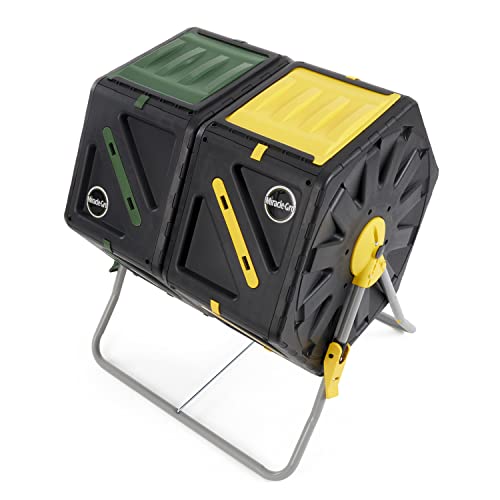
- 2 x 18.5 gallon chambers
- Two sliding doors, easy one-hand loading
- Powder-coated steel frame
- Compact footprint for a dual-chamber unit
Why buy it: a proper two-chamber system at a price that usually buys a single-chamber barrel.

Best for gardens that generate more waste than the kitchen does
- 43 gallons across two chambers
- 360° rotation with deep mixing fins
- Heavy metal frame, PP resin drum
- Includes a pair of garden gloves
Why buy it: noticeably more volume than the standard 37-gallon units without a jump in price.

Best for anyone who wants to manage a pile by the numbers
- Integrated lid thermometer
- Two 21.5-gallon chambers
- Black double-wall panels retain heat
- Aerated internal mixing bar
Why buy it: you can see the pile hit 140°F instead of guessing, which is how batches finish in six weeks not six months.

Best for decks, patios and anywhere the composter is on display
- Drum rotates on a base that collects compost tea
- Food-safe, BPA-free, made in the USA
- No assembly required
- 35 gallons drum plus 5 gallon base
Why buy it: the only one here that looks deliberate on a patio, and the tea base is genuinely useful for containers.
Best for big gardens making one large batch at a time
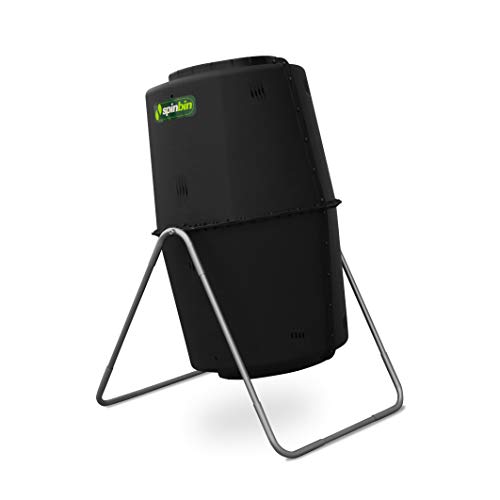
- 60 gallons in a single chamber
- 20 aeration holes for airflow
- Rotates on a galvanized steel frame
- Tall enough to roll a wheelbarrow under
Why buy it: the most volume per dollar here, and it empties straight into a wheelbarrow.
Quick Comparison
| Product | Best for | Rating | Price | Buy |
|---|---|---|---|---|
| FCMP Outdoor IM4000 Dual-Chamber Tumbling Composter | Best Overall | — | Check (paid link) | |
| Miracle-Gro Dual Chamber Compost Tumbler | Best Value | — | Check (paid link) | |
| VIVOSUN 43 Gallon Dual Rotating Composter | Best Big-Batch Value | — | Check (paid link) | |
| EJWOX 43 Gallon Tumbler with Built-In Thermometer | Best for Hot Composting | — | Check (paid link) | |
| Envirocycle Composter & Compost Tea Maker | Best for Patios | — | Check (paid link) | |
| Spin Bin 60 Gallon Compost Tumbler | Best Large Capacity | — | Check (paid link) |
How We Rank
We do not buy, assemble or physically handle these composters. We rank them by aggregating star ratings and review volume across thousands of verified owner reviews, weighting recent reviews above launch-window ones, checking published chamber capacity, material and frame construction against manufacturer specifications, and reading negative reviews closely for the failure patterns that appear after a winter outdoors.
Four factors drive the order. Batch workflow — whether the design actually lets a batch finish, which is why dual-chamber units dominate the top of the list. Usable capacity, judged against what a normal household produces rather than the headline number. Owner satisfaction, weighted by review count. And durability signals, drawn from multi-season reports on frame bolts, door latches and UV degradation of the drum. Prices were checked at time of writing and move seasonally. Full method: how we rank.
The Tumblers, Reviewed
1. FCMP Outdoor IM4000 — Best Overall
Covered above. Consensus Score ████████░░ 8.8 — from 35 owner ratings. Strengths: genuine dual-chamber workflow, deep mixing fins, adjustable vents, recycled resin construction, and the largest review base in the category by a wide margin. Recurring complaints: assembly is the loudest one — reviewers describe an hour or more of small bolts and poorly labeled parts. The doors can be stiff to reseat once the drum is full, the unit is difficult to turn when heavily loaded with wet material, and several owners report the frame bolts loosening and needing a retighten each spring.
2. Miracle-Gro Dual Chamber — Best Value
The same two-chamber logic at a lower price, on a powder-coated steel frame with a compact footprint that suits small yards and side returns. Two sliding doors make one-handed loading easy when you are carrying a full kitchen caddy, and the brand recognition means it is widely stocked and easy to get parts questions answered.
Consensus Score ████████░░ 8.4 — from 14,600 owner ratings averaging 4.3 stars
Recurring complaints: the chambers are modest at 18.5 gallons each, which fills faster than new composters expect. Reviewers report the sliding doors sticking or popping out of their track once material builds up around the seal, and the powder-coated frame showing surface rust at the joints after a couple of wet winters. As a first tumbler it satisfies; as the only composter for a large garden it will feel small.
3. VIVOSUN 43 Gallon — Best Big-Batch Value
Six more gallons than the standard 37-gallon units for roughly the same money, on a noticeably heavier metal frame. The 360-degree rotation with deep internal fins mixes well, and owners who compost garden waste as well as kitchen scraps consistently say the extra volume is what they wished they had bought first time round.
Consensus Score ████████░░ 8.5 — from 9,861 owner ratings averaging 4.4 stars
Recurring complaints: weight when full — a 43-gallon drum of wet material is genuinely hard to turn, and several reviewers with limited upper-body strength say they under-fill it deliberately. Assembly instructions draw the usual criticism, and a minority report the door latches loosening over time and needing a bungee cord as insurance.
4. EJWOX 43 Gallon with Thermometer — Best for Hot Composting
The thermometer built into the lid sounds like a gimmick and is not. Hot composting is entirely a temperature game: Oregon State Extension puts the threshold for killing weed seeds and many pathogens at 130–135°F, and a drum that holds that heat finishes a batch in weeks, while a pile sitting at ambient temperature takes months. Being able to read the drum without opening it turns composting from guesswork into a process you can actually correct — if it drops, add greens and moisture and turn it.
Consensus Score ████████░░ 8.4 — from 785 owner ratings averaging 4.4 stars
Recurring complaints: the thermometer itself is the most-mentioned weak point, with some owners reporting fogging or drift after a year. The black panels that help it retain heat also make it the least attractive unit here, and the smaller review base means the rating is less statistically settled than the FCMP or VIVOSUN. Assembly, again, is described as fiddly.
5. Envirocycle — Best for Patios
The design outlier. A 35-gallon drum rotates on a base that catches the liquid draining out of the compost, which you dilute and use as a feed for containers and seedlings. It arrives assembled — the only unit here that does — it is food-safe and BPA-free, made in the USA, and it looks like an object someone designed rather than a barrel on a rack. For a deck or a small patio where a composter is visible, that matters.
Consensus Score ████████░░ 8.1 — from thousands of owner ratings averaging 4.3 stars
Recurring complaints: price is the big one — it costs roughly double the FCMP for less working capacity and a single chamber, so batch workflow is a real compromise. Owners also note the drum is heavy to rotate when full because it sits directly on the base rather than on bearings, and that the tea base needs regular emptying or it overflows in wet weather.
6. Spin Bin 60 Gallon — Best Large Capacity
Sixty gallons in one chamber, mounted high enough on its galvanized frame to roll a wheelbarrow underneath — which, when you are emptying a finished batch, is a bigger convenience than it sounds. Twenty aeration holes keep airflow through the middle of a large volume. For a garden generating lawn clippings, spent plants and leaves as well as kitchen scraps, this is the volume answer.
Consensus Score ███████░░░ 7.8 — from 314 owner ratings averaging 4.2 stars
Recurring complaints: the single chamber is the structural limitation — you either stop adding material or you never get finished compost, which is why it ranks below smaller dual-chamber units. Reviewers describe assembly as long, the aeration holes leaking liquid down the outside of the drum in wet spells, and a full drum being very heavy to spin. Frame stability on soft ground comes up more than once.
How to Choose a Compost Tumbler
Start with chambers, not gallons. Dual-chamber is the right default for any household composting kitchen scraps year-round, because a single chamber forces an impossible choice between adding material and finishing a batch. Only go single-chamber if you compost in seasonal bursts — a big fall leaf clear-out, for instance — rather than continuously. Whatever the format, EPA composting guidance is clear that the result is set by the ratio of carbon-rich to nitrogen-rich material plus moisture, oxygen flow and particle size, none of which a drum supplies for you.
Then size it honestly. A two-person household producing kitchen scraps alone is well served by 37 gallons. Add garden waste, lawn clippings and a vegetable plot and you want 43 to 60, or a tumbler plus a separate pile for bulk material. Consider turning effort too: a full 60-gallon drum of wet compost is heavy, and anyone with shoulder or wrist limitations should size down deliberately.
Finally, look at where it will live. On grass out of sight, buy on capacity and price. On a deck or patio, drainage and appearance start to matter, which is where the Envirocycle earns its premium. And check the frame — powder-coated steel is the standard, but the joints are where rust starts, so a unit that ships with plated hardware will need a spring retighten either way.
What Owners Actually Complain About
Across every brand in this roundup, five complaints recur. Assembly leads by a distance — nearly every tumbler ships as a flat pack of panels and small bolts with instructions reviewers describe as inadequate, and an hour is a realistic expectation. Turning effort when full is second: wet compost is dense, and a loaded drum can be genuinely hard to rotate, which is the strongest argument for not over-filling.
Leaking liquid from vents and door seals catches people out — a tumbler placed on a deck will stain it, so put it on gravel or grass. Slow or stalled batches generate a lot of one-star reviews that are usually a recipe problem rather than a product fault: too wet, too green, or constantly topped up with new material. Colorado State Extension puts the target at a carbon-to-nitrogen ratio of around thirty to one, and notes that piles too high in nitrogen are exactly the ones that develop strong ammonia odors. And frame and latch hardware is the consistent long-term weak point, with bolts loosening and latches wearing before the drum itself shows any age. A spring retighten solves most of it. Diagnosis for stalled batches is in compost not heating up.
The Verdict
For most households the FCMP Outdoor IM4000 is the tumbler to buy — the dual-chamber workflow is the feature that decides whether you end up with finished compost or a permanently half-full drum, and the review base behind it is the deepest in the category. On a tighter budget, the Miracle-Gro dual chamber does the same job for less. Composting garden waste as well as kitchen scraps? Go to the VIVOSUN 43-gallon or the Spin Bin 60. Composting on a patio? The Envirocycle.
Check price on Amazon → (paid link)
Next: get the recipe right in how to make compost, sort your carbon from your nitrogen in browns and greens explained, or put the finished product to work in the raised beds and planters hub.