 Garden

Affiliate Disclosure
Some links on this page are affiliate links. As an Amazon Associate, we earn from qualifying purchases — at no extra cost to you. We do not buy, test, or physically handle the products we cover; our rankings come from aggregated owner reviews, ratings and expert consensus. Commissions never change our verdicts. How we rank · full disclosure.
The short answer: if you need a number you can trust, buy the VIVOSUN Digital pH Meter and read a soil slurry with it. If you just want a quick, cheap comparative check across your beds — and most gardeners do — the SONKIR 3-in-1 probe is fine, as long as you treat its pH as directional rather than precise. Understanding that difference is the whole decision.
Soil pH quietly governs your garden. It decides which nutrients a plant can actually absorb, so a bed can be full of fertilizer and still starve a plant if the pH is wrong. The trouble is that the tool most people reach for — the $9 three-prong probe — is far less accurate than its confident dial suggests. This page ranks the meters honestly on that axis: which give a real number, and which are only good for telling one bed from another.
What Actually Separates a Good Soil pH Meter
The category splits into two genuinely different tools, and the ranking reflects that:
- Accuracy you can trust. A calibrated digital pen reading a soil slurry gives a true pH value. A conductivity probe pushed into the ground does not — it estimates, and moisture and salts skew it.
- Calibration. A meter you can calibrate can be kept honest; one you cannot is stuck with whatever error it left the factory with.
- What else it reads. Moisture and light are genuinely useful extras on a probe; a nutrient reading is rough but occasionally handy.
- Ease of use. A stick-in probe is instant but approximate; a pen needs a slurry and calibration but rewards the effort with a real answer.
- The proven record. A large, long review base separates the meters that keep reading from the ones that die in a month.
The Meters at a Glance
Our #1 Pick: The VIVOSUN Digital pH Meter
This tops the list because it is the only kind of meter here that can give you a soil pH number you can actually act on.
Why a pen beats a probe. The cheap three-prong testers estimate pH from electrical conductivity between two metal prongs, and that conductivity is swayed by how wet the soil is and how many dissolved salts it holds — not just by acidity. A digital pen sidesteps all of that: you make a slurry of soil and distilled water, let it settle, and dip the calibrated electrode into the liquid to read true pH. It is the same principle a lab uses, in a pocket tool. The stated 0.01 resolution and automatic temperature compensation are the difference between a reading you can trust and a needle that merely looks precise.
The catch, stated plainly, is that it is more work. You have to mix a slurry rather than jab a stick in the ground, and you have to calibrate the pen periodically with buffer powders, which is a small ongoing cost. In return you get an actual pH figure, which is what you need if you are trying to grow blueberries at 5.0 or correct a bed that will not thrive. Its large best-seller review base shows the electrode holds up with reasonable care.
Consensus Score ████████░░ 8.5 — the accuracy leader, held back only by the slurry-and-calibrate routine.
Where it is weak. It reads liquid or a slurry, not soil directly, so it is slower than a probe; the electrode needs calibration and eventually replacement; and if you only ever want a rough comparison between beds, it is more meter than the job requires.
Check price on Amazon → (paid link)
The Meters, Ranked

Best for anyone who needs a genuinely accurate reading from a soil slurry, hydroponics or water
- Digital pen with stated 0.01 pH resolution and auto calibration
- Automatic temperature compensation for stable readings
- Reads a soil-and-water slurry, not just liquid
- Best-seller with a very large owner base
Why buy it: If you want a number you can actually trust, this is the pick. A calibrated digital pen reading a soil slurry gives a real pH value, which the cheap probe meters cannot. Slightly more work than a stick-in probe, and far more reliable.

Best for the gardener who wants a quick relative pH check plus moisture and light for a few dollars
- Reads soil pH, moisture and light in one probe
- No batteries required, just push into the soil
- Toggle switch between the three functions
- One of the most popular garden testers sold
Why buy it: The default cheap tester, and honestly assessed it is a comparative tool, not a lab instrument: excellent for telling one bed from another and spotting big pH swings, less so for a precise number. For most casual gardeners that is all they need.

Best for a simple no-battery probe for houseplants and beds
- Battery-free 3-in-1 probe for moisture, pH and light
- Simple dial readout, nothing to charge
- Suits indoor plants and outdoor beds alike
- Large, well-established review base
Why buy it: A close cousin of the SONKIR at the same low price: push it in, read the relative pH, moisture and light. Treat the pH as a directional guide rather than a precise figure and it is a genuinely useful, maintenance-free tool.
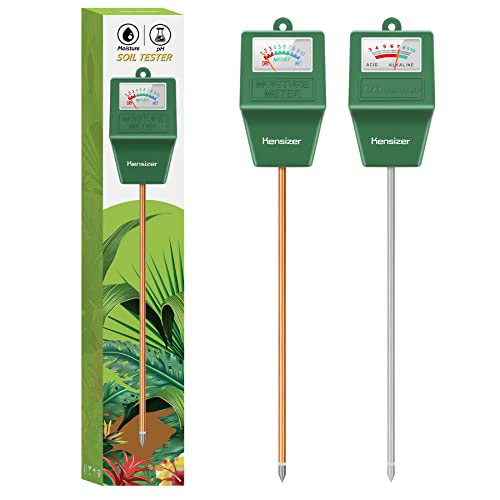
Best for indoor and outdoor gardeners who want a plain, reliable probe
- Moisture, pH and light in one no-battery probe
- Long dual-needle stem for deeper readings
- Clear color-zoned dial
- Works indoors and outdoors
Why buy it: Another solid entry in the battery-free probe class, with a slightly longer stem than most. Same honest caveat applies: superb for relative comparison across your plants, approximate on absolute pH.

Best for gardeners who also want a rough nutrient indication alongside pH
- Adds a nutrient reading to the usual moisture, light and pH
- No batteries required
- Single probe covers four garden metrics
- Popular gift-style tester
Why buy it: The four-function probe throws in a nutrient indicator for the same money as the three-in-ones. The nutrient reading is very rough, but as a broad health check across a garden it adds a little useful context to the pH.

Best for buyers who want a digital screen and readings in low light
- Digital LCD with backlight for dim conditions
- Reads temperature, moisture, pH and light
- Clearer numeric readout than an analog dial
- Higher-rated than most probe testers
Why buy it: For those who prefer a screen to a needle, this digital probe adds a backlit LCD and a temperature reading. It is easier to read precisely than a dial, though as a soil-probe design it still trails a calibrated pen for true accuracy.
Quick Comparison
| Product | Best for | Rating | Price | Buy |
|---|---|---|---|---|
| VIVOSUN Digital pH Meter with 0.01 Accuracy (Water & Hydroponics) | Best Accurate pH Meter | — | Check (paid link) | |
| SONKIR MS02 3-in-1 Soil Moisture, Light & pH Meter | Best Value 3-in-1 Probe | — | Check (paid link) | |
| VIVOSUN 3-in-1 Soil Moisture, pH & Light Tester | Best Battery-Free Basic | — | Check (paid link) | |
| Soil Tester 3-in-1 Moisture, pH & Light Probe | Best No-Battery All-Rounder | — | Check (paid link) | |
| 4-in-1 Soil Meter: Moisture, Light, Nutrients & pH | Best 4-in-1 Probe | — | Check (paid link) | |
| YAMRON 4-in-1 Digital Soil Meter with Backlit LCD | Best Backlit Display | — | Check (paid link) |
The Honest Truth About Cheap Probes
The three-in-one probes dominate the best-seller lists, and they are not useless — but you have to know what you are holding. They read pH by conductivity, which means a dry soil and a wet soil can give different pH readings from the same ground, and heavily fertilized soil reads differently again. As a relative instrument they are excellent: push it into two beds and you will reliably learn which is more acidic, and push it in before and after adding lime and you will see the direction of change. As an absolute instrument they are unreliable, and no amount of decimal places on the dial changes that. If a plant tag says it needs pH 5.5 and your probe says 6.0, do not trust the gap. Confirm it with a slurry-and-pen reading or a chemical test kit before you amend the soil. Used within those limits, a cheap probe is a genuinely good buy; used as a lab, it will mislead you.
How We Rank Soil pH Meters
We do not buy, calibrate, or physically handle these meters. The ranking is built from aggregated owner reviews read across the full life of each product, published specifications and the settled consensus of experienced gardeners and growers. We weight genuine accuracy and calibration ability most heavily, then ease of use, the value of the extra readings, and the depth of the review record — because dead electrodes and stuck needles show up in the reviews written months later. We are deliberately blunt about the accuracy gap between pens and probes, because a confident wrong reading is worse than no reading. Prices were current at the time of writing. Full method on how we rank.
The Meters, Assessed
1. VIVOSUN Digital pH Meter — Best Accuracy
Covered above. Who it is for: anyone who needs a real pH number. What it does better: calibrated, temperature-compensated readings from a slurry. Where it is weak: slower to use and needs calibration.
2. SONKIR MS02 3-in-1 — Best Value Probe
Who it is for: the casual gardener who wants a quick, cheap, battery-free check of pH, moisture and light. It is one of the most popular garden testers sold, and for comparative work it is genuinely handy. Where it is weak: the pH reading is directional, not precise, and cannot be calibrated, so do not amend soil on its number alone.
3. VIVOSUN 3-in-1 — Best Battery-Free Basic
Who it is for: houseplant owners and gardeners who want a maintenance-free probe. Same low price and same honest caveat as the SONKIR: read the pH as a guide. Where it is weak: conductivity-based pH, no calibration, approximate on absolute values.
4. 3-in-1 Soil Tester Probe — Best No-Battery All-Rounder
Who it is for: indoor and outdoor use with a slightly longer stem for deeper readings. A solid, plain member of the probe class. Where it is weak: the familiar limitation — excellent for relative comparison, unreliable for a precise figure.
5. 4-in-1 Soil Meter — Best 4-in-1 Probe
Who it is for: gardeners who want a rough nutrient indication on top of pH, moisture and light. The extra function adds broad context for the same money. Where it is weak: the nutrient reading is very approximate, and the pH shares every limitation of the other probes.
6. YAMRON 4-in-1 Digital — Best Backlit Display
Who it is for: people who prefer a clear digital screen and readings in low light. The backlit LCD and temperature reading make it easier to read precisely than a dial. Where it is weak: as a soil probe it still trails a calibrated pen on true accuracy, and it costs more than the analog probes.
How to Choose
Need a real number for fussy plants or soil correction? The VIVOSUN pen, plus calibration solution. Just want to compare beds and spot changes cheaply? Any of the 3-in-1 probes, with the SONKIR the safe default. Want a nutrient hint too? The 4-in-1. Prefer a screen? The YAMRON digital. Whatever you buy, pH is only worth measuring if you act on it sensibly — look up the target range for what you grow, amend gradually, and re-test. Pair it with a compost thermometer if you make your own soil amendments, and browse the wider composting and soil hub.
The Verdict
The VIVOSUN Digital pH Meter is the one to buy if the number has to be right, because it is the only meter here that gives a true, calibrated reading. If you only need to compare beds and watch for change, a 3-in-1 probe like the SONKIR is a fine, cheap tool — provided you remember its pH is a guide, not gospel. Understand that distinction and you will not waste money amending soil on a bad reading. Explore the rest of the composting and soil hub or the full resources library. Check the current price on Amazon → (paid link)